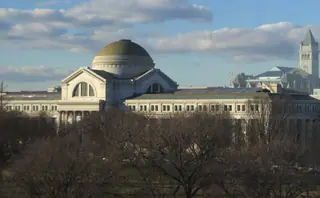
Smithsonian National Museum of Natural History
Free Smithsonian museum on the National Mall with dinosaurs, the Hope Diamond, human origins, mammals and ocean life.
Show individual sections
About the museum
The Smithsonian’s natural history collections were first shown in the Smithsonian Castle and later in the National Museum Building, today’s Arts and Industries Building. As the collections grew, Congress approved a much larger building on the north side of the National Mall. Designed by the Washington firm Hornblower & Marshall, the neoclassical Natural History Building opened to the public in March 1910 and was completed the following year; at first it also held the Smithsonian’s history and art collections.
Today the museum looks after more than 140 million specimens and artifacts, from plants, animals and fossils to minerals, meteorites and cultural objects, making it one of the largest natural history collections in the world. Around the exhibitions works a large staff of scientists who study the natural world and human cultures.
The permanent halls have been renewed step by step: the Hope Diamond received its own presentation in 2009, the Sant Ocean Hall shows marine life with a large reef aquarium, and the dinosaur and fossil hall reopened in 2019 as the David H. Koch Hall of Fossils – Deep Time, centered on a Tyrannosaurus rex skeleton. With more than three million visits a year it is one of the most visited museums in the world.
Highlights
- Hope Diamond in the Janet Annenberg Hooker Hall of Geology, Gems, and Minerals
- David H. Koch Hall of Fossils – Deep Time with T. rex and Triceratops
- Sant Ocean Hall with a living coral reef tank and megalodon jaws
- David H. Koch Hall of Human Origins
- Kenneth E. Behring Family Hall of Mammals
- O. Orkin Insect Zoo with live insects and tarantula feedings
Permanent exhibitions
- David H. Koch Hall of Fossils – Deep Time – Fossil hall tracing the history of life on Earth, with dinosaur skeletons such as Tyrannosaurus rex and Triceratops.
- Janet Annenberg Hooker Hall of Geology, Gems, and Minerals – Gems, minerals, meteorites and rocks on the Second Floor, including the Hope Diamond.
- Sant Ocean Hall – Hall on ocean life with a living coral reef tank, models and specimens such as megalodon jaws.
- Founded
- 1910
- Operated by
- Smithsonian Institution
- Director
- Kirk R. Johnson
Admission & discounts
Admission is free.
Admission is free; tickets are not required.
Booking: not required – tickets at the desk · No tickets needed for general admission.
Accessibility
- Wheelchair accessible
- Elevator
- Accessible restroom
- Accessible parking: no information
- Service dogs welcome
- Tactile models & exhibits
- Sign language tours: no information
- Easy-to-read materials: no information
- Audio description
All entrances and exits are stair-free; every exhibition, including the Butterfly Pavilion, is wheelchair accessible and all public floors can be reached by elevator. Theaters have wheelchair and companion seating. Free manual courtesy wheelchairs at the Information Desk in the Evans Gallery on the Ground Floor. Family/companion care restrooms on the First Floor off the Rotunda. Hearing loop (induction loop) at the Rotunda Visitor Information Desk and in the Worldwide Theater in the Hall of Human Origins; assistive listening devices on request for programs in Baird Auditorium and the Q?rius Theater; exhibition videos have open captions. ASL interpretation for tours and programs on request by email (two weeks’ notice appreciated); Aira ASL interpreting on visitors’ own devices free of charge. Tactile objects at points throughout the museum; audio or visual description tours for several halls; visual description highlights tour (about 60 minutes) on request; Aira Explorer for blind and low-vision visitors. Quieter visits Monday to Wednesday and on weekdays in September and February. Accessible parking spaces around the National Mall. Contact: NMNHAccessibility@si.edu, +1 202 633 3611.
Kids & families
Great for kids & families
- Hands-on stations
Q?rius is an interactive learning space for teens, tweens and their families with microscopes and thousands of objects to handle; in the O. Orkin Insect Zoo visitors can touch live insects. The Atrium Café has family-friendly menus. Lactation room available.
Getting there & parking
By public transit
Federal Triangle
Metrorail Federal Triangle (Blue, Orange and Silver lines), Archives–Navy Memorial (Green and Yellow lines) or Metro Center (Red line).
By car
No on-site parking at the museum.
No Smithsonian public parking on the National Mall; metered street parking (check enforcement hours) and commercial parking lots nearby. Designated accessible spaces around the Mall.
The entrance is on Madison Drive NW between 9th and 12th Streets; the Constitution Avenue entrance at 10th Street is the accessible entrance closest to Federal Triangle station.
Get directionsAddress & contact
Smithsonian National Museum of Natural History10th Street and Constitution Avenue NW
20560 Washington
Washington, D.C., United States
Amenities & dining
- Café
- Museum shop
- Wi-Fi
Free Wi-Fi: network “si-visitor”, no password (public, unsecured). Atrium Café on the Ground Floor and Ocean Terrace Café and Coffee Bar on the First Floor (café with seasonal opening). Several museum stores, including the Gallery Store and Family Store in the Evans Gallery, the Gem and Mineral Store and the Nature Store. Outside food may not be eaten in the museum; no seating for bag lunches. Airport-style security screening.
Events & venue rental
The museum hasn’t published any information on this.
Plan your visit
| Guided tours | yes |
|---|---|
| School programs | yes |
| Photography | Still and video photography for noncommercial use is allowed unless posted otherwise; tripods, monopods and selfie sticks are not permitted. |
| Dogs | not allowed (assistance dogs excepted) · Pets and emotional support animals are not permitted; service animals are welcome. |
| Good to know | Visitors can enter from the National Mall on Madison Drive or from Constitution Avenue. Group and school visits can be planned through the museum. |
Visitor experiences
Loading experiences …
Museums nearby
All 64 museums in Washington All museums in Washington, D.C.