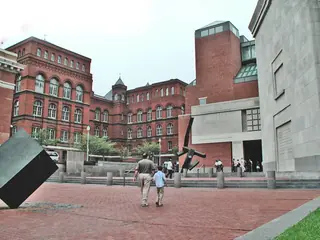
United States Holocaust Memorial Museum
America’s national Holocaust memorial and museum next to the National Mall, with a chronological permanent exhibition and the Hall of Remembrance.
Show individual sections
About the museum
The museum grew out of the President’s Commission on the Holocaust, which President Jimmy Carter set up in 1978 under the chairmanship of the author and survivor Elie Wiesel. In 1979 the commission recommended a national memorial museum in Washington, and in 1980 Congress voted unanimously to create it. The federal government provided land next to the Washington Monument, while the building, the collections and the exhibitions were financed largely by private donations.
The building by architect James Ingo Freed, himself a refugee from Nazi Germany, uses brick, steel and glass to evoke the architecture of ghettos and camps without copying it. The museum was dedicated on April 22, 1993, and opened to the public a few days later. Its address on Raoul Wallenberg Place honors the Swedish diplomat who rescued Jews in Budapest.
Since opening, the museum has welcomed tens of millions of visitors, a large share of them school students. Besides the exhibitions and the Hall of Remembrance, it runs a research institute, an extensive archive of documents, photographs, films and oral histories, education programs and a center for genocide prevention. A new permanent exhibition is in preparation; construction begins in January 2027 and is scheduled to be finished in 2029.
Key themes
- Permanent Exhibition The Holocaust on three floors, from the Nazi rise to power to liberation and aftermath
- Milk can from the Warsaw ghetto used to hide part of the Oneg Shabbat archive
- Identification cards telling the life story of a person who lived during the Holocaust
- Hall of Remembrance, the national memorial to the victims
- Building by James Ingo Freed with its Hall of Witness
Permanent exhibition
- The Holocaust – Chronological, self-guided narrative on three floors with artifacts, photographs, film and survivor testimony, from 1933 to liberation and its aftermath. It will close in January 2027 while a new permanent exhibition is built.
- Founded
- 1993
- Operated by
- United States Holocaust Memorial Museum (federal institution)
- Director
- Sara J. Bloomfield
Admission & discounts
Admission is free.
Admission is free. Free timed-entry tickets are required for the Permanent Exhibition; tickets reserved online in advance carry a $1 transaction fee from Etix. Daniel’s Story and other exhibitions can be visited without a ticket.
Booking: visits by advance booking only · timed-entry tickets · Reserve free timed-entry tickets for the Permanent Exhibition online; a limited number of same-day tickets is released online daily at 07:00 ET. Groups of ten or more request group tickets.
Accessibility
- Wheelchair accessible
- Elevator
- Accessible restroom
- Accessible parking: no information
- Service dogs welcome
- Tactile models & exhibits
- Sign language tours: no information
- Easy-to-read materials: no information
- Audio description
Fully accessible for visitors using mobility devices: elevators to all floors and ramps at level changes. Wheelchairs are available from the coat check on the main floor. Accessible restrooms on every floor of the Permanent Exhibition and on the lower level. Car drop-off on the 14th Street side. All exhibition multimedia is captioned (closed captions) and most audio media are equipped with T-coil technology (hearing loop); First Person programs have real-time open captions; assistive listening devices for auditorium programs, first come, first served. Guided highlights tours with visual description and touchable objects for blind and low-vision visitors with two weeks’ notice (GHT@ushmm.org, +1 202 488 6100); large-print and Braille ID cards; downloadable audio-descriptive tour of the Hall of Witness and Hall of Remembrance. TTY +1 202 488 0406. About ten accessible parking spaces are designated by the National Park Service around the Washington Monument, on Independence Avenue west of 14th Street and at the Tidal Basin lot.
Kids & families
Only partly suitable for kidsRecommended for ages 11+
| Time needed | approx. 60 min |
|---|
The Permanent Exhibition is recommended for ages 11 and up. Daniel’s Story, which tells the Holocaust from the perspective of a child, is aimed at elementary and middle school students. Children can be nursed anywhere in the museum; staff can offer a semi-private room.
Getting there & parking
By public transit
Smithsonian
Metrorail Smithsonian station (Blue, Orange and Silver lines), one block east of the museum.
By car
No on-site parking at the museum.
No public parking at the museum. Paid parking garage across the street on D Street SW between 13th and 14th Streets and some metered parking along Independence Avenue.
The museum lies just south of Independence Avenue SW between 14th Street and Raoul Wallenberg Place.
Get directionsAddress & contact
United States Holocaust Memorial Museum100 Raoul Wallenberg Place SW
20024-2126 Washington
Washington, D.C., United States
Amenities & dining
- Café
- Museum shop
- Coat check
The Museum Cafe in the building next door across the plaza (exit toward Raoul Wallenberg Place) is open daily 09:00–16:30 for dine-in and to-go meals. The Deanie and Jay Stein Museum Shop sells books and gifts. Oversized items can be left at the coat check. Eating and drinking in the museum only as medically necessary; water in capped bottles is allowed. Security screening for all visitors; at busy times entry can take 15 minutes or longer.
Events & venue rental
The museum hasn’t published any information on this.
Plan your visit
| School programs | yes |
|---|---|
| Photography | Non-commercial photography without flash is allowed; no selfie sticks or tripods. |
| Dogs | not allowed (assistance dogs excepted) · Only service animals are allowed. |
| Good to know | The self-guided Permanent Exhibition on three floors takes 1–3 hours; the museum recommends it for visitors 11 and older. Spaces are kept cool, so bring a sweater. |
Visitor experiences
Loading experiences …
Museums nearby
All 64 museums in Washington All museums in Washington, D.C.