Reading Museum
Free museum in Reading Town Hall with Britain's full-size Victorian copy of the Bayeux Tapestry, Roman Silchester finds and Huntley & Palmers biscuit history.
Få kun enkelte afsnit læst op
Om museet
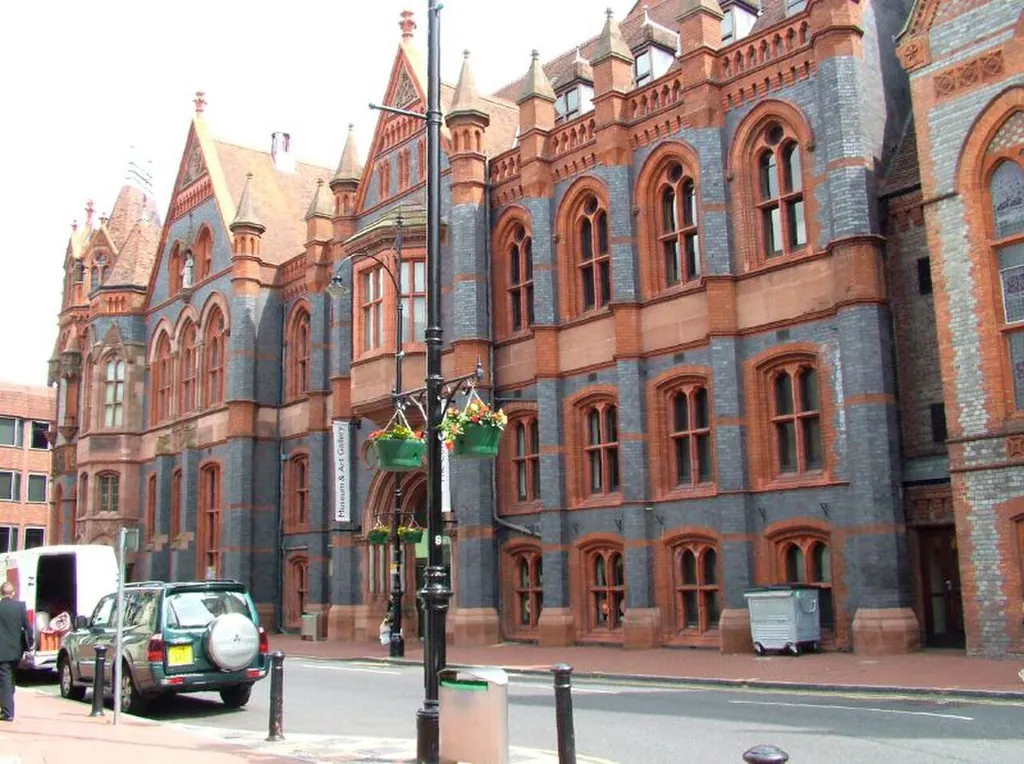
Reading Museum opened in June 1883 on the first floor of an extension to Reading Town Hall designed by the architect Thomas Lainson. Its founding collection was offered to Reading Corporation in 1877 by the trustees of Horatio Bland, and its first curator was Dr Joseph Stevens. An art gallery building was added in 1897 to house the art collection that William Isaac Palmer, a founding partner of the Huntley & Palmers biscuit company, left to the museum on his death in 1893.
The Town Hall itself is a landmark with a clock tower by Alfred Waterhouse, built in 1875 around an older hall of 1786. An air raid destroyed the southern end of Waterhouse's building in 1943, and a restoration between 1989 and 2000 brought the concert hall back into use and created new galleries for the museum.
Today the museum has ten galleries covering art, archaeology, local history and natural history. Highlights include finds from the Roman town of Silchester and from medieval Reading Abbey, the Huntley & Palmers gallery with its famous biscuit tins, contemporary Aldermaston pottery and a Green Space gallery on the natural world. Britain's Bayeux Tapestry, a full-size copy embroidered by Victorian needlewomen in the late 19th century, is shown in its own gallery. The museum also looks after the Riverside Museum at Blake's Lock and leads guided tours of the Abbey Quarter, including the Abbey Gateway where Jane Austen's school was located. Admission is free.
Højdepunkter
- Britain's Bayeux Tapestry, a 70-metre Victorian copy
- Finds from Roman Silchester
- Huntley & Palmers gallery with biscuit tins
- Medieval Reading Abbey finds and Abbey Quarter tours
- Aldermaston pottery
- Free entry
Permanente udstillinger
- Britain's Bayeux Tapestry – A full-size 70-metre copy of the Bayeux Tapestry embroidered by Victorian needlewomen, displayed in its own gallery.
- Huntley & Palmers Gallery – The story of Reading's biscuit makers and their factory, with a collection of decorative biscuit tins.
- Silchester Gallery – Archaeological finds from the Roman town of Silchester.
- Grundlagt
- 1883
- Ejer
- Reading Borough Council
Entrépriser & rabatter
Der er gratis entré.
| Grupper (fra 10 pers.) | –Groups of 10 or more must book in advance; entry is free with a suggested donation of 5 pounds per person. Talks and tours for groups start from 50 pounds, for example a 20-minute introduction for up to 20 people costs 70 pounds and a one-hour Bayeux Tapestry tour for up to 20 people costs 120 pounds. |
|---|
Admission is free, with a suggested donation of 5 pounds per visitor. Guided tours of the Bayeux Tapestry and the Abbey Quarter can be booked for a fee.
Tilgængelighed
- Kørestolsvenlig
- Elevator
- Handicaptoilet
- Handicapparkering
- Servicehunde tilladt
- Taktile tilbud
- Rundvisninger på tegnsprog: ingen oplysninger
- Letlæste tilbud: ingen oplysninger
- Synstolkning: ingen oplysninger
The main Town Hall entrance on Blagrave Street has automatic glass doors and a gentle slope to reception and the shop. The museum entrance is to the left of reception by a short flight of stairs or a ramp with handrails, and a lift on the ground floor serves the first and second floors. An accessible toilet behind reception is opened with a code from reception staff, and larger toilets with baby changing are on other floors. Seating is provided throughout and portable stools can be borrowed, along with magnifying glasses and torches. A sensory map, a visual story and a quick guide are available to download. Thermoform raised images of Bayeux Tapestry scenes and touchable objects in the Green Space gallery are available. Guide, hearing and assistance dogs are welcome. There are three Blue Badge spaces at the front of the building.
Børn og familie
Velegnet til børn og familier
- Familieomvisninger & workshops
- Opgavehæfte, skattejagt eller audioguide for børn
- Interaktive stationer
- Puslerum
The museum describes its ten galleries as hands-on, accessible and family friendly, with interactives, listening posts and dressing-up. Free trails, worksheets and picture bingo help children explore, and family activities run during school holidays. The Saturday break-out space and sensory bags are offered through the Museums, My Way programme, developed with Autism Berkshire. Baby changing is available.
Transport & parkering
Med offentlig transport
Reading station · 2 min. til fods
The museum is a two-minute walk from Reading station (mainline and Elizabeth line services) and all main bus stops. Park and ride buses serve the town centre; see the Reading Buses website for routes. There is a coach set-down point on Valpy Street opposite the museum.
I bil
Museet har ingen egen parkeringsplads.
The museum has no car park, but three Blue Badge spaces are at the front of the building. Nearby public car parks include Reading Station and Queen's Road.
- Handicapparkering
The main entrance is on Blagrave Street in the Town Hall (what3words: racing.festivity.pink). The museum recommends park and ride for visitors arriving by car.
Planlæg ruteService & spisesteder
- Café
- Museumsbutik
The Pantry Café & Kitchen on the ground floor of the Town Hall is open Tuesday to Saturday 10:00 to 16:00 and serves sandwiches, jacket potatoes, soups, scones, cakes and drinks, with vegetarian, vegan and gluten-free options. The gift shop is behind reception. Visitors are asked not to bring food or drink into the galleries.
Arrangementer & udlejning
Museet har ikke offentliggjort oplysninger om dette.
Planlæg dit besøg
| Rundvisninger | ja · varighed ca. 60 min. |
|---|---|
| Tilbud til skoler | ja |
| Fotografering | Visitors may photograph themselves, family and friends; the museum's photography policy sets out the other rules. |
| Godt at vide | Guided tours of the Bayeux Tapestry (about one hour) and of the Abbey Quarter and Abbey Gateway can be booked; public Abbey Quarter tours run in the summer. Groups of 10 or more must book in advance. The museum also runs a weekly break-out space for neurodivergent visitors every Saturday. |