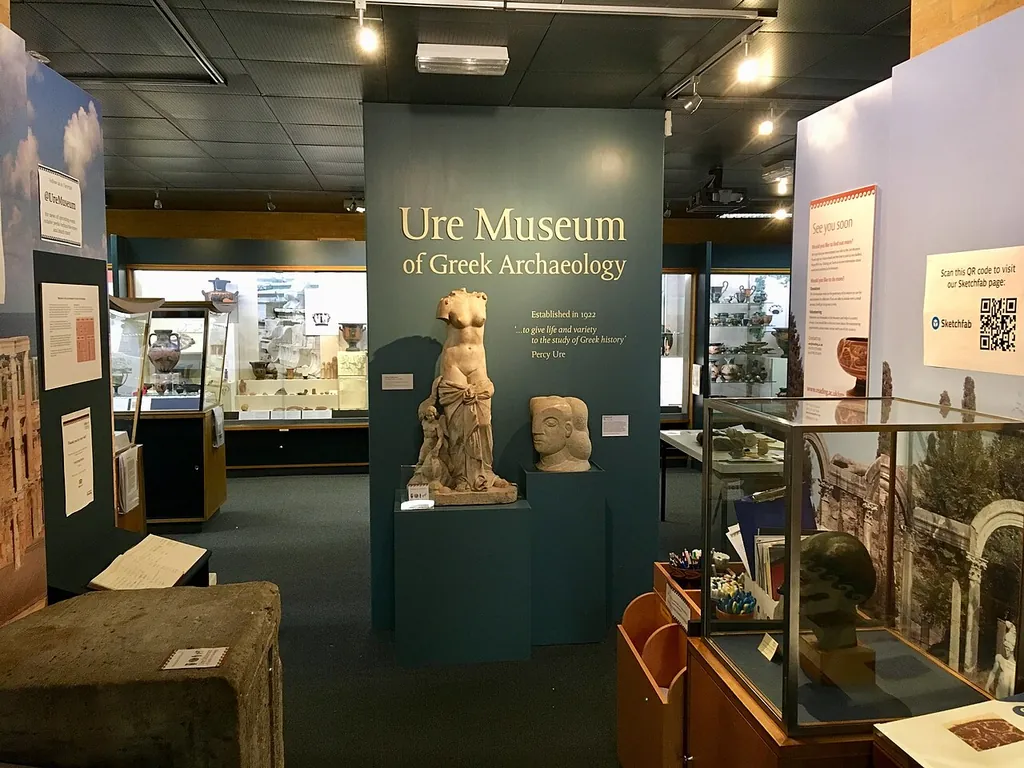
Ure Museum of Greek Archaeology
University of Reading museum with one of Britain's largest collections of ancient Greek pottery; admission is free on three weekdays.
Få kun enkelte afsnit læst op
Om museet
The museum was founded in 1922 as the Museum of Greek Archaeology at University College Reading by the classical archaeologists Percy Ure and his wife Annie Ure. It grew out of a small group of Egyptian, Cypriot, Greek and British antiquities that had been shown in the college library during the First World War, and it first opened in a house on the college's London Road site. An earlier gift of Egyptian antiquities, made in 1909 by Hilda Petrie, is part of the collection.
Gifts, bequests and purchases, many of them supported by friends of the university, built up what is now recognised as the fourth largest collection of Greek ceramics in Britain, alongside Etruscan, Egyptian, Cypriot and Roman objects. In the 1950s Reading Museum lent about 300 further vases, and in 1957 the collection moved to the new Whiteknights campus. After Annie Ure died in 1976, Jane Gardner became curator; the museum was renamed the Ure Museum in 1984 and its displays were redesigned in 2005.
Today the museum is on the ground floor of the Edith Morley Building and works closely with the university's Department of Classics. It serves teaching and research as well as the public, and its archive also records the early history of the college.
Højdepunkter
- Fourth largest collection of Greek ceramics in Britain
- Attic black-figure and red-figure vases, including the name vase of the Hasselmann Painter
- Etruscan black-figure amphora attributed to the Tityos Painter
- Egyptian antiquities including a 12th Dynasty model boat
- Free digital guide in more than 30 languages
Permanent udstilling
- Permanent collection – Greek, Etruscan and Cypriot pottery and terracottas, with Roman objects and Egyptian antiquities from the pre-dynastic to the Roman period.
- Grundlagt
- 1922
- Ejer
- University of Reading
Entrépriser & rabatter
Der er gratis entré.
| Grupper | –Groups of more than 8 people must book in advance. |
|---|
Admission is free; the museum welcomes donations.
Tilgængelighed
- Kørestolsvenlig
- Elevator: ingen oplysninger
- Handicaptoilet
- Handicapparkering: ingen oplysninger
- Servicehunde tilladt
- Taktile tilbud: ingen oplysninger
- Rundvisninger på tegnsprog: ingen oplysninger
- Letlæste tilbud: ingen oplysninger
- Synstolkning: ingen oplysninger
The museum is on the ground floor. Entrance 1 of the Edith Morley Building has step-free access and power-assisted doors; entrance 5 is closer to the museum but is not described as step-free. An accessible toilet is a short distance from the museum, near entrance 1. Large-print texts are available in the museum, and a sensory guide and a visual map showing the entry to the museum can be requested.
Børn og familie
Velegnet til børn og familier
- Opgavehæfte, skattejagt eller audioguide for børn
The museum offers colour-in pages, activity sheets and trails, online games and a Makaton film guide. School sessions use real ancient objects and are aimed at Key Stage 2 (Ancient Greeks, Ancient Egyptians) and Key Stage 1 (Ancient Toys and Games).
Transport & parkering
Med offentlig transport
The museum refers visitors to the University of Reading's 'Visit us' page for current public transport information; it encourages alternatives to driving.
I bil
Betalingsparkering
Pay-and-display car park 1a off the Shinfield Road entrance, next to the Sports Park; the machine accepts cards only.
The museum is in the Edith Morley Building (building 1 on the campus map) on the Whiteknights campus. The sat-nav postcode given by the museum is RG6 6UR.
Planlæg ruteService & spisesteder
- Café: findes ikke
- Wi-fi
There is no cafe in the museum; the campus has catering outlets serving snacks and meals. Public Wi-Fi is available for using the digital guide. The museum has an online shop.
Arrangementer & udlejning
Museet har ikke offentliggjort oplysninger om dette.
Planlæg dit besøg
| Audioguide | ja |
|---|---|
| Tilbud til skoler | ja |
| Godt at vide | A free digital guide (browser or app) lets visitors listen to staff and volunteers talking about the displays and follow trails; it is offered in more than 30 languages and is used by connecting to the public Wi-Fi and scanning a QR code in the museum. School sessions for Key Stages 1 and 2 and sessions for A-level students are available. Groups may be asked to wait if the museum is at capacity. |