Begrænset åbent. Due to the roof and façade renovation, not all areas have been accessible since July 2023, and construction noise is possible; no end date for the work has been announced. The building may currently close at short notice due to staff illness.
Photographs by Moritz Wondrak show relics from the Nazi era – in public spaces and in private ownership – in their present-day surroundings and ask how they should be dealt with. Opening on October 29, 2026, accompanied by talks and lectures.
German premiere of an exhibition by the Goethe-Institut and the DFB-Kulturstiftung (German Football Association's cultural foundation) about Gottfried Fuchs, one of only two Jewish players ever to play for the German national soccer team.
Om museet
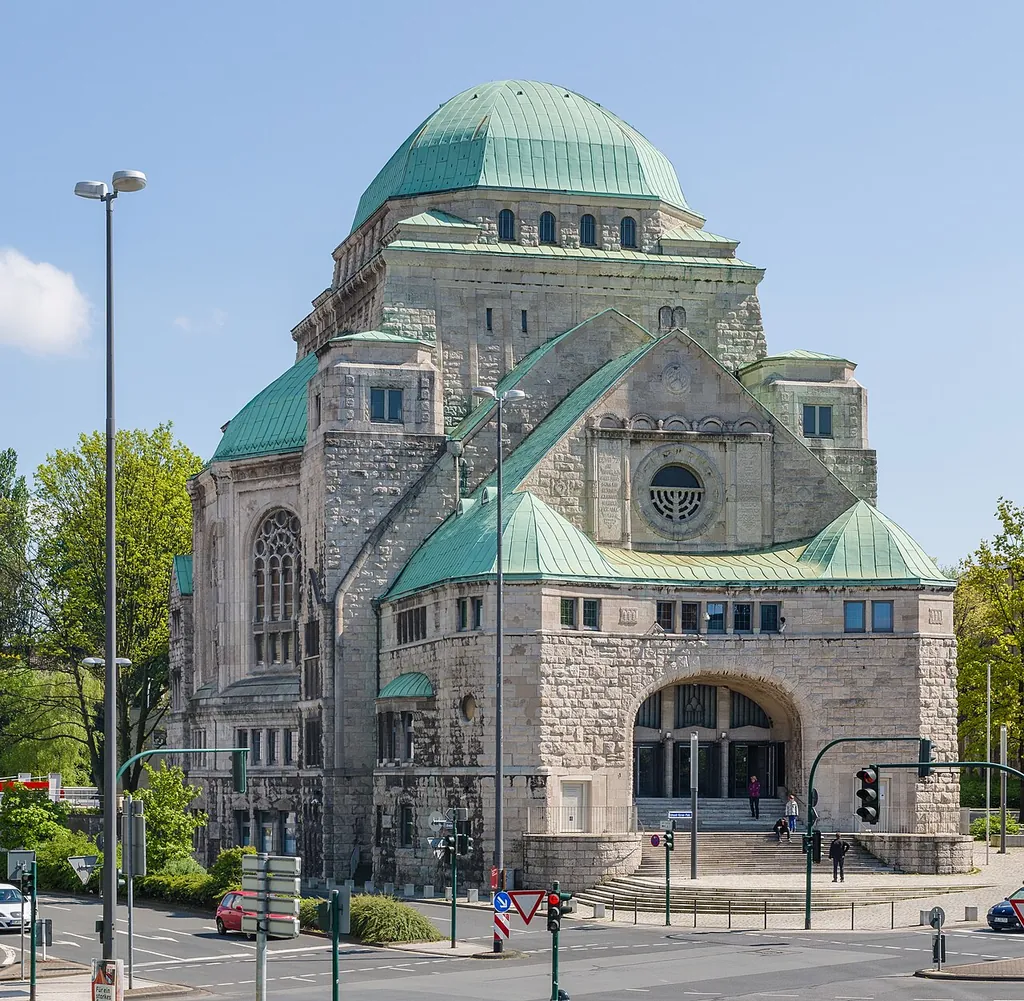
Essen's growing Jewish community had the synagogue built from 1911 on the edge of the city center to designs by the architect Edmund Körner. It was consecrated as the "Neue Synagoge" (New Synagogue) on September 25, 1913. With its dome rising some 37 meters, the building combines influences of late Art Nouveau with Oriental and Western forms and is considered one of the largest and best-preserved prewar synagogue buildings in Germany.
During the pogrom night of November 9–10, 1938, the interior was gutted by fire, but the solid structure itself remained standing and also survived the war. After 1945 it long stood derelict as a ruin until the City of Essen acquired it in 1959. The small postwar community built itself a new synagogue; from the early 1960s the city used the gutted building to show industrial design as "Haus Industrieform" – and in the process the synagogue's furnishings disappeared completely.
After a fire damaged the design exhibition in 1979, the city council decided to establish a memorial here: in 1980 the Alte Synagoge opened as a memorial site and political-historical documentation forum. Between 1986 and 1988 the synagogue hall was partially reconstructed, and Jewish culture took on a larger role in the program.
In 2008 the council decided to reorient it as a center of Jewish culture; after renovation it reopened on July 13, 2010. Since then the permanent exhibition has been devoted to Jewish religion, festivals, and ways of life, as well as the history of Essen's Jews and of the building. Diana Matut has directed the municipal institution since 2023; the renovation of the roof and façade is still ongoing.
Højdepunkter
Monumental synagogue building by Edmund Körner (1913) with a dome some 37 meters high
Permanent exhibition on the sources of Jewish tradition, festivals, and Jewish life today
Sections on the history of Essen's Jews and the eventful history of the building
Free admission and a full program of talks, concerts, and readings
Permanente udstillinger
Dauerausstellung zu jüdischer Religion, Kultur und Geschichte – Five sections on the ground floor, gallery, and mezzanine cover the sources of Jewish tradition, festivals, Jewish ways of life today, and the history of Essen's Jews and of the building. The audio guide (German/English) runs on your own smartphone.
Grundlagt
1980
Ejer
Stadt Essen
Ledelse
Diana Matut
Entrépriser & rabatter
Der er gratis entré.
Børn og unge
–Free admission for everyone.
Pensionister
–Free admission for everyone.
Personer med handicap
–Free admission for everyone.
Studerende og elever
–Free admission; guided tours free for school classes, apprentices, and university students.
Grupper
–Free admission. Overview tour (approx. 1.5 hours) €45 per group of up to 20 people, booked through the office (0201 88-45218 or -45268, alte-synagoge@essen.de); free for school classes, apprentices, and university students.
Familier
–Free admission for everyone.
Public guided tours of the exhibition on the 1st and 3rd Sunday of the month at 15:00: €3, reduced €2, no registration needed. Tours by arrangement also in English, Arabic, Hebrew, Yiddish, Portuguese, Polish, as well as in sign language and Easy Language (Leichte Sprache). Tours of the Jewish cemeteries in Segeroth and Werden €45 per group (not on Shabbat or Jewish holidays). Many events with free admission; donations welcome.
Tilgængelighed
Delvis kørestolsvenlig
Elevator: ingen oplysninger
Handicaptoilet: ingen oplysninger
Handicapparkering: ingen oplysninger
Servicehunde tilladt
Taktile tilbud: ingen oplysninger
Rundvisninger på tegnsprog
Letlæste tilbud
Synstolkning: ingen oplysninger
According to the city, the building is accessible with few exceptions; for step-free access, contact the front desk in advance (0201 88-45224). Due to the renovation, not all areas are currently accessible. Guide dogs and assistance dogs with documentation are welcome (in harness or on a short leash). Tours in sign language and Easy Language by arrangement.
Børn og familie
Velegnet til børn og familier
Educational programs mainly for groups: interactive tours for daycare centers, tours and workshops for grades 1 to 6, and tours with various focuses and workshops from grade 7. Registration at least eight weeks in advance.
Transport & parkering
Med offentlig transport
Rathaus Essen
From Essen Hauptbahnhof (main station), take lines 101, 103, 106, or 107 to the Rathaus Essen stop; the building is right next to the city hall.
I bil
Parkering muligt
No museum parking; the building refers visitors to the Alfredistraße, Q-Park, and Rathaus Essen parking garages.
No permanent café; pop-up café in the Forum Dreilinden on Tuesdays 12:00–14:00. For security reasons, larger bags are not allowed inside; lockers in the basement.
Arrangementer & udlejning
Museet har ikke offentliggjort oplysninger om dette – spørg venligst museet direkte.
Planlæg dit besøg
Rundvisninger
ja · varighed ca. 1,5 t.
Audioguide
ja (DE, EN)
Tilbud til skoler
ja
Godt at vide
Public guided tour of the permanent exhibition on the 1st and 3rd Sunday of the month at 15:00 (approx. 90 minutes, no registration needed); overview tours for groups last about 1.5 hours, tours of the Jewish cemetery 1 to 1.5 hours.