Major collector's museum with the most extensive Vienna 1900 permanent exhibition. The house holds the world's largest collections of the Austrian Expressionists Egon Schiele and Richard Gerstl and shows the most comprehensive permanent presentations on Gustav Klimt, co-founder of the Vienna Secession, and Oskar Kokoschka, another leading figure of Austrian Expressionism.
The exhibition explores fashion in Vienna from around 1900 to 1930: the reform dress, the fashion department of the Wiener Werkstätte and the exchange with Paris, with works by Klimt, Schiele and Hoffmann, among others.
More than 100 works of New Photography, arranged thematically, with loans from European museums and private collections, including works shown publicly for the first time. On view are, among others, August Sander and Trude Fleischmann.
A pairing of the painter Herbert Boeckl and the sculptor Hans Josephsohn, who never met: both held on to the human figure and condensed it into an archaic, powerful formal language.
About the museum
The foundation of the museum is the private collection of the Viennese eye doctor, passionate collector and museum founder Prof. Rudolf Leopold (1925–2010) and his wife Elisabeth (1926–2024), who assembled Austrian art over four decades from the 1950s onward. Early on they acquired works by Egon Schiele and Gustav Klimt, when these artists were still little valued and comparatively cheap to buy.
In 1994 a large part of the holdings, around 5,200 works, passed to the newly founded Leopold Museum-Privatstiftung. The Republic of Austria and the Oesterreichische Nationalbank paid the collector an amount roughly equal to a third of the total value. Another part remained a private collection, which Rudolf Leopold continued to expand until his death. He led the house as museological director and board member until his death in 2010.
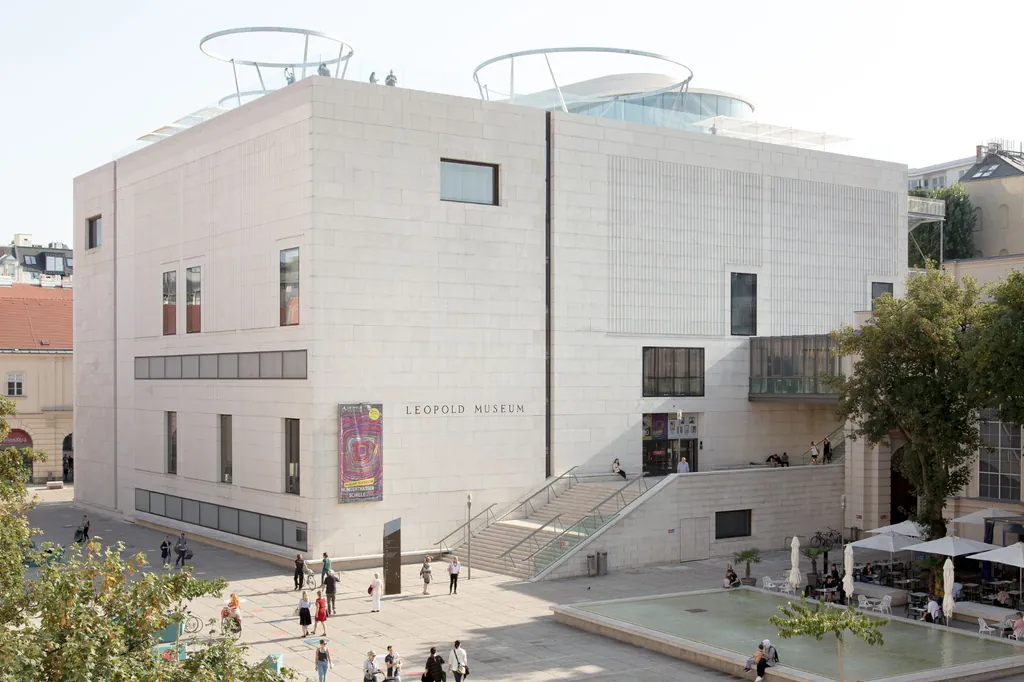
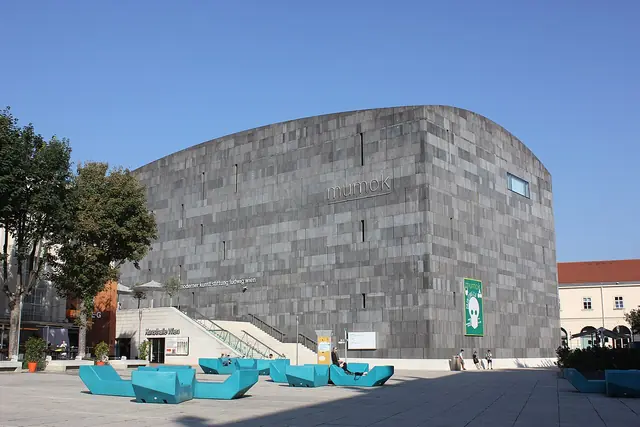
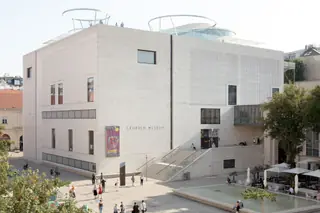
In 2001 the museum opened in a purpose-built new building in the MuseumsQuartier. Designed by the architects Laurids and Manfred Ortner (O&O), the building is made of light shell limestone. The cube offers around 5,400 square meters of exhibition space on several levels. It lies on an axis with the Kunsthistorisches Museum, while the mumok, on the opposite side of the site, shows art after 1945.
Today the collection comprises around 9,000 objects, from Biedermeier through atmospheric Impressionism, Symbolism and Art Nouveau to Expressionism and New Objectivity. With around 300 works, including 48 paintings, the house holds the most extensive Schiele holding in the world. Since 2019 the permanent presentation "Wien 1900. Aufbruch in die Moderne" has brought together painting, graphic art and applied art of Viennese Modernism; comprehensive monographic special exhibitions and thematic shows run alongside it. As a center of competence for Viennese Modernism, the museum operates the Egon Schiele Documentation Center, organizes the Egon Schiele Symposia and conducts ongoing provenance research.
Highlights
World's largest Egon Schiele collection, with around 300 works
Largest permanent presentations on Gustav Klimt, Richard Gerstl and Oskar Kokoschka
Gustav Klimt: "Tod und Leben", "Ein Morgen am Teiche" and "Am Attersee"
Egon Schiele: "Sitzender Männerakt (Selbstdarstellung)", "Bildnis Wally Neuzil" and "Selbstbildnis mit Lampionfrüchten"
Furniture and applied art of the Wiener Werkstätte, including works by Koloman Moser, Josef Hoffmann, Otto Prutscher and Dagobert Peche
Works by Carl Moll, Richard Gerstl, Oskar Kokoschka and Albin Egger-Lienz
Permanent presentation "Wien 1900. Aufbruch in die Moderne"
Permanent exhibitions
Wien 1900. Aufbruch in die Moderne – Permanent presentation across several levels on Viennese Modernism: paintings and graphic works by Klimt, Schiele, Kokoschka and Gerstl, alongside furniture and objects of the Wiener Werkstätte.
Vom Expressionismus zur Neuen Sachlichkeit – Expanded collection presentation from Viennese Expressionism around 1910 through the art of the interwar period to Neue Sachlichkeit (New Objectivity), including works by Egon Schiele, Oskar Kokoschka, Albin Egger-Lienz, Anton Kolig, Herbert Boeckl and Rudolf Wacker; the room on German Expressionism on level 0 has been merged into it.
Founded
2001
Operated by
Leopold Museum-Privatstiftung
Director
Hans-Peter Wipplinger
Visitors per year
approx. 359,691 (2024)
Admission & discounts
Adults
€19
Reduced
€16People under 26 and aged 65 and over, people with disabilities, unemployed people
Children & teens
€2.50free up to age 6 · Children under 7 free; young people under 19 pay €2.50.
Seniors
€16From age 65
Visitors with disabilities
€16Reduced admission; please ask at the ticket desk.
Students & apprentices
€16Reduction for everyone under 26
Groups (10+ people)
€16 per personFrom 10 people in the same category; young people under 19 in groups pay €2.50. Groups of more than 10 people only after a confirmed registration, max. 25 people per group; from 10 people, one accompanying person is free.
Families
€21Family ticket 1: 1 adult with up to 3 young people under 19; with 2 adults €40.
Family ticket 2 (2 adults + up to 3 young people under 19)
€40
Public guided tour (plus admission)
€5Sat, Sun, public holidays and selected dates
Audio guide
€5"Nimm 2" €8, smartphone guide €3
Free admission with the Kulturpass ("Hunger auf Kunst und Kultur"), ICOM card, for annual pass holders, members of the Circle of Patrons and Vienna tour guides. Accepted include the Vienna Pass, Flexi Pass, Vienna City Card, Vienna E-Pass and the Ö1 Club. Tickets bought at the ticket desk are valid for one year, online tickets for the chosen day. There is also an annual pass, combined tickets with other Vienna museums and packages, for example with breakfast in Café Leopold or a drink on the MQ Libelle roof terrace – the latter only while the terrace is open to the public (not during the winter closure, roughly November to April); details on the museum's website.
According to the museum, largely accessible. An outdoor lift at the back leads to the level of the main entrance; next to the revolving door there is a wide door with an EuroKey opener. All exhibition levels can be reached by lift (cabin width 89 cm). Wheelchairs and folding stools are available free of charge at the cloakroom (ID, advance registration recommended). Accessible toilets on the ground floor (Euro key) and on level −1. Tactile models of works by Schiele and Klimt and of the building. Marked accessible parking spaces at the rear of the museum (access to the MuseumsQuartier near the Volkstheater).
Kids & families
Great for kids & families
Time needed
approx. 2 hrs
Kids’ admission
free up to age 6
Family ticket
€21 · Family ticket 1: 1 adult with up to 3 young people under 19; with 2 adults €40.
Family tours & workshops
Activity booklet, scavenger hunt or kids’ audio guide
Baby changing facilities
LEO children's studio for ages 6–12 every Saturday and Sunday 15:00–16:30 (short tour and workshop, from €5 per child). Free children's and youth audio tour on your own smartphone, e.g. "Mit Poldi und Leo durchs Museum" for ages 6–11. Family tickets for adults with young people under 19.
Getting there & parking
By public transit
Museumsquartier (U2)
U2 to Museumsquartier or U3 to Volkstheater; trams 1, 2, D, 49 and 71 and bus 48A to Ring/Volkstheater. The Museumsquartier and Volkstheater subway stations have a lift.
By car
Parking available
MuseumsQuartier car park directly in front of the site (entrance Museumsplatz 1, open around the clock, with lift). Tour buses use the in/out stop at Burgring.
Café Leopold on level 2, also accessible from outside without an entry ticket (daily 10:00–24:00, breakfast until 12:00). Museum shop on level 1. Reference library by appointment.
Events & venue rental
Spaces for rent
Corporate events
Up to 250 guests.
Available to rent: atrium, lower atrium, studio, lounge, auditorium and museum rooms. The atrium and lower atrium each hold up to 250 guests for a standing reception or 150 for a gala dinner. Level −2 can be expanded with further museum rooms to up to 1,240 m². Atrium and lounge only outside opening hours. The rent includes the guests' admission, staff and furniture; catering and technology are extra.
Photography without flash for private purposes is permitted in the collection; special exhibitions have their own rules. No tripods, selfie sticks or additional lighting.
Good to know
The museum recommends around 2–3 hours for a visit. Public guided tours in German on weekends and public holidays (tickets online or from 10:00 at the ticket desk); individual tours for groups (60 or 90 minutes, several languages) must be booked at least 14 days in advance. School programs as a one-hour tour or a 90-minute program with a studio workshop. Animals are not allowed.