Frøslevlejrens Museum
Museum in the preserved Frøslev prison camp near Padborg about the Gestapo camp of 1944–45 and the Faarhuslejren internment camp of 1945–49.
About the museum
The Frøslev camp in the Frøslev Plantage near Padborg was built in 1944 to prevent the deportation of Danish prisoners to Germany. Under the supervision of the German security police, thousands of Danes were held here – resistance fighters, police officers, and others whom the occupying power wanted out of the way. Contrary to agreements, around 1,600 prisoners were nevertheless taken to German concentration camps. After the liberation on May 5, 1945, the site was used until 1949 under the name Faarhuslejren as an internment camp for people convicted of collaboration in the course of the legal reckoning; many of them came from the German minority in Sønderjylland.
The idea of a museum arose in 1963 among former prisoners, took concrete shape in 1965, and Frøslevlejrens Museum opened in 1969. The camp is considered one of the best-preserved German prison camps of the Second World War in Europe; the former prisoner area is a national monument. Since January 1, 2007, the museum has belonged to the Nationalmuseet as an independent unit.
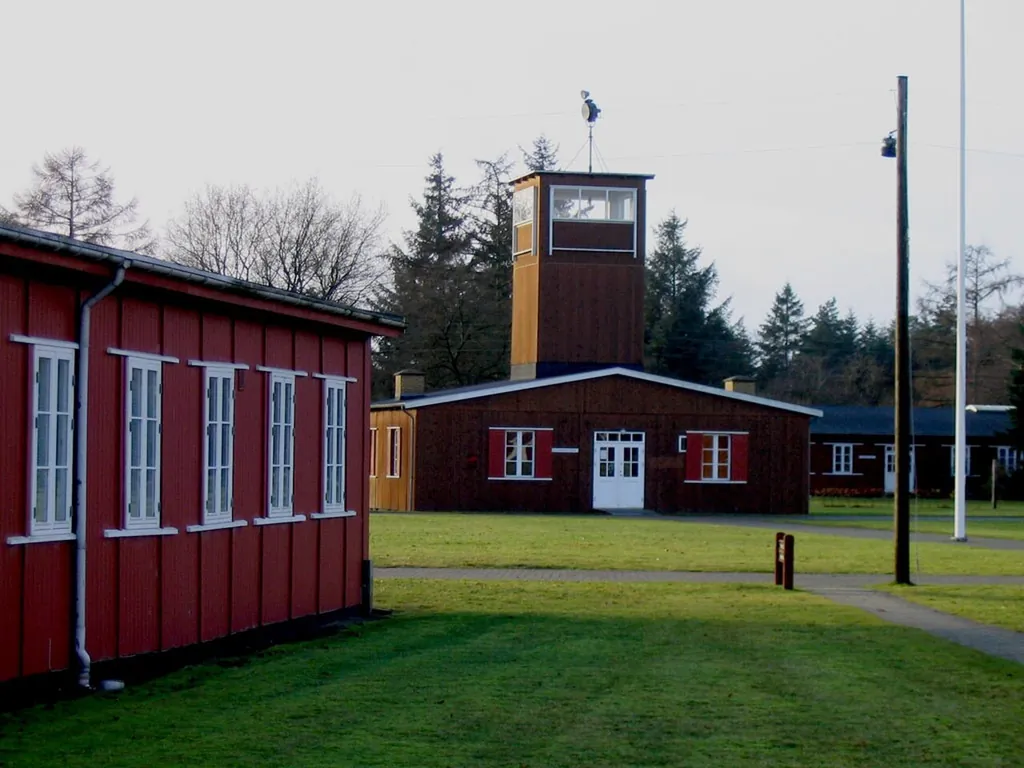
The exhibitions are spread over three buildings in the middle of the camp: in the main watchtower, the organization and staff of the camp are explained with an interactive table model; the original prisoner barrack H4 tells of the prisoners' everyday life and shows a large deportation board as well as an originally equipped White Bus from the 1945 rescue operation. Barrack H6 is devoted to the Faarhuslejren and the reckoning after the war. On the freely accessible camp grounds, barbed wire, watchtowers, and the Gendarmmuren (Gendarme Wall) commemorate the border gendarmes who did not return.
Highlights
- One of the best-preserved German prison camps of the Second World War
- Original prisoner barrack H4 with deportation board
- Originally equipped White Bus from the 1945 rescue operation
- Exhibition on the Faarhuslejren and the legal reckoning after 1945
- Gendarmmuren, watchtowers, and former minefield on the camp grounds
- Escape room in the camp commandant's office
Permanent exhibitions
- Gestapos fangelejr i Danmark – The main watchtower and the original prisoner barrack H4 deal with camp administration, the prisoners' everyday life, and the deportations; a fully preserved White Bus is also on display.
- Faarhuslejren og opgøret efter krigen – The exhibition in barrack H6 covers the internment camp of 1945–49 and the reckoning with collaborators, including many members of the German minority.
- Lejrområdet – Tour of the freely accessible camp grounds with barbed wire, watchtowers, former minefield, and the Gendarmmuren.
- Founded
- 1969
- Operated by
- Nationalmuseet
- Director
- Mikkel Leth Jespersen
Admission & discounts
| Adults | DKK 76.50 |
|---|---|
| Children & teens | freefree up to age 17 · Children and young people under 18 free. |
| Visitors with disabilities | –companion free · Free admission for companions with a Ledsagerkort (companion card; show it at the ticket desk). |
| Groups | –School classes have free admission (not adult education centers and evening schools) and register in advance by email. |
| Frøslevlejren annual pass | DKK 155One year of free admission, 20% discount at the other sites of the Nationalmuseet |
| Public guided tour "Følg fangernes fodspor" | DKK 140Including admission; children under 18 DKK 55, under 10 free |
| Escape room (up to 5 people) | DKK 495Per group, museum admission additional; ages 12 and up |
Admission DKK 85 at the ticket desk, DKK 76.5 when purchased online; the ticket can be used within one year and converted into an annual pass on the day of the visit. Discounts through cooperation with Danske Museer and ICOM. The museum shop is accessible without an admission ticket.
Accessibility
- Wheelchair accessible
- Elevator: no information
- Accessible restroom: no information
- Accessible parking
- Service dogs welcome
- Tactile models & exhibits: no information
- Sign language tours: no information
- Easy-to-read materials: no information
- Audio description: no information
All three museum buildings are accessible by wheelchair and walker, and there are seating options in the exhibitions. Wheelchairs and walkers are not loaned out. Accessible parking spaces near the entrance to the camp grounds. Clean dogs on a leash are allowed in the buildings. Public restrooms in barrack W5 (operated by Aabenraa Municipality). The public outdoor guided tour is not suitable for people with mobility impairments.
Kids & families
Great for kids & families
| Kids’ admission | free up to age 17 |
|---|
- Family tours & workshops
- Activity booklet, scavenger hunt or kids’ audio guide
- Hands-on stations
- Stroller-friendly
The museum puzzle "Museumsmysteriet" (Useeum app, in Danish only, playable without reading ability) leads children, families, and school classes through the main watchtower, barrack H4, and the grounds. The escape room in the commandant's office is suitable from age 12, children only with adults. In the main watchtower there is an interactive table model. Strollers are allowed in the exhibitions but are not loaned out. The museum is a memorial site.
Getting there & parking
By public transit
Padborg Station · 4 km
The nearest train station is Padborg, about 4 km from the camp. No direct bus connection to the camp; Sydtrafik bus line 661 in the area.
By car
Free parking · 5-min walk to the entrance
Public, free parking lots outside the camp grounds; no parking lots belonging to the museum. Accessible parking spaces near the entrance. Driving and parking on the camp grounds is not allowed.
- Accessible parking
By car via the Sønderjyske Motorvej, exit 76 (last exit before or first exit after the German border). The three museum buildings (main watchtower, barracks H4 and H6) are in the middle of the camp; information and ticket desk in barrack H6, Lejrvejen 83.
Get directionsAmenities & dining
- Café: not available
- Restaurant: not available
- Museum shop
- Wi-Fi
No café; food you have brought can be eaten in the packed-lunch building in barrack W9 near the main gate or at tables on the camp grounds, but not in the exhibitions. Museum shop with ticket desk in barrack H6 (books, souvenirs, coffee from the occupation period). Free Wi-Fi "Froeslev_Guest".
Events & venue rental
The museum hasn’t published any information on this – please ask the museum directly.
Plan your visit
| Guided tours | yes · approx. 45 min |
|---|---|
| School programs | yes |
| Photography | Photography and filming for private use allowed; professional recordings by arrangement. |
| Good to know | Public guided tour "Følg fangernes fodspor" (45 minutes, outdoors) from April to October on weekends and during holidays at 11:00 and 13:00; from late October to November weekend tours in the barrack. Private tours (1–1.5 hours) and lectures on request. Information and ticket desk in barrack H6; for tours, check in there 15 minutes beforehand. Groups and school classes announce their visit in advance. |