Patarei vangla
In the former building of the Patarei sea fortress and prison, the exhibition area “Kommunism on vangla” (Communism Is a Prison) presents prison life, the occupations and the crimes of communist regimes.
Have only individual sections read aloud
About the museum
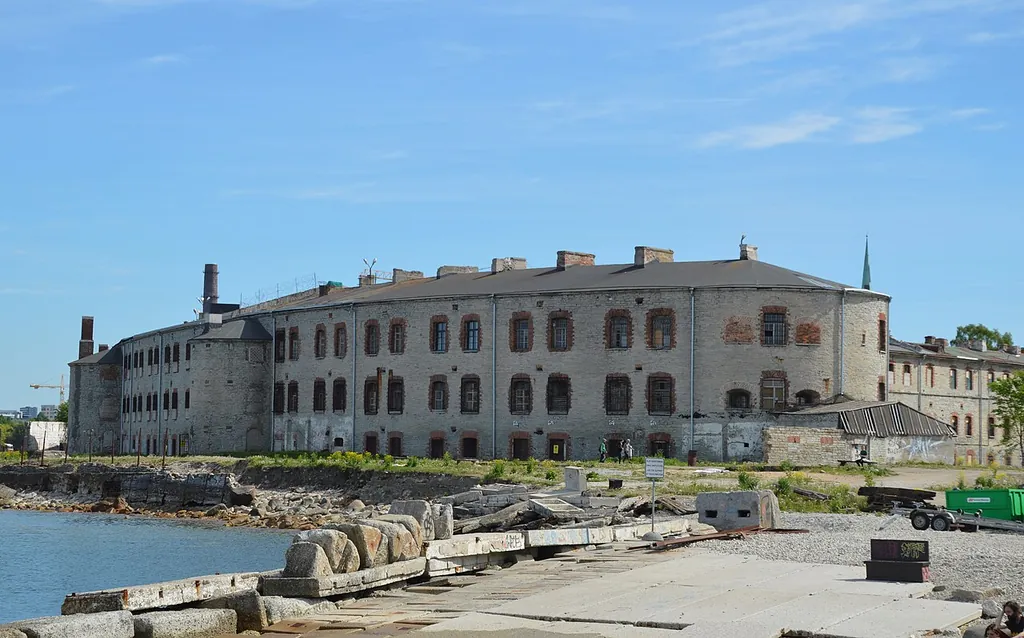
The history of Patarei begins in 1827, when, on the order of the Russian Emperor Nicholas I, planning and construction of the Tallinn sea fortress began, to defend Saint Petersburg. The main part of the complex is a curved three-storey artillery building about 250 metres long, facing the sea, from which two wings more than 100 metres long extend landward. The fortress was solemnly opened in 1840 and was later extended during the Crimean War. The name Patarei comes from the original function of the building as a place for housing artillery guns.
After the First World War the barracks was handed over in 1919 to the Ministry of Justice of the Republic of Estonia, and in 1920 the central prison, Estonia's largest prison, was opened there, with room for nearly a thousand prisoners. In the 1930s two new wings were added. During the Soviet and German occupations (1940–1991) the prison was the scene of the suffering of thousands of innocent people. The prison operated until 2002. The main part of the building has been a cultural monument since 1997; it is Estonia's largest classicist building complex and the only fully preserved defensive structure of its kind in the Baltics.
The exhibition area “Kommunism on vangla” in the prison is compiled and run by the Eesti Mälu Instituut (Estonian Institute of Memory). The exhibition includes the prisoners' exercise cages preserved in the courtyard, the cell block, the cells of the main building, the washroom, the corridors and the execution chamber. The exhibition area is currently closed, and visitors are expected again in 2027. The institute is preparing the establishment of a Museum of Victims of Communism, which according to plan will open on 14 June 2027.
Key themes
- Exhibition area “Kommunism on vangla” (Communism Is a Prison) in the former central prison
- Prisoners' exercise cages preserved in the courtyard
- Cell block and the cells of the main building
- Execution chamber
- International exhibition “Kommunism ja terror” (Communism and Terror)
- Estonia's largest classicist building complex and a 19th-century sea fortress
Permanent exhibition
- Kommunism on vangla – The exhibition area includes the preserved prisoners' exercise cages, cells, corridors and the execution chamber, and presents the history of Patarei, the everyday life of prisoners and the crimes of communist regimes.
- Founded
- 1920
- Operated by
- Eesti Mälu Instituut
Admission & discounts
The exhibition area is closed; visitors are expected again in 2027.
Accessibility
- Wheelchair accessible: not available
- Elevator: not available
- Accessible restroom: no information
- Accessible parking: no information
- Service dogs welcome: no information
- Tactile models & exhibits: no information
- Sign language tours: no information
- Easy-to-read materials: no information
- Audio description: no information
The exhibition area is not built for people with mobility impairments: the exhibition is on two floors and there is no lift.
Kids & families
Only partly suitable for kids
The content of the exhibition may be disturbing.
Getting there & parking
By car
Free parking
Parking in front of the gate at Kalaranna 28 is free; elsewhere the general parking rules apply.
Amenities & dining
The exhibition area is closed; visitors are expected again in 2027.
Events & venue rental
The exhibition area is closed; visitors are expected again in 2027.
Plan your visit
| Good to know | The entrance to the exhibition area is through the Suur-Patarei cul-de-sac; the exhibition area is in the eastern wing of Patarei. It can be cool in the exhibition area, and the content may be disturbing. |
|---|