Limited operations (expected until 2026-10-21). The collection display on the second exhibition floor (including Impressionism and Realism) is closed until October 21, 2026, following the end of the Cassirer special exhibition, and will be accessible again from October 22, 2026; the first and third exhibition floors are open.
The exhibition tells how the painter Hermione von Preuschen exhibited her painting “Mors Imperator,” rejected by the Academy in 1887, on her own initiative and became famous as a result – complemented by letters, photos and publications.
The launch of a new cabinet series hosting national galleries from around the world: under the title “Die Erfindung der Mythen” (The Invention of Myths), the National Museum in Warsaw shows Polish painting, for example by Jacek Malczewski and Jan Matejko.
In the anniversary year, individual works of the 20th century and the present enter into dialogue with the 19th-century collection on all three floors.
Marking Arnold Böcklin's 200th birthday, the exhibition, in cooperation with the Kunstmuseum Basel, shows around 150 works and brings together several versions of the “Isle of the Dead.”
About the museum
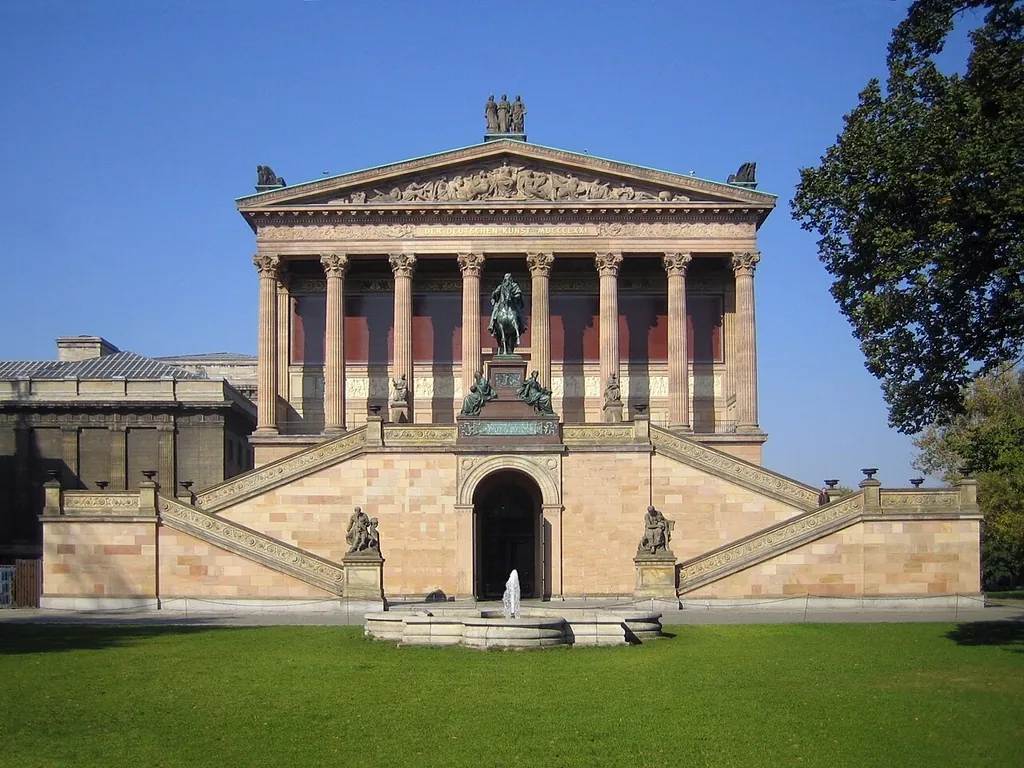
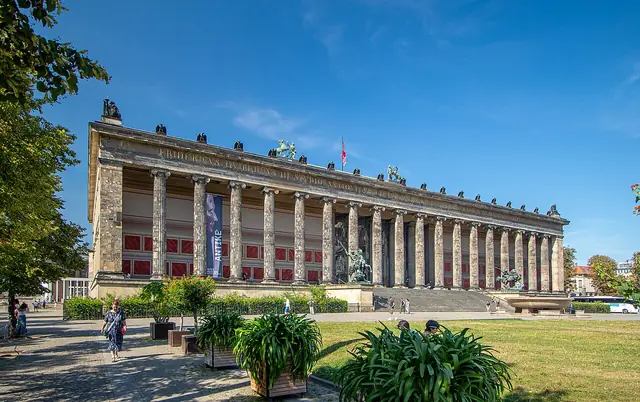
The impetus for the Nationalgalerie came from the banker Joachim Heinrich Wilhelm Wagener, who on his death in 1861 bequeathed his collection of paintings to the Prussian state – together with the wish that it be made accessible to the public. The idea of a temple-like building on a high base went back to King Friedrich Wilhelm IV; Friedrich August Stüler designed the building, and after his death Johann Heinrich Strack completed it. On March 22, 1876, the Nationalgalerie opened as the third museum on Museum Island.
During World War II, the building was hit by bombs several times; the collection had been moved to safe storage beforehand. It was able to partially reopen as early as 1949. During the division of Germany, the 19th-century works held in the West found homes in places including the Neue Nationalgalerie and, from 1986, the Galerie der Romantik in Charlottenburg Palace.
After the fall of the Wall, the holdings were reorganized: since then, the Alte Nationalgalerie has been devoted to art between the French Revolution and World War I, from Neoclassicism and Romanticism to Impressionism, Symbolism and the Secession. From 1998 to 2001, the building was renovated by the architectural firm HG Merz and reopened on December 2, 2001.
The museum holds the world's largest collection of paintings by Adolph Menzel as well as major works by Caspar David Friedrich. For its 150th anniversary in 2026, it launched new exhibition formats and redesigned a room on the history of the building.
Highlights
Caspar David Friedrich: “The Monk by the Sea”
World's largest collection of paintings by Adolph Menzel, including “The Flute Concert”
Arnold Böcklin: “Isle of the Dead”
Édouard Manet: “In the Conservatory”
Johann Gottfried Schadow: Princesses Group
Auguste Rodin: “The Thinker”
Permanent exhibitions
Sammlungspräsentation: Die Kunst des 19. Jahrhunderts – Across three floors, the tour leads from the age of Goethe and Romanticism through Realism and Impressionism to Symbolism and the Secession, accompanied by sculptures of the period.
Tür zur Geschichte – Redesigned room on the first exhibition floor that makes traces of 150 years of building history visible and, in a cabinet, tells the story of the collection through three monumental works.
Founded
1876
Operated by
Staatliche Museen zu Berlin – Stiftung Preußischer Kulturbesitz
Director
Anette Hüsch
Visitors per year
approx. 376,000 (2019)
Admission & discounts
Adults
€14
Reduced
€7School students, apprentices, university students, volunteer service participants, jobseekers receiving ALG I (unemployment benefit) and people with a severe disability rating (GdB) of 50 or more (proof required in each case)
Children & teens
freefree up to age 17 · Children and young people up to their 18th birthday free.
Seniors
–No senior discount.
Visitors with disabilities
€7companion free · Reduced admission from a disability rating (GdB) of 50; a necessary companion noted on the severe disability ID (Schwerbehindertenausweis) is admitted free.
Students & apprentices
€7University students, school students and apprentices with proof; university students on registered classes free.
Groups (10+ people)
–No group rate: groups of 10 or more must register at least two weeks in advance (online ticket shop or info service) and pay admission plus a €10 registration fee per group; groups of 25 or more are split. Registered school classes free.
Families
–No family ticket; children and young people under 18 get free admission.
The ticket is valid for the collection and special exhibitions. Museum Island ticket (all museums on Museum Island on one day) €24, reduced €12. Tickets online or at the ticket desk; advance sales open four weeks ahead. SMB annual passes (BASIC, CLASSIC, CLASSIC PLUS) and Museum Pass Berlin (3 days, €32/reduced €16) valid. Free admission for groups including recipients of Bürgergeld (basic income support), housing benefit, basic social security or asylum seekers' benefits, ICOM and DMB members, and press. The former free-admission museum Sunday was discontinued at the end of 2024.
Accessibility
Partially wheelchair accessible
Elevator
Accessible restroom
Accessible parking: no information
Service dogs welcome
Tactile models & exhibits: no information
Sign language tours
Easy-to-read materials
Audio description: no information
According to the SMB, partially wheelchair-accessible; the floor plan shows accessible access to all three exhibition floors as well as an accessible restroom. Ask the info service about loan wheelchairs in advance (030 266 42 42 42, Mon–Fri 9:00–16:00). Regular tandem tours in German Sign Language for deaf and hearing guests, as well as tours in plain language for people with and without learning difficulties. Only trained assistance dogs are allowed.
Kids & families
Great for kids & families
Kids’ admission
free up to age 17
Family tours & workshops
Activity booklet, scavenger hunt or kids’ audio guide
Baby changing facilities
Gallery talks and workshops for families (e.g., making paints from plants), workshops in the neighboring Haus Bastian. Free coloring sheets with a clipboard for ages 6 to 12 at the ticket desk (“Familienzeit im Museum” – family time at the museum). Baby changing table according to the floor plan. Under the house rules of the Staatliche Museen, certain strollers may have to be swapped for strollers provided by the museum; children may not be carried in back carriers or on shoulders.
Getting there & parking
By public transit
Museumsinsel
U-Bahn Museumsinsel; S-Bahn Friedrichstraße or Hackescher Markt; tram to Am Kupfergraben or Hackescher Markt; bus to U Museumsinsel.
By car
No on-site parking at the museum.
The Staatliche Museen do not list any parking and recommend arriving by public transport or bicycle.
Café and Walther König bookstore in the building (Tue–Sun 10:00–18:00). Cloakroom and lockers; bags larger than 30 × 20 × 10 cm must be checked, travel luggage is not accepted.
Events & venue rental
Spaces for rent
Corporate events
Up to 150 guests.
Rentals outside opening hours via Museum&Location, the events company of the Staatliche Museen (kontakt@museum-location.de, 030 263948826). Foyer and staircase for standing receptions of up to 100 people, Sculpture Hall for lectures and concerts of up to 80 people or dinners of up to 60 people, Deutsch-Römer-Saal with theater-style seating for up to 150 people.