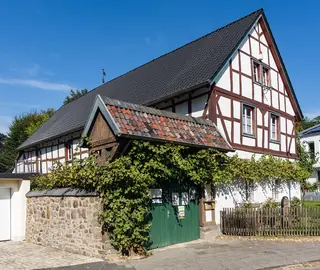
Volunteer-run local history museum in the half-timbered Brückenhof farmstead in Königswinter-Oberdollendorf, with local history, crafts, and the Heisterbacher Talbahn railway.
Anniversary exhibition with a cross-section through 35 years of museum history: the attic extension of 1999, examples of earlier exhibitions, and the courtyard paving and façade renewal of 2016. Open Sundays until at least 22 November 2026.
About the museum
The Heimatverein Oberdollendorf und Römlinghoven (local history association) was founded in 1962 and at first collected without a permanent home; its holdings were stored in school rooms, and from 1977 in a classroom of the "Rote Schule" (Red School). In 1989, the town of Königswinter handed the former winegrower's farmstead Brückenhof on Bachstraße over to the association. After renovation by many helpers, the museum opened there in 1991 and is still run by the association on a volunteer basis.
The gabled half-timbered house took its present form in the 1680s as a farm complex with a gatehouse and winepress house; the predecessor farm is documented as the Rennenberger Hof as early as 1540. It received its present name in the 19th century after the bridge over the then open-flowing Mühlenbach (mill stream). In 1999/2000 the house was restored and the museum was expanded to include the attic.
The permanent exhibition includes a kitchen from the early 20th century, a shoemaker's workshop, a large collection of group photos from Ober- and Niederdollendorf, a classroom on regional Jewish history, as well as sections on quarrying, stonemasonry and woodworking, half-timbered construction, and the Heisterbacher Talbahn with the Weilberg model layout. In addition, the association regularly shows special exhibitions on local history.
Highlights
Weilberg model layout of the Heisterbacher Talbahn
LED route map of the railways in the Siebengebirge
Over 300 group photos with more than 7,000 identified people
Historic kitchen and shoemaker's workshop
Classroom for regional Jewish history
Half-timbered farmstead from the 17th century
Permanent exhibitions
Heisterbacher Talbahn und Modellanlage Weilberg – In the attic, a model, photos, and documents recall the narrow-gauge railway that carried basalt from the Siebengebirge to the Rhine until 1950; also crafts and stone quarrying.
Alltag und Ortsgeschichte – An old kitchen, a shoemaker's workshop, and an extensive collection of group pictures show village life in Ober- and Niederdollendorf.
Lehrraum für jüdische Regionalgeschichte – Small room on the history of and traces of Jewish life in the region.
Founded
1991
Operated by
Heimatverein Oberdollendorf und Römlinghoven e. V.
Admission & discounts
Admission is free.
Free admission; donations for the upkeep of the museum are welcome.
Accessibility
The museum hasn’t published any information on this.
Kids & families
The museum hasn’t published any information on this.
Getting there & parking
By public transit
Oberdollendorf Mitte · 2-min walk
Light rail line 66 (Bonn – Bad Honnef) to the Oberdollendorf stop, from there about 7 minutes on foot; bus 520 to Oberdollendorf Mitte, about 2 minutes on foot; regional train on the right bank of the Rhine to Niederdollendorf station, about 10 minutes on foot.
The museum is located at the corner of Bachstraße/Falltorstraße at the foot of the Hülle; from the Rheinsteig (Bonn–Königswinter stage), it is about a 10-minute walk from the shelter on the Hülle.