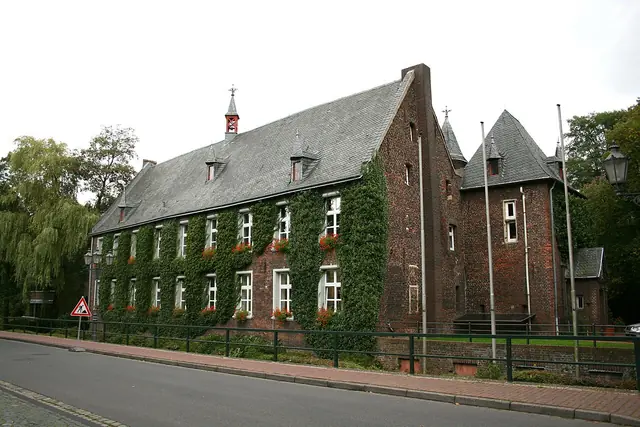
Bürgerbegegnungsstätte Oermterberg
Natural history exhibition at the foot of the Oermter Berg on the Ice Age, geology, forests, waters, and wildlife of the Lower Rhine, in the Volkspark.
Have only individual sections read aloud
About the museum
The Oermter Berg is a terminal moraine, piled up from glacial debris at the end of the Saale glaciation about 150,000 years ago. In the Middle Ages and early modern period, the slope was used for viticulture, latterly by Cistercians from Kamp. Around 1900 the Kreis Moers (district of Moers) acquired the site for social facilities; from 1922 it served as a children's recreation home, later as a school camp, and in 1953 the hill was redesigned as a Volkspark (public park). Since 1991 it has belonged to the Kreis Kleve (district of Kleve).
In 1993 the Friends and Support Circle of the Volkspark was founded. In 1995 the community center was built at the foot of the hill, and in 2000 the Natural History Collection of the Lower Rhine was opened to the public.
The exhibition explains how the Oermter Berg formed in the Ice Age and how it is geologically structured. It shows how people, hard coal mining, and forestry have changed the Lower Rhine landscape, and presents Kuhlen waters as well as the Fleuth and Kendel as typical habitats. Three aquariums hold fish from the Niers and Fleuth. The aim is to promote gentle treatment of nature.
Highlights
- Formation of the Oermter Berg during the Ice Age
- Three aquariums with fish from the Niers and Fleuth
- Kuhlen waters, Fleuth, and Kendel as habitats
- Volkspark with animal enclosures and playgrounds
Permanent exhibition
- Naturkundliche Sammlung Niederrhein – The exhibition shows the formation, geology, and plant and animal life of the Oermter Berg and the Lower Rhine landscape.
- Founded
- 2000
Admission & discounts
The museum hasn’t published any information on this.
Accessibility
The museum hasn’t published any information on this.
Kids & families
- Playground / play area
The Volkspark Oermter Berg has animal enclosures with red and fallow deer and mouflon, as well as several children's playgrounds. At the museum there is a feed dispenser for the animals (€2 per day).
Getting there & parking
By car
Parking available
Parking access via Rheurdter Straße (from the direction of Oermten) or via Niederend (from the direction of Rheurdt).
Marked hiking and cycling trails lead from the Oermter Berg to Kamp Monastery, the Hexenland leisure pool, Bloemersheim Castle, and the His-Törchen in Issum.
Get directionsAmenities & dining
The museum hasn’t published any information on this.
Events & venue rental
- Spaces for rent
- Private parties
- Corporate events
Up to 40 guests.
A meeting room for up to 40 people can be rented at the community center (meetings, training sessions, club gatherings, workshops). Clubs from Issum and Rheurdt pay €30; other renters pay €50 to €100; drinks are available for an extra charge.
Inquiries & detailsPlan your visit
| Guided tours | yes · approx. 1.5 hrs |
|---|---|
| Good to know | Group tours last about 1.5 hours; register by phone at 02845 6745. |