Dokumentationsstätte Gelsenkirchen im Nationalsozialismus
Nazi-era documentation centre in the former seat of the NSDAP local group Buer-Erle: seven rooms on Gelsenkirchen 1933–1945, admission and tours free.
Have only individual sections read aloud
About the museum
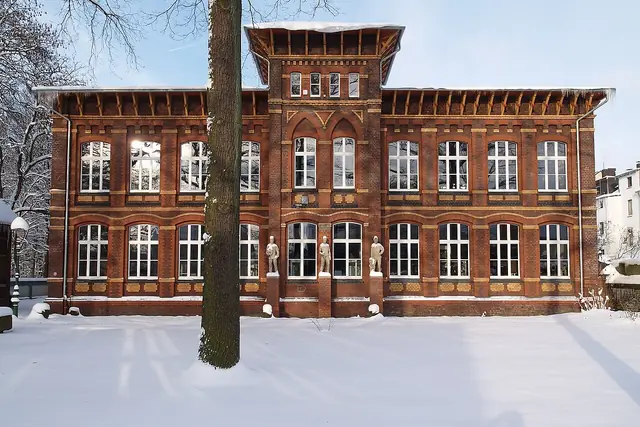
The building on Cranger Straße in Gelsenkirchen-Erle was built in 1907 as a police station. After the police moved into an annex in 1932, a savings bank branch moved into the main building. From 1933, the Buer-Erle local group leadership of the NSDAP and the local SA used the first floor. In one room, which served as an office and later as a training room, they had the party's 25-point programme painted on the wall as an inscription.
After the end of the war, the inscription was painted over and forgotten. In the following decades the building again served the savings bank and the police, and at times also the residents' registration office, a sewing workshop and a district library. The wall inscription only came to light again in summer 1986. The city council then decided to set up a documentation centre at this authentic site; the conversion was funded by the state of North Rhine-Westphalia. It opened on 8 May 1994.
In 2014/15, the permanent exhibition was completely revised and reopened on 8 May 2015. In seven rooms, it traces how National Socialism gained a foothold in the industrial city, how exclusion, persecution and war shaped everyday life, and how the city dealt with this past after 1945. The Institut für Stadtgeschichte (Institute for Urban History) also uses the building for tours, seminars, project support and events, and maintains a reference library there.
Key themes
- Rediscovered wall inscription with the NSDAP party programme at the authentic site
- Permanent exhibition in seven rooms from the rise of the NSDAP to the post-war period
- Former police station from 1907
- Free tours, seminars and reference library
Permanent exhibition
- Gelsenkirchen im Nationalsozialismus – Exhibition redesigned in 2015 in seven rooms, showing the rise, “Gleichschaltung” (forced coordination), Volksgemeinschaft (people's community), persecution, war and the post-war period using the example of Gelsenkirchen.
- Founded
- 1994
- Operated by
- Stadt Gelsenkirchen – Institut für Stadtgeschichte
Admission & discounts
Admission is free.
Visits, tours, events and other offerings are free of charge.
Accessibility
The museum hasn’t published any information on this.
Kids & families
Only partly suitable for kids
The exhibition is aimed at young people and adults; tours and project support are available for school classes.
Getting there & parking
The museum hasn’t published any information on this.
Amenities & dining
The museum hasn’t published any information on this.
Events & venue rental
The museum hasn’t published any information on this.
Plan your visit
| Guided tours | yes |
|---|---|
| School programs | yes |
| Good to know | Tours for school classes, groups and individual visitors by arrangement; also project support, seminars and a reference library. A virtual tour is available on the city's website. |