Goethes Gartenhaus
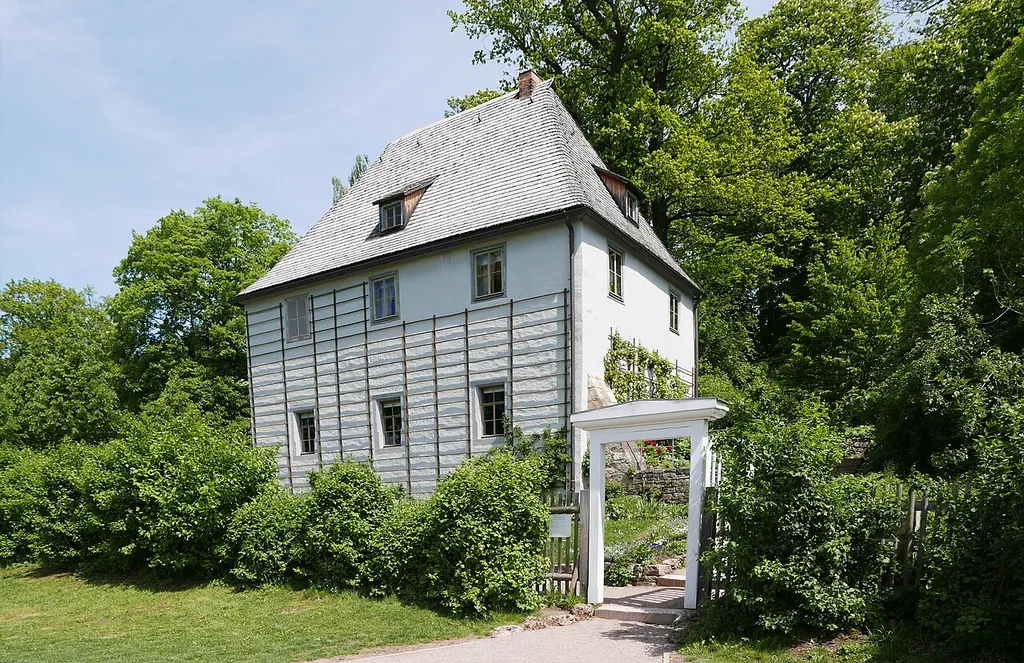
Goethe's first home of his own in Weimar, on the edge of the Park an der Ilm – with original furniture, drawings and the garden with the “Stein des guten Glücks” (Stone of Good Fortune).
About the museum
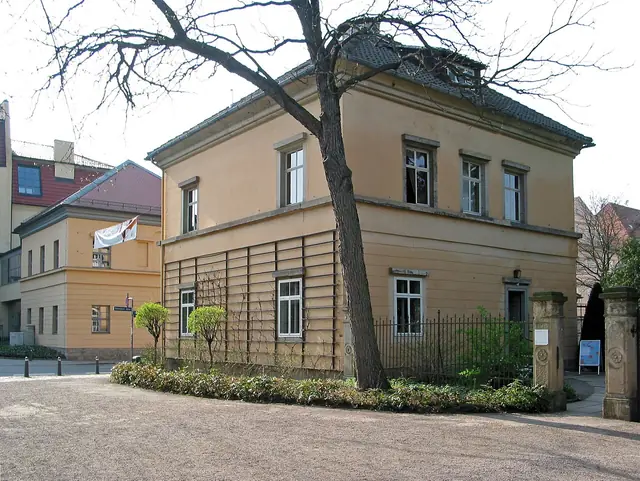
The small house on the slope above the Ilm was probably built in the 16th century as a vineyard house and stood empty and neglected when Duke Carl August acquired it in 1776 and gave it to Goethe. Goethe had it repaired and remodeled; until he moved to the house on Frauenplan in 1782, it was his most important place to live and work. Works written here include the “Erlkönig” and the poem “An den Mond” (To the Moon). In later life, too, he liked to retreat here.
While the building work was underway, Goethe redesigned the overgrown garden: he had the slope terraced, paths and steps laid out, and fruit trees and vegetable beds planted. The division into a shady slope, an orchard meadow and a kitchen garden is still recognizable today. In 1777 the “Stein des guten Glücks”, designed by Goethe and Adam Friedrich Oeser, was set up – one of the earliest non-figurative monuments in Germany.
After Goethe's death, his grandsons opened the house to visitors in 1841; in 1886 it opened as a memorial. During the restoration of 1995/96 the rooms were returned to the colors Goethe had chosen. Today the Gartenhaus belongs to the Klassik Stiftung Weimar and is part of the UNESCO World Heritage Site “Classical Weimar”.
The tour leads through the dining room (“Erdsälchen”) and the kitchen on the first floor and through four rooms on the upper floor that Goethe used for working, living and sleeping. On display are original furnishings such as the standing desk with its “Sitzbock” (saddle stool) and a folding bed, as well as artworks, manuscripts and drawings by Goethe of the surrounding area.
Highlights
- Goethe's study with standing desk and “Sitzbock”
- Where the “Erlkönig” and “An den Mond” were written
- Garden laid out by Goethe with the “Stein des guten Glücks” (1777)
- Original furniture, manuscripts and drawings by Goethe
- Part of the UNESCO World Heritage Site “Classical Weimar” in the Park an der Ilm
Permanent exhibitions
- Goethes Gartenhaus und Garten – Tour through the Erdsälchen, the kitchen and Goethe's study, living room and bedroom with original furniture, manuscripts and drawings, plus the garden designed by Goethe.
- Founded
- 1886
- Operated by
- Klassik Stiftung Weimar
Admission & discounts
| Adults | €8 |
|---|---|
| Reduced | €6University students (except distance learners), people with a severe disability, federal volunteers and voluntary military service members, apprentices, the unemployed, artCard holders |
| Children & teens | €3free up to age 15 · Free admission until the 16th birthday and for school classes up to grade 10; school students aged 16 to 20 pay €3. |
| Seniors | –No senior discount. |
| Visitors with disabilities | €6companion free · Reduced with a severe disability ID (Schwerbehindertenausweis); one medically recognized companion is admitted free. |
| Students & apprentices | €6University students reduced (does not apply to distance learners). |
| Groups | –Group tickets via the Klassik Stiftung's online group form. |
| Families | –No family ticket; children and teenagers under 16 are admitted free. |
| MuseumsCard (annual pass, all Klassik Stiftung venues) | €49reduced €29, school students €19, partner card (2 people) €79; guided tours included |
Free admission: Foundation-wide free admission days: International Women's Day (March 8) and Buß- und Bettag (Day of Repentance and Prayer, November 18, 2026; the Gartenhaus is then closed for the winter)
Tickets online with a time slot or on site. Free admission with the weimar card, for refugees and for ICOM and DMB members. Reduction rules as per the foundation-wide ticket page.
Accessibility
- Wheelchair accessible: not available
- Elevator: not available
- Accessible restroom: not available
- Accessible parking: not available
- Service dogs welcome
- Tactile models & exhibits: no information
- Sign language tours: no information
- Easy-to-read materials
- Audio description: no information
Not wheelchair-accessible: no direct vehicle access, several steps at the entrance and in the grounds, narrow front door, no elevator and no wheelchair-accessible restroom. Offerings for people with hearing and visual impairments and in plain language (also in the Weimar+ app); guided tour for groups of blind or visually impaired people available. Assistance dogs allowed (dog socks at the ticket desk).
Kids & families
Great for kids & families
| Kids’ admission | free up to age 15 |
|---|
- Family tours & workshops
- Activity booklet, scavenger hunt or kids’ audio guide
Backpack tour “Abenteuer Garten” (Garden Adventure) through the garden at the Stern for children aged 3 to 7 (with texts to read aloud), available to borrow at the ticket desk from April to October; not step-free.
Getting there & parking
By car
No on-site parking at the museum.
No direct vehicle access and no parking at the house (located in the Park an der Ilm).
- Accessible parking: not available
Amenities & dining
The Park an der Ilm is freely accessible all year round.
Events & venue rental
The museum hasn’t published any information on this – please ask the museum directly.
Plan your visit
| Audio guide | yes (DE) |
|---|---|
| Good to know | Audio guide with stops for all rooms and the garden in the Weimar+ app or as a download. Timed tickets recommended, as the number of visitors per day is limited. |