Photos and letters of Fritz Julius Traugott, a Jewish Berliner who emigrated and was stationed in the former SS villa as a US soldier in 1945; with an audio walk in the garden.
Israeli artist Inbar Chotzen paints over copies of postcards her family wrote from the Theresienstadt ghetto with scenes from the time before the persecution; on the second floor.
About the museum
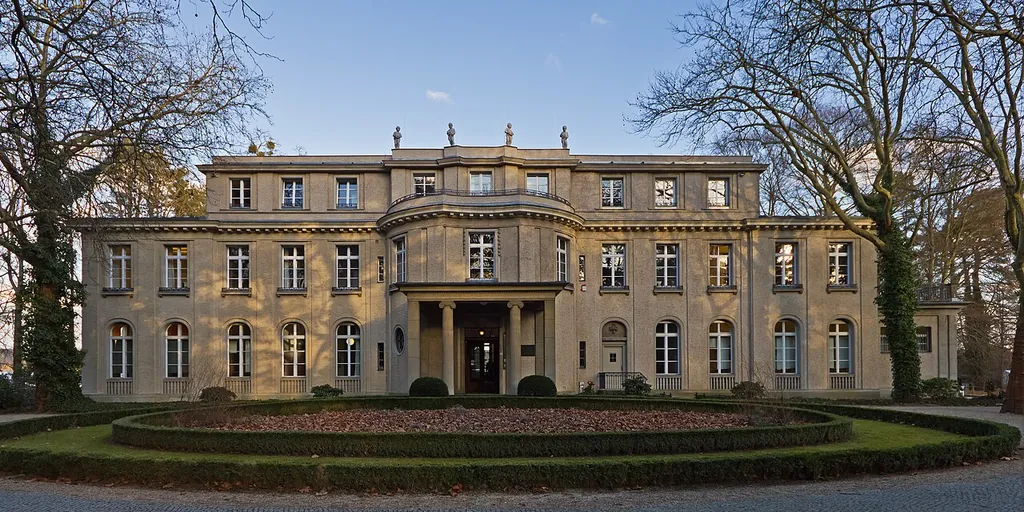
The villa on the shore of the Großer Wannsee lake was built in 1914/15 to designs by architect Paul Baumgarten for the manufacturer Ernst Marlier. In 1921 it was bought by the industrialist Friedrich Minoux. In 1940 the property passed via the SS-owned Stiftung Nordhav foundation to the Sicherheitsdienst (SD, the SS security service), which used it as a guesthouse and conference center.
On January 20, 1942, 15 high-ranking representatives of the SS, the Nazi Party and Reich ministries met here at the invitation of Reinhard Heydrich. They agreed on how their agencies would cooperate in the deportation and murder of Europe’s Jews, which was already underway. The surviving minutes of the meeting are among the central documents of the Holocaust.
After the war, the building was used first by Allied troops and then by the August-Bebel-Institut; from 1952 the Neukölln district ran a school country hostel there. In the 1960s, the historian Joseph Wulf campaigned for a documentation center at this site but failed for lack of political support.
It was not until the 50th anniversary of the conference, on January 20, 1992, that the memorial and educational site opened. The permanent exhibition was redesigned in 2006 and most recently in 2020; it spans the period from exclusion to the treatment of the perpetrators after 1945. In addition to exhibitions in the house and garden, the institution offers seminars, workshops and the Joseph Wulf Library.
Highlights
The original site of the meeting of January 20, 1942
Permanent exhibition in nine rooms on the persecution and murder of Europe’s Jews
Exhibitions in the villa garden on the Großer Wannsee
Audio guide in eight languages, free web app for your own smartphone
Joseph Wulf Library on the history of National Socialism and the Holocaust
Permanent exhibitions
Die Besprechung am Wannsee und der Mord an den europäischen Jüdinnen und Juden – Opened in 2020, the main exhibition on the first floor traces the path from exclusion to mass murder across nine rooms and examines how those involved were dealt with after 1945.
20. Januar 1942. Und heute? – Bilingual exhibition in the villa garden, set up for the 80th anniversary of the conference, that asks what the site means for the present.
Founded
1992
Operated by
Erinnern für die Zukunft – Trägerverein des Hauses der Wannsee-Konferenz e. V.
Director
Deborah Hartmann
Admission & discounts
Admission is free.
Children & teens
–Free admission; recommended for ages 14 and up
Seniors
–Free admission
Visitors with disabilities
–Free admission
Students & apprentices
–Free admission; educational programs for university students are free
Groups (10+ people)
–Free admission; registration required for 10 or more people. Group tour (90 min.) per group: up to 15 people €45, 16–30 people €90, 31–50 people €120; workshops €75/€150, seminars €90/€180. Free for school classes from 9th grade up, apprentices and university students.
Families
–Free admission
Audio guide (rental device)
€3In eight languages; free as a web app on your own smartphone
Exhibitions and garden are free; no tickets required. For groups without their own income, the memorial waives fees by arrangement.
Accessibility
Partially wheelchair accessible
Elevator
Accessible restroom
Accessible parking: no information
Service dogs welcome
Tactile models & exhibits
Sign language tours
Easy-to-read materials
Audio description
Ramp at the main entrance; the permanent exhibition on the first floor is wheelchair-accessible, with display cases you can roll under. The heritage-listed elevator to the upper floors is too small for larger wheelchairs, and the villa garden is only partly accessible. Low-barrier restroom, free loaner wheelchair. Tactile floor guidance system, touchable exhibits and floor plans; media guide with audio description, transcripts, German Sign Language (DGS) videos and a DGS highlights tour; content in Easy Language; induction listening devices in the exhibition. Certified under “Reisen für Alle” (Travel for All).
Kids & families
Only partly suitable for kidsRecommended for ages 14+
Time needed
approx. 1.5 hrs
Family tours & workshops: not available
The memorial recommends visiting from age 14; educational programs are aimed at groups from 9th grade.
Getting there & parking
By public transit
Haus der Wannsee-Konferenz (Bus 114)
S1 or S7 to S-Bahnhof Wannsee, then bus 114 toward Heckeshorn (fare zone AB); located on the signposted Wannsee–Babelsberg bike path.
From downtown Berlin about 45 minutes by S-Bahn or regional train and bus 114, depending on connections.
No café for individual visitors, only a drinks vending machine; catering for booked seminars and workshops on request. Pets are not allowed in the building; leashed dogs are allowed in the park. Exhibition catalog in eight languages (€8.50).
Events & venue rental
The museum hasn’t published any information on this – please ask the museum directly.
Plan your visit
Guided tours
yes · approx. 1.5 hrs
Audio guide
yes (DE, EN, HE, FR, AR, IT, PL, ES)
School programs
yes
Photography
Photography for private purposes is allowed as long as other visitors are not disturbed; filming only with prior permission.
Good to know
Allow about 1–1.5 hours for the permanent exhibition; the audio guide takes about 60 minutes. Group tours (90 min.) by online booking only: 10–30 people at 10:00 and 12:00, 10–50 people at 14:00 and 16:00; depending on availability in German, English, Hebrew, French, Italian or Dutch. Educational programs (workshops, seminars) for 9th grade and up. Groups of more than 10 people should register even without a tour.