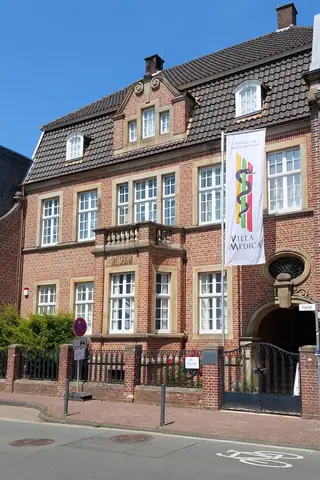
Medical and pharmacy museum Villa Medica in a town villa in the center of Rhede – with an old Hirsch-Apotheke, dentist’s office and the history of nutrition.
A Dutch artists' collective from Noordwijk shows painting, graphic art, ceramics, mixed media and basketry with nine members and friends; the members see themselves as modern craftspeople.
About the museum
The idea for a medical museum in Rhede arose in the 1980s. After about eight years of collecting and renovation work, the Heimat- und Museumsverein (local history and museum association) opened the museum on July 2, 1993. The foundation was the furnishings of the old Rhede Hirsch-Apotheke, donated by the pharmacist family.
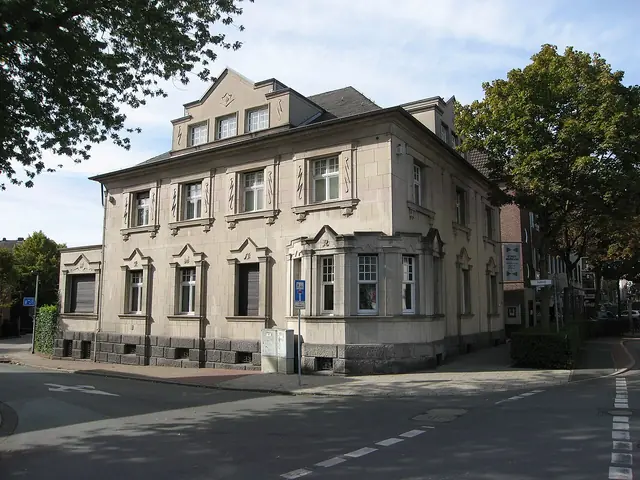
The museum is housed in a listed neo-Baroque townhouse that Gertrud and Bernhard Harde had built on the market square in 1923, now known as Villa Medica. The furnishing was financed with funds from the state, the European Community, the museum office, the Borken district, and the town.
After almost three decades, the exhibition was fundamentally renewed: from fall 2022 the museum remained closed, and on June 14, 2025 it reopened with a new design, digital media stations, elevators, and the additional theme of nutrition. A large part of the work was done by volunteers, with professional support from the hospital, doctors, pharmacists, midwives, and the University of Münster.
The tour across three floors tells the rural medical history of the 19th and 20th centuries, from the country doctor through pharmacy, drugstore, dentist, and midwife to nursing, hospital, and diagnostics. The fictional Rheesing family accompanies visitors through the rooms over four generations.
Highlights
Original furnishings of the historic Rhede Hirsch-Apotheke
Reconstructed dentist's office of the 19th and 20th centuries
Media stations on the fictional Rheesing family over four generations
New section on the history of nutrition from the 19th century to today
Children's time journey "Die Suche nach der Wund-Wundersalbe" (The Search for the Wonder-Wonder Ointment)
Permanent exhibitions
Medizinische Dauerausstellung – Tour across three floors through rural medical history with the country doctor, pharmacy, drugstore, dentist, midwife, nursing, and hospital; the fictional Rheesing family guides visitors through the building via media stations.
Ernährung im Wandel der Zeit – A dedicated section showing how eating habits have changed from the 19th century to today.
Founded
1993
Operated by
Heimat- und Museumsverein Rhede e.V.
Director
André Grunden
Admission & discounts
Adults
€5
Reduced
€3School students (ages 6–16), trainees, university students, and people with disabilities (each with ID)
Children & teens
€3School students aged 6 to 16 pay €3.
Visitors with disabilities
€3With ID
Students & apprentices
€3Trainees and university students with ID
Groups (10+ people)
€4 per personAdults in groups of 10 or more
Families
€122 adults with at least one child under 16
Guided tour flat fee (1–15 people, approx. 90 min.)
€40plus admission; by registration only
Special exhibition (only during special exhibitions)
€3
Accessibility
Wheelchair accessible
Elevator
Accessible restroom
Accessible parking: no information
Service dogs welcome: no information
Tactile models & exhibits
Sign language tours: no information
Easy-to-read materials: no information
Audio description: no information
Low-barrier entrance with an elevator at Burgplatz; all exhibition areas can be reached by elevator. Accessible toilet and tactile offerings available.
Kids & families
Great for kids & families
Family ticket
€12 · 2 adults with at least one child under 16
Activity booklet, scavenger hunt or kids’ audio guide
With a time machine and an activity booklet, elementary school children and families go in search of the "Wund-Wundersalbe" (Wonder-Wonder Ointment) (about 1 hour, included in admission, no registration, in German, English, and Dutch).
Getting there & parking
By public transit
Gudulakirche · 2-min walk
Bus R51 (from Bocholt or Borken/Coesfeld) to "Gudulakirche"; express bus S75 (Bocholt–Münster) to "Ludgerusschule", then about a 10-minute walk. Nearest train stations: Bocholt and Borken.
In the town center, diagonally across from the parish church of St. Gudula. Within Rhede, also by Bürgerbus (community bus) on weekdays (destination "Gudulakirche"). Wheelchair-accessible entrance at Burgplatz.
Tours by registration only (preferably 2–3 weeks in advance), max. 15 people, in German only; also outside opening hours by arrangement. Offerings for schools and experimental programs for school classes are not currently taking place; corresponding programs are in development. Please do not bring pets.