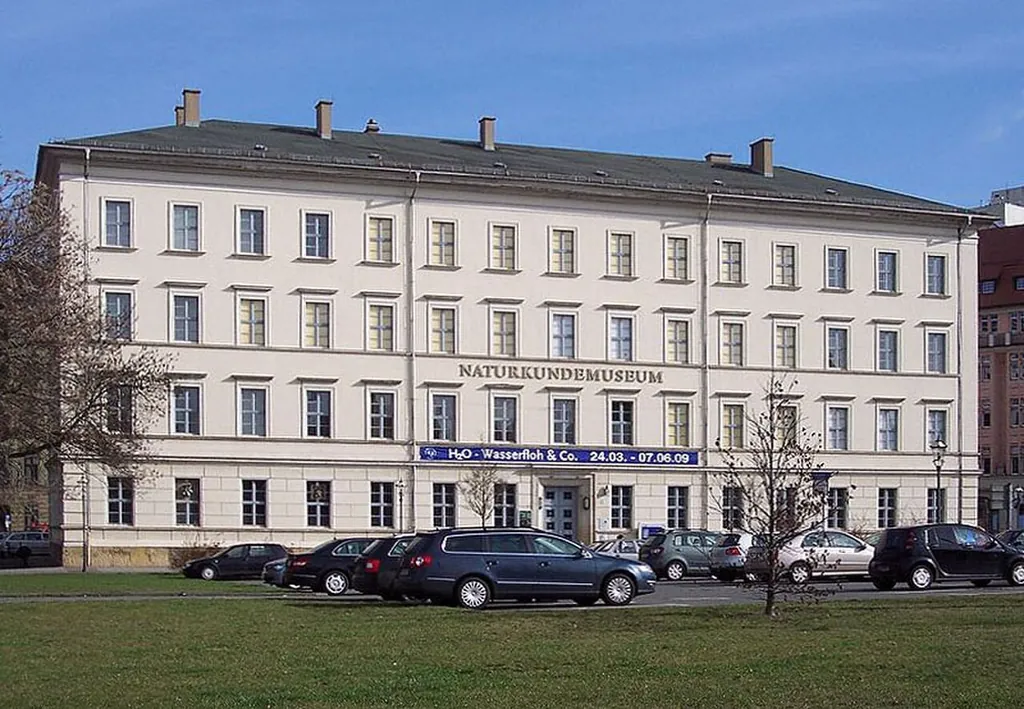
Municipal natural history museum with dioramas, prehistory and early history, and the world's largest ter Meer collection – ahead of its move to a new building, free admission.
Third part of the farewell series: fossils and rocks from the collection tell of 600 million years of Earth's history and offer insights into the work of the specialist department.
About the museum
Members of the natural science association of the Leipzig teachers' society founded the museum in 1906, building on the ideas of the naturalist and popular educator Emil Adolf Roßmäßler. In 1912 it opened as the Naturkundliches Heimatmuseum on the Tröndlinring; in 1923 it moved into the building of the former II. Höhere Bürgerschule (secondary school) on Lortzingstraße, built in 1837–1839, which it still uses today. In 1930 the city of Leipzig took over as its operator.
During the redesign of 1937–1942, the Leipzig artist Emil Block created murals in the stairwell. After World War II the holdings that had been moved to safety were brought back; from the 1960s the museum was for a time known as the Naturwissenschaftliches Museum, and it has borne its current name since 1987.
The treasures of the collection include the world's largest collection of animal specimens and sculptures by the Dutch taxidermist Herman H. ter Meer, ornithological holdings, specimens of extinct species, and archaeological finds from northwestern Saxony. The permanent exhibition, covering around 800 square meters, is characterized by its dioramas. In 2021 the museum received the Saxon Museum Prize.
Because the old building is too small and barely accessible, the museum is moving into the converted former Bowlingtreff on Wilhelm-Leuschner-Platz. Construction has been underway since 2025/26, with an opening expected in 2029 at the earliest. Until then, the museum is bidding farewell to its old location with the eight-part exhibition series "Das Haus mit der Spinne" (The House with the Spider).
Highlights
The world's largest collection of specimens by the dermoplastic taxidermist Herman H. ter Meer
Numerous dioramas with animals from the region and distant lands
Female figurine of Wehlitz from the Linear Pottery culture
Paleolithic flint artifacts from the Markkleeberg site
Specimens of extinct animal species
Permanent exhibitions
Dauerausstellung mit Dioramen – Around 800 square meters on the second and third floors show animals and plants in naturalistic dioramas as well as a cross-section of the collections.
Ur- und Frühgeschichte – Chronological tour through the prehistory and early history of northwestern Saxony from the Paleolithic to the first centuries AD.
Founded
1906
Operated by
Stadt Leipzig
Director
Prof. Dr. Ronny Maik Leder
Admission & discounts
Admission is free.
Groups
–Guided tours for daycare and school groups (60 min.) €2 per child, accompanying adults free; optional creative program €1 extra.
Since January 1, 2024, admission to the permanent and special exhibitions has been free; museum education programs are charged according to the City of Leipzig's fee schedule.
Accessibility
Partially wheelchair accessible
Elevator: not available
Accessible restroom: not available
Accessible parking
Service dogs welcome
Tactile models & exhibits
Sign language tours: no information
Easy-to-read materials: no information
Audio description: no information
No elevator: wheelchair users can only visit the special exhibition on the first floor. Separate entrance with a ramp after advance notice by phone (0341 982210). No dedicated accessible restroom; the existing restrooms can only be used with small wheelchairs. Coat check and lockers are accessible. Guided tours with touch objects for visitors with visual or mobility impairments, as well as individual tours for visitors with hearing impairments.
Kids & families
Great for kids & families
Family tours & workshops
Hands-on stations
Kids’ birthday parties
Animal pelts, skulls, bird nests, and eggs to touch. Children's birthday parties (90 min., from age 5 to 8 depending on the theme, max. 10 children); family tours and holiday programs according to the program.
Getting there & parking
By public transit
Goerdelerring
Tram 1, 3, 4, 7, 9, 12, 14, 15 to Goerdelerring; about a 5-minute walk from the main train station.
Museum shop at the ticket desk (minerals, books). Backpacks must be placed in the lockers on the first floor; leave bike trailers in front of the museum. Dogs are not allowed, except assistance dogs.
Events & venue rental
The museum hasn’t published any information on this – please ask the museum directly.
Plan your visit
Guided tours
yes · approx. 60 min
School programs
yes
Good to know
One-hour guided tours and school projects can be booked via service.naturkundemuseum@leipzig.de; tours in English and for groups with special needs on request. Public events according to the bimonthly program.