Joint exhibition with the association Weimarer Mal- und Zeichenschule marking the 250th anniversary of the school, founded in 1776 as the Freie Zeichenschule (Free Drawing School).
About the museum
The museum's roots lie in private 19th-century collections, above all that of Bruno Schwabe. In 1889 these became the basis of a natural history museum run by the Naturwissenschaftlicher Verein (natural science society), housed first in a school behind the Stadtkirche and from 1892 in the Posecksches Haus. In 1903 the city of Weimar took over the institution – which is why it is considered the oldest city museum in Thuringia.
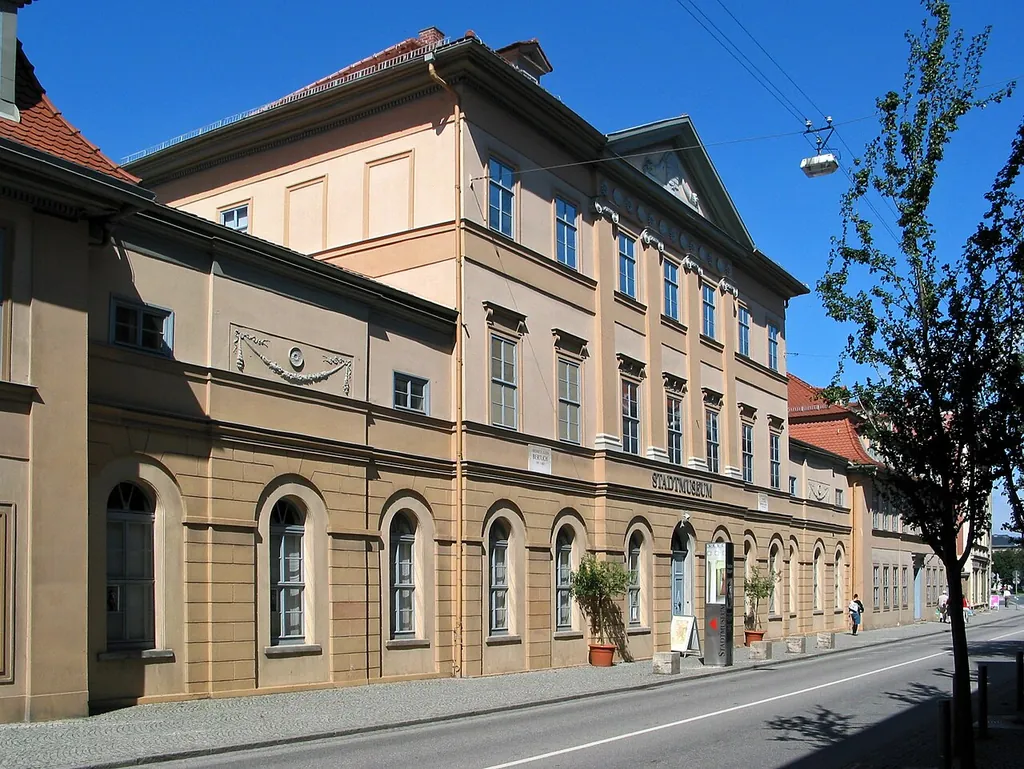
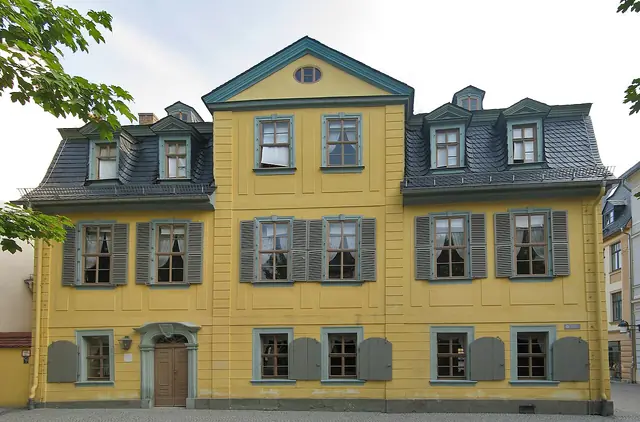
Since 1954/55 the museum has been located in the Bertuchhaus on what is now Karl-Liebknecht-Straße. The neoclassical residential and commercial building was constructed in two phases between 1780 and 1803 for Friedrich Justin Bertuch, a writer, publisher, and one of the most important entrepreneurs in Weimar during Goethe's time. Later his descendants from the Froriep family lived here; the last resident was the painter Bertha Froriep.
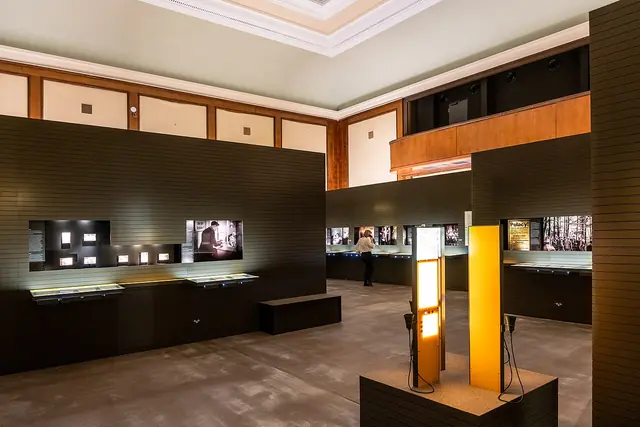
The permanent exhibition on two floors explores selected chapters of the city's history: the lives of the Bertuch and Froriep families and their publishing business, middle-class everyday life since the late 18th century, the economy and technology, and the National Assembly that met in Weimar in 1919. Separate sections commemorate the court photographer and cinema pioneer Louis Held and the graphic design studio of Alexander Olbricht. The collection also includes an important textile collection and the artistic estate of the painter Alfred Ahner. On the first floor, the museum shows special exhibitions, a film on the city's history, and a tactile model of the city.
Highlights
The neoclassical Bertuchhaus as the museum building
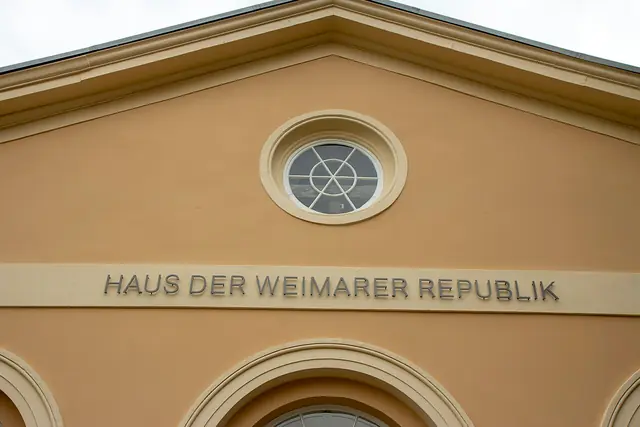
Exhibition section "Demokratie aus Weimar. Die Nationalversammlung 1919"
Living quarters from the time of Friedrich Justin Bertuch around 1800
Court photographer and cinema pioneer Louis Held
Film "Weimar. Mythos und Wahrheit" on the city's history
Tactile model of Weimar
Permanent exhibitions
Stadtgeschichte im Bertuchhaus – Two floors on Weimar's everyday life, economy, and technology since the late 18th century – with living quarters from Bertuch's time, middle-class interiors, mechanical musical instruments, and early vehicles.
Demokratie aus Weimar. Die Nationalversammlung 1919 – Focus of the permanent exhibition on the constituent assembly that met in Weimar in 1919 and on the city during the Weimar Republic.
Founded
1903
Operated by
Stadt Weimar
Admission & discounts
Adults
€3
Reduced
€1.50Students, people doing civilian or military service, unemployed people, people with severe disabilities, retirees, asylum seekers
Children & teens
–Children and school students are admitted free until the end of compulsory schooling.
Seniors
€1.50Retirees pay the reduced price.
Visitors with disabilities
€1.50Reduced with a severe disability ID (Schwerbehindertenausweis).
Students & apprentices
€1.50Students pay the reduced price.
Groups
€1.50 per personRegistered groups pay the reduced admission per person plus a €25 tour fee. School groups visiting as part of lessons: admission and guided tour free.
Annual pass
€10.50reduced €5.50
Guided tour for individual visitors (plus reduced admission)
€3reduced €1
All prices include a €0.50 culture promotion levy (Kulturförderabgabe). Free admission with the weimar card, for overnight guests who pay Weimar's culture promotion levy, and for ICOM members and members of the friends' association. The combination ticket with the Kunsthalle Harry Graf Kessler (€4, reduced €2) is currently not relevant, as the Kunsthalle is closed.
Accessibility
Partially wheelchair accessible
Elevator: no information
Accessible restroom
Accessible parking: no information
Service dogs welcome: no information
Tactile models & exhibits
Sign language tours: no information
Easy-to-read materials: no information
Audio description: no information
Only the first floor, with special exhibitions, lecture hall, film, and museum education, is accessible; the permanent exhibition on the upper floors is not. Doorbell to the left of the entrance for help with the double door; narrowest passage 80 cm. Wheelchair-accessible restroom on the first floor. Tactile city model with descriptions in German, English, and Dutch in the winter garden. No induction loop in the lecture hall.
Kids & families
Great for kids & families
Family tours & workshops
Activity booklet, scavenger hunt or kids’ audio guide
Kids’ birthday parties
Museum activity sheets for puzzles, search games, and coloring (also printable), hands-on tours, and holiday tours according to the events calendar. Children's birthday parties and family programs by arrangement with the museum education team.
Getting there & parking
By public transit
Goetheplatz · 50 m
Goetheplatz stop (almost all city buses, including lines 1 and 7, and many regional buses), about 50 m away. About a 10-minute walk from the main train station (Hauptbahnhof).
By car
Parking available · 50 m to the entrance
No museum parking. According to the accessibility page, parking is available at Rollplatz (about 50 m) or in the Atrium underground parking (about 200 m); the directions page lists the parking garage at the Weimarhalle and the Weimar-Atrium parking garage in the immediate vicinity.
By car, follow the signs toward the city center (Stadtmitte).
Museum shop with catalogs, Weimar publications, and calendars.
Events & venue rental
The museum hasn’t published any information on this – please ask the museum directly.
Plan your visit
Guided tours
yes
School programs
yes
Good to know
Guided tours and workshops through the education officer (+49 3643 826033). On the first floor, the 28-minute film "Weimar. Mythos und Wahrheit" covers the city's history from the prehistoric Ehringsdorf man to the present.