Foyer display case marking the 100th birthday of the conductor and composer Hans Auenmüller, who shaped the Halberstadt Theatre from 1954. Documents, photographs, scores and objects from his estate are shown, including his baton.
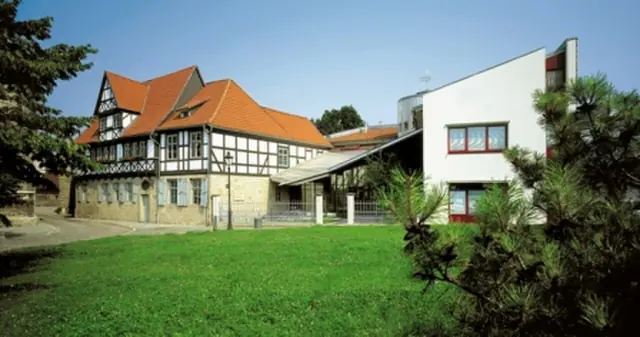
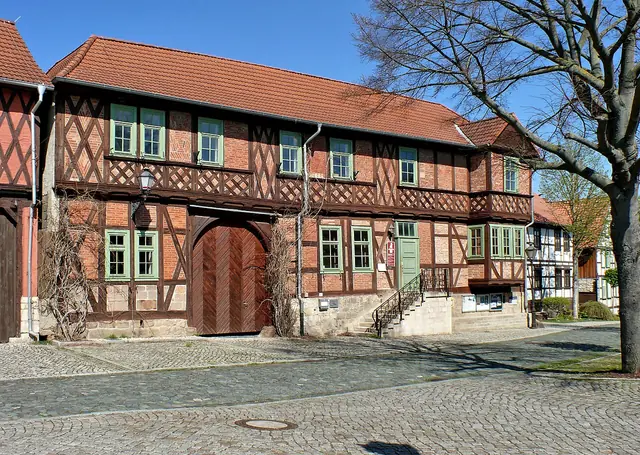
Exhibition of the Volksbund Deutsche Kriegsgräberfürsorge in the Schraube-Museum. Using historical and current conflicts, it asks how lasting peace can emerge from the end of a war, and addresses justice, reconciliation and remembrance.
Retrospective of the artist and author Karl Anton, who died in 2025, with central series of works, some of them long unseen and shown publicly for the first time. On view in the Schraube-Museum.
About the museum
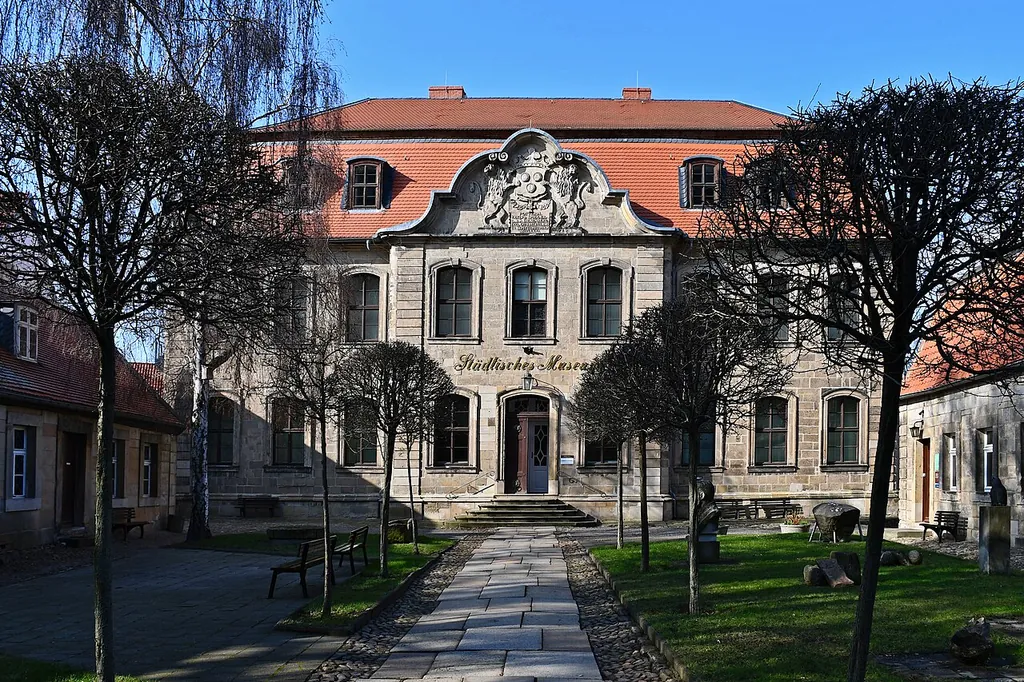
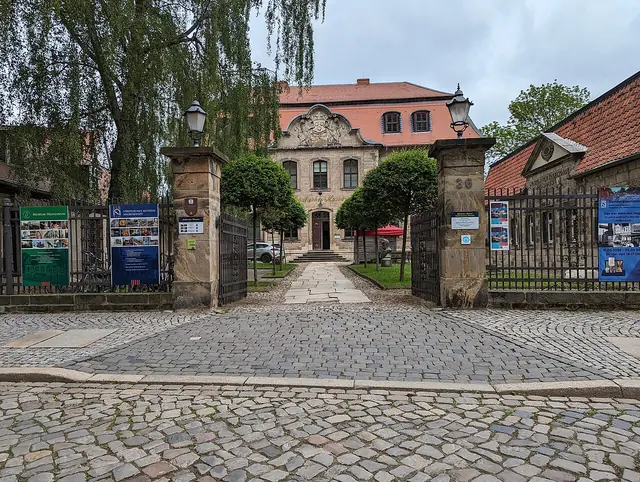
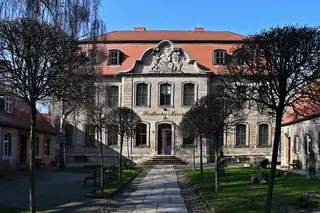
The Städtisches Museum traces its origins to considerations around 1900 about bringing together the growing collections on the history of the town and the northern Harz foreland and displaying them permanently. In 1904, the town bought the Spiegelsche Kurie on Domplatz, a Baroque house completed in 1782, which the cathedral dean Ernst Ludwig Christoph von Spiegel zum Diesenberg had built. The museum opened there as early as 1905. Its first head was the teacher August Hemprich, who was appointed the first full-time museum director in 1925.
Valuable holdings were lost in the bombing raid of April 8, 1945, and others are still considered missing today. The museum reopened on June 21, 1946. In the 1950s, the portrayal of the workers' movement moved strongly into the foreground; after 1989, the house once again became a place that shows the entire history of the town and of the Prince-Bishopric of Halberstadt.
Today, the permanent exhibition covers the early traces of the region, Halberstadt as a cathedral town, the emergence of the town, and the 20th century. Two large town models show Halberstadt before and after its destruction; in addition, there are a historic pharmacy and a room on the Franco-Prussian War. The museum also includes the Schraube Museum, the half-timbering exhibition in the cloister of the Liebfrauenkirche, the Martini towers, and the Chess Museum in Ströbeck.
Highlights
Spiegelsche Kurie from 1782 on Domplatz
Large historic town model and model of destroyed Halberstadt
Historic pharmacy
Halberstadt as a cathedral town and bishop's seat
Halberstadt in the 20th century
Permanent exhibitions
Halberstadt als Domstadt – The exhibition covers the founding of the bishopric and Halberstadt's role as a cathedral town.
Historisches Großmodell der Stadt – A large town model shows Halberstadt in miniature; a second model records the town's destruction in 1945.
Historische Apotheke – The furnished historic pharmacy is one of the house's special rooms.
Founded
1905
Operated by
Stadt Halberstadt
Director
Dr. Antje J. Gornig
Admission & discounts
Adults
€7
Reduced
€5School pupils, apprentices, students, volunteer service participants, recipients of unemployment benefit I (ALG I), severely disabled persons (degree of disability 50 or higher), groups of 10 or more people, holders of the Sozialpass, the Halberstadt guest card (HATIX), or the combined card of the Halberstadt museums
Children & teens
freefree up to age 17 · Children and young people up to age 18 are admitted free.
Visitors with disabilities
€5companion free · Reduced admission from a degree of disability (GdB) of 50; a companion is admitted free if noted on the severe disability ID (Schwerbehindertenausweis).
Students & apprentices
€5
Groups (10+ people)
€5 per personReduced admission for groups of 10 or more people. Booked guided tour for up to 20 people: €40 plus admission; school class guided tour for up to 30 people: €30, including accompanying adults.
Surcharge for special exhibitions (up to)
€4per person
Free admission:Free admission for all visitors on the last Friday of each month.
Admission applies to each individual site (Städtisches Museum, Schraube Museum, Museum Heineanum). With the combined card of the Halberstadt museums (valid for 12 months), you pay the full price at the first site and the reduced price at all others. Admission is free with, among others, the HarzCard, the city's Kulturpass, a press ID, for recipients of transfer benefits, for newcomers to the city, and for members of the friends' associations. Cloister of the Liebfrauenkirche: free admission.
Accessibility
The museum hasn’t published any information on this.
Kids & families
Great for kids & families
Kids’ admission
free up to age 17
Family tours & workshops
Kids’ birthday parties
Museum education for kindergartens, school classes, and after-school groups, holiday programs, and children's birthday parties (flat fee of €30 for up to 10 people, plus material costs). Children and young people up to age 18 are admitted free.
Getting there & parking
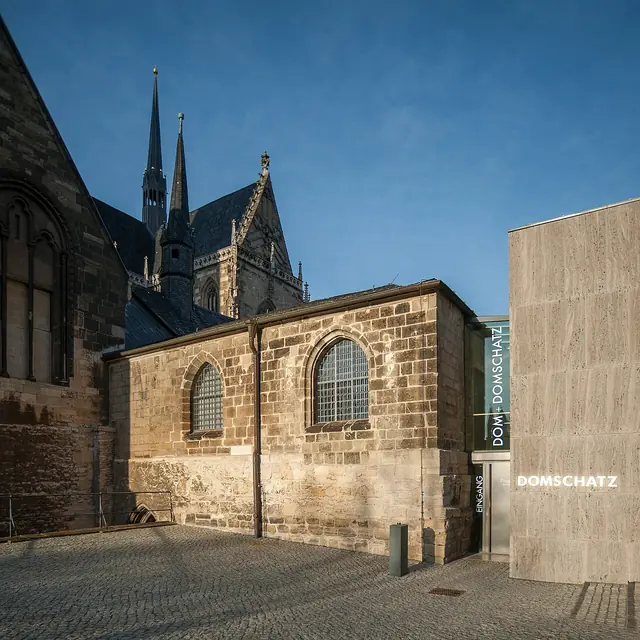
The museum is in the center of Halberstadt, right by the cathedral, at Domplatz 36.