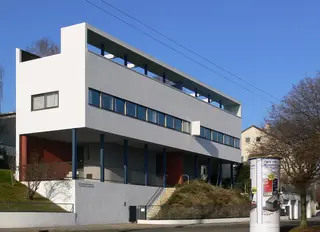
Museum in Le Corbusier's UNESCO World Heritage double house, telling the story of the 1927 Weissenhofsiedlung – with a reconstructed apartment and roof garden.
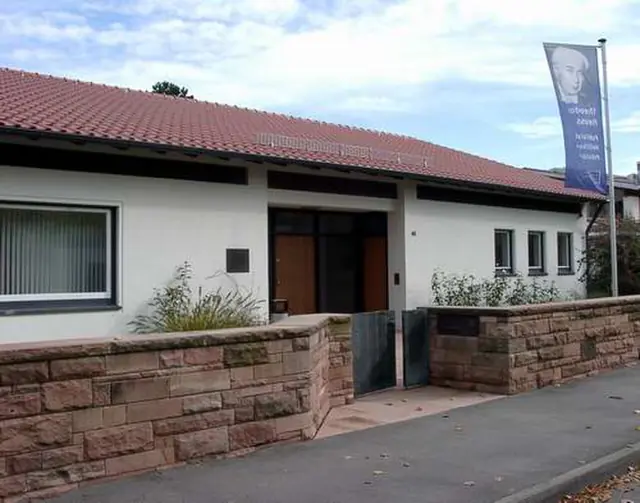
Students from the class of Choi at the Staatliche Akademie der Bildenden Künste Stuttgart show sculptural works in the Weissenhof Workshop in the Haus Mies van der Rohe; the title alludes to the Werkbund poster for the 1927 exhibition “Die Wohnung”.
About the museum
The Weissenhofsiedlung was built on Stuttgart's Killesberg hill in 1927 for the Werkbund exhibition "Die Wohnung" (The Dwelling), with 17 modernist architects taking part. Le Corbusier and Pierre Jeanneret designed a double house on Rathenaustraße and a neighboring single-family house for it. After the exhibition the city rented out the houses; under National Socialism the estate was denounced, and ten houses were destroyed in World War II.
The estate has been a protected monument since late 1958 and was first renovated in the 1980s. In 2002 the City of Stuttgart bought the double house back from the federal government; with support from the Wüstenrot Stiftung it was painstakingly restored and opened as a museum on October 25, 2006. In 2016 UNESCO added the double house and the neighboring house to the World Heritage List as part of Le Corbusier's architectural work.
The two halves of the house tell different stories. On the left, models, plans and photos trace the creation of the estate and its architects in chronological order – from the founding of the Werkbund in 1907 to the opening of the museum. The right half has been returned to its 1927 state and lets visitors experience Le Corbusier's adaptable living concept, with sliding walls, pull-out beds and a narrow corridor like a sleeping car. The roof garden offers views over the city.
The museum is run by the association Freunde der Weissenhofsiedlung (Friends of the Weissenhof Estate). For the 100th anniversary in 2027, the Weissenhof.Forum visitor center, with exhibition space, a children's workshop, a shop and a café-restaurant, is being built at the entrance to the estate.
Highlights
Double house by Le Corbusier and Pierre Jeanneret, a UNESCO World Heritage Site since 2016
Reconstructed "transformable" apartment from 1927 with sliding walls and folding beds
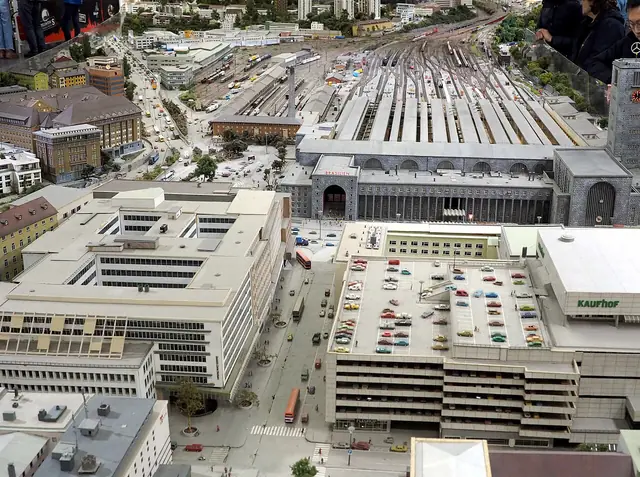
1:100 scale model of the Weissenhofsiedlung
Roof garden with a covered promenade
Starting point for walks through the freely accessible Weissenhofsiedlung
Permanent exhibitions
Geschichte der Weissenhofsiedlung – In the left half of the house, models, plans, photos and objects chronologically tell the story of the 1927 Werkbund exhibition, its 17 architects and the later fate of the estate.
Das transformable Haus von Le Corbusier – The right half of the house has been returned to its 1927 state with furniture, colors and an adaptable floor plan – including a library with information on Le Corbusier in Stuttgart and the roof garden.
Founded
2006
Operated by
Freunde der Weissenhofsiedlung e. V.
Director
Verena Lebherz
Visitors per year
approx. 28,917 (2024)
Admission & discounts
Adults
€6.50
Reduced
€3School students, apprentices, university students, recipients of unemployment benefits (ALG I, ALG II) and social assistance, people with disabilities
Children & teens
€3free up to age 10 · Children free until their 11th birthday.
Visitors with disabilities
€3
Students & apprentices
€3Students of the Stuttgart Academy of Art and Design (Kunstakademie Stuttgart) free.
Groups (15+ people)
€6 per personGroups of 15 or more receive a €0.50 discount per person; please register visits by groups of 10 or more in advance.
Short tour (approx. 45 min., plus admission)
€6Reduced €4.
Long tour with walk through the estate (approx. 90 min., plus admission)
€8.50Reduced €5.
Free admission with the Museums-PASS-Musées, StuttCard and Bonuscard + Kultur, for refugees and for members of the Freunde der Weissenhofsiedlung association. Booked group tours (max. 20 people) cost €80–140 per group depending on length, plus admission.
The listed building is not accessible: the stairs are narrow and steep, some without handrails; wheelchairs and rollators cannot be taken inside. By arrangement, the museum looks for individual solutions. The Weissenhofsiedlung itself can be visited without barriers.
Kids & families
Great for kids & families
Kids’ admission
free up to age 10
Family tours & workshops
Stroller-friendly: not available
Bookable explorer tour for children aged 8 to 12 (approx. 45 min., max. 15 children, €70 per group, free admission for the children). On the website, a short film follows a girl named Emma through the museum. Strollers are not allowed because of the narrow stairs and can be left on the entrance terrace.
Getting there & parking
By public transit
U5 toward Killesberg to the Killesberg stop; bus 44 toward Killesberg to the Kunstakademie stop.
By car
Parking available
Parking around the estate is scarce; the museum recommends the Killesberghöhe underground parking and the Kunstakademie/Am Weißenhof parking garage. Tour buses stop at Friedrich-Ebert-Straße 110 (enter this address into your GPS); the narrow streets of the estate are unsuitable for large vehicles.
Arriving by public transport is recommended. Tour groups should leave bags and backpacks on the bus.
Small museum shop with publications, posters and postcards. Bags are not allowed in the exhibition and are stored in lockers or at the reception desk; lockers are limited.
Events & venue rental
Spaces for rent
Weddings / ceremonies
Civil wedding ceremonies on the roof terrace or in the adaptable living room for up to 15 guests plus the couple, only on Fridays 9:00–10:00 or 10:00–11:00 outside opening hours; fee €535.50.
Permitted for private purposes with a small camera and no equipment; publishing the photos is not allowed. Professional photography only by arrangement outside opening hours.
Dogs
not allowed
Good to know
Public guided tours daily except Mondays at 15:00, plus 11:00 on Sundays and public holidays (German only, max. 20 people, no reservations – tickets on the day at the ticket desk). Choose between the short tour (approx. 45 min.) or the long tour with a walk through the estate (approx. 90 min.). Request booked tours at least two weeks in advance; these are also available in English, French, Italian and Spanish. Exhibition texts in German and English. Bags are not allowed in the museum.