Wendisch-Deutsches Heimatmuseum
Local history museum in Jänschwalde on everyday life, costumes and customs of the Sorbian/Wendish rural population, with a large Lusatian ceramics collection.
Have only individual sections read aloud
About the museum
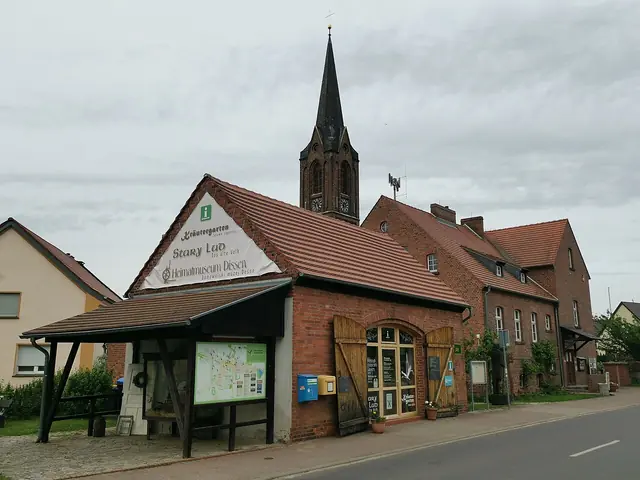
The museum is located in the historic village center of Jänschwalde, directly beside the tower-less classicist village church. The main part of the exhibition is in the rooms of the school building erected in 1875. The restored parsonage barn and an adjacent stable, both from the first half of the 19th century, serve as additional exhibition buildings.
On more than 500 square meters, the house shows the rural life of the Sorbian/Wendish and German population: furniture, household goods and work tools around 1900, photos, and documents on village history, mostly from the holdings of Jänschwalde residents. Labels are bilingual throughout, in Wendish and German. Four rooms in the stable show everyday activities such as washing, churning butter, food storage and flax processing.
More than 40 costumes document clothing across a lifetime, alongside customs of the annual cycle that are still kept alive in the village. A special feature is the Jänschwalder Christkind “Janšojski bog”, a pre-Christmas custom that has survived only in the municipality of Jänschwalde. The parsonage barn holds one of the largest ceramics collections in Lusatia, with more than 1,000 objects from three centuries, as well as a historic hearse and a working loom. A VR headset takes visitors into a documentary film about flax processing about a century ago.
Highlights
- Bilingual exhibition in Wendish and German
- More than 40 original costumes and customs of the annual cycle
- Ceramics collection “Im Feuer geboren” with more than 1,000 objects
- Jänschwalder Christkind “Janšojski bog”
- VR film on flax processing
Permanent exhibitions
- Leben auf dem Lande – Alltag der sorbischen/wendischen Landbevölkerung – Furniture, household goods and work tools show washing, butter churning, food storage and flax processing in village life.
- Trachten, Bräuche, Traditionen – Festive, everyday and work costumes, and customs from the life cycle and the annual cycle, including the Jänschwalder Christkind.
- Im Feuer geboren – Keramiksammlung der Lausitz – More than 1,000 objects from three centuries, mainly salt-glazed stoneware and clay-glazed brown ware, in the restored parsonage barn.
Admission & discounts
| Adults | €2.50 |
|---|---|
| Reduced | €2Trainees, pupils, students and people with severe disabilities |
| Children & teens | €1 |
| Groups | €2 per person |
| Annual pass | €10 |
Accessibility
The museum hasn’t published any information on this.
Kids & families
Great for kids & families
- Family tours & workshops
The museum spirit Kobi tells children stories from earlier times (offer “Mit Kobi ins Museum” of the Lausitzer Museenland).
Getting there & parking
The museum is at Kirchstraße 11 in the center of Jänschwalde, directly next to the village church.
Get directionsAmenities & dining
The museum hasn’t published any information on this.
Events & venue rental
The museum hasn’t published any information on this.
Plan your visit
| Guided tours | yes |
|---|---|
| School programs | yes |
| Good to know | Themed guided tours for school classes and travel groups by prior registration. A VR headset shows a documentary film on flax processing. |