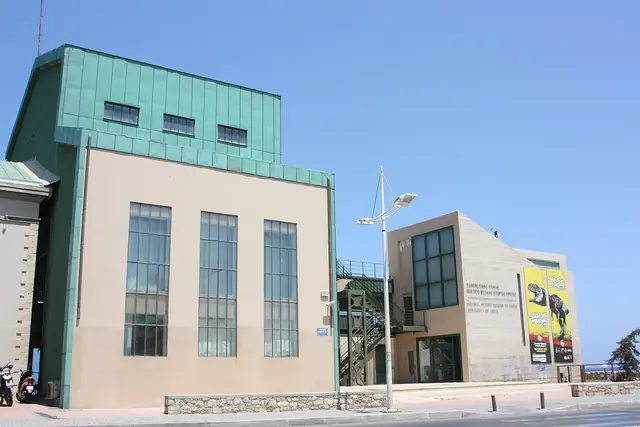
Archaeological Site of Knossos
The largest palace of Minoan Crete, with the Throne Room, the frescoes and the labyrinthine layout of its four wings.
Have only individual sections read aloud
About the museum
Knossos was the centre of Minoan civilisation and was inhabited from the Neolithic period into Roman times. In myth it is linked with King Minos, the Labyrinth and the Minotaur. The first excavations on the Kephala hill were carried out in 1878 by the merchant and antiquarian Minos Kalokairinos, while the systematic research of the British archaeologist Arthur Evans, from 1900 to 1931, brought to light the palace and much of the surrounding town.
The first palace was built around 2000–1900 BC and, after it was destroyed by an earthquake around 1700 BC, it was replaced by an even more magnificent one, the largest on Crete. The multi-storey complex covers about 22,000 m² among olive trees, vineyards and cypresses, and extends over four wings around a spacious central courtyard. It includes the royal apartments, the Throne Room with its alabaster throne, halls for ceremonies and banquets, shrines, storerooms, workshops, cisterns and a small stone-built theatre.
Evans’s extensive reconstructions, with their distinctive red columns, have been considered controversial, but they still shape the picture of the Minoan palace today. In 2025 Knossos was inscribed on the UNESCO World Heritage List together with five other Minoan palaces.
Highlights
- Throne Room with alabaster throne
- Central courtyard and royal apartments
- Frescoes with griffins and dolphins
- Red columns from the reconstruction
- Stone-built theatre
- Operated by
- Υπουργείο Πολιτισμού – Εφορεία Αρχαιοτήτων Ηρακλείου
Admission & discounts
| Adults | €20 |
|---|---|
| Reduced | €10People over 65 from Greece and the EU (with ID card or passport), teachers accompanying school visits and parents accompanying primary school pupils from Greece and the EU. |
| Children & teens | freefree up to age 18 · Free admission for children under 18, with ID card or passport. |
| Seniors | €10Reduced ticket for people over 65 from Greece and the EU, with ID card or passport. |
| Visitors with disabilities | freecompanion free · Free admission for people with a disability (67% and above) and one companion, with ID card or passport and a disability certificate (KEPA or equivalent from abroad). |
| Students & apprentices | freeFree admission for young people aged 18–25 from Greece and the EU, with ID card or passport. |
Free admission: 6 March, 18 April, 18 May, the last weekend of September, 28 October, as well as every first and third Sunday of the month from 1 November to 31 March.
Free and reduced admission also apply to other categories defined by the Ministry of Culture. Tickets are also available online via the Hellenic Heritage platform. The combined ticket for Knossos and the Heraklion Archaeological Museum is valid for three days, with one visit to each site.
Accessibility
- Partially wheelchair accessible
- Elevator: no information
- Accessible restroom: no information
- Accessible parking: no information
- Service dogs welcome: no information
- Tactile models & exhibits: no information
- Sign language tours: no information
- Easy-to-read materials: no information
- Audio description: no information
The site is described as accessible for people with mobility impairments.
Kids & families
The museum hasn’t published any information on this.
Getting there & parking
By public transit
There is a connection by city bus from the city of Heraklion; the journey takes about 20 minutes.
By car
Parking available
From the city of Heraklion the journey by car takes about 15 minutes.
Get directionsAmenities & dining
- Café
- Restaurant
- Museum shop
- Wi-Fi
On site: café and restaurant, shop, Wi-Fi, toilets.
Events & venue rental
The museum hasn’t published any information on this.