Around 1600, drawing underwent a revolution in the northern Netherlands, driven by artists such as Goltzius, De Gheyn and Bloemaert. More than 100 highlights from European and American collections are on show.
A major drawing exhibition devoted to the work of Rotterdam-born Willem de Kooning, complemented by famous paintings and sculptures. Over 120 works show how his drawing developed over more than 65 years.
Photographer Kadir van Lohuizen documents the energy transition around the North Sea, from offshore wind farms and hydrogen plants to data centres. Part of the museum's annual series of photographic commissions.
A small fashion presentation with 24 garments that were worn, altered and reused, dating from 1640 to 1930. Traces of use and repair tell the story of the textiles' lives.
The selection from the print collection, which changes every six months, focuses on Roman facade art, social satire and Japanese fairy tales. A separate cabinet shows a seventeenth-century sketchbook that was recently donated.
About the museum
The Rijksmuseum's roots go back to 1800, when a national art gallery modeled on the French example was set up in The Hague and housed in the Huis ten Bosch palace. Under King Louis Napoleon, the collection moved to Amsterdam in 1808, into the Royal Palace on Dam Square, and was given the name Rijksmuseum. It was later shown in the Trippenhuis, which soon became too small for the growing number of works.
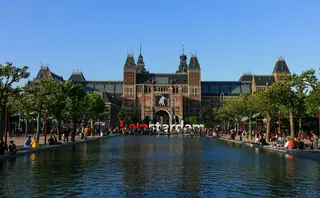
In 1885 the present building by architect Pierre Cuypers opened on the edge of what would later become the Museumplein. The building combines Gothic and Renaissance forms and, with a public passage for cyclists and pedestrians, also serves as a city gate. Over the course of the 20th century, inner courtyards were built over and rooms were redesigned several times.
From 2003 to 2013 the museum underwent a thorough renovation based on plans by the Spanish firm Cruz y Ortiz; during that period only a small part of the collection could be seen in the Philips Wing. Since reopening in April 2013, the museum has told the story of Dutch art and cultural history from around 1200 to the present in a chronological display, complemented by an Asian Pavilion and redesigned gardens.
The collection comprises around one million objects, of which about 8,000 are on display. At its heart is the Gallery of Honour (Eregalerij) with masterpieces of the Golden Age. Since 2019, Rembrandt's Night Watch has been examined and restored in full view of the public as part of the “Operatie Nachtwacht” project.
Highlights
Rembrandt's “The Night Watch” in the Gallery of Honour (Eregalerij), restored in front of visitors
Vermeer's “The Milkmaid” and other works of the Golden Age
Works by Frans Hals and Jan Steen and a self-portrait by Vincent van Gogh
Magnificent library (Cuypersbibliotheek) and large dollhouses
Free-to-enter Rijksmuseumtuinen (gardens) with a changing sculpture exhibition in summer
Permanent exhibitions
Eregalerij – The heart of the museum, with major works of the Golden Age by Rembrandt, Vermeer, Frans Hals and Jan Steen.
Operatie Nachtwacht – Since 2019, the Night Watch has been researched and restored in a glass chamber in the Gallery of Honour; visitors can watch the specialists at work.
Founded
1800
Operated by
Stichting Het Rijksmuseum
Director
Taco Dibbits
Visitors per year
approx. 2,500,000 (2024)
Admission & discounts
Adults
€25
Reduced
€11.25Holders of a CJP or EYCA card
Children & teens
freefree up to age 18 · Free up to and including age 18 (free timed ticket required).
Seniors
–No senior discount listed.
Visitors with disabilities
–companion free · One companion of a visitor who cannot get around the museum independently is admitted free (book a free ticket with a start time in advance).
Students & apprentices
–No general student discount; half price with a CJP or EYCA card.
Groups (12+ people)
–Group tickets online for 12 people or more (children count), with fast-lane access; guided tours can be booked, external guides must register.
Families
–No family ticket, since children and teens up to age 18 are free.
Audio tour for the special exhibition
€6.50Can be added when booking
Guided tour “Het beste van het Rijksmuseum” (1 hr)
€7.50Per person, plus admission, ages 16 and up
Private guided tour (up to 15 people)
€125Per tour, plus admission, book at least 14 days in advance
Free with the Museumkaart; also free with the I amsterdam City Card, ICOM, Amsterdamse Stadspas, Vereniging Rembrandt, KOG, VVAK, VriendenLoterij VIP-KAART and for Vrienden (Friends) of the Rijksmuseum. All visitors (including Museumkaart holders) must book a start time online; only Vrienden and ICOM/ICOMOS cardholders can enter without a reservation. Only a small remaining allocation is available at the ticket desk. Payment throughout the museum is cashless only.
Booking: visits by advance booking only · timed-entry tickets
The entire museum is accessible by wheelchair, mobility scooter and walking bike; entrance with an elevator on the left in the passage (seen from the Museumplein side), operated by security staff. Wheelchairs, rollators, walking sticks, strollers and folding stools can be borrowed at the information desk. Accessible parking spaces on Johannes Vermeerstraat, Jan Luijkenstraat and in the Q-Park Museumplein (level -1). Fast-lane declaration for invisible disabilities, Sunflower lanyard, Changing Place, accessibility map at the information desk, the eZwayZ navigation app with descriptions of works for blind and visually impaired people, tours in International Sign on request, whisper sets for tours, programs for people with dementia and low-sensory visits.
Kids & families
Great for kids & families
Kids’ admission
free up to age 18
Family tours & workshops
Activity booklet, scavenger hunt or kids’ audio guide
Stroller-friendly
Baby changing facilities
Free admission up to age 18. Family tours, a family scavenger hunt (Family Quest) and a family route booklet at the information desk. Strollers allowed (back carriers not), buggies can be borrowed free of charge, nursing room on request, baby changing table by the restrooms. Food brought from home can be eaten in the picnic area (on weekends) or in the atrium.
Getting there & parking
By public transit
Spiegelgracht
Several tram lines from Amsterdam Centraal, Amsterdam Zuid and Amsterdam Amstel stop near the museum; Spiegelgracht stop (including tram 7). Metro 52 to Vijzelgracht, then under 10 minutes on foot.
By car
Paid parking · 500 m to the entrance
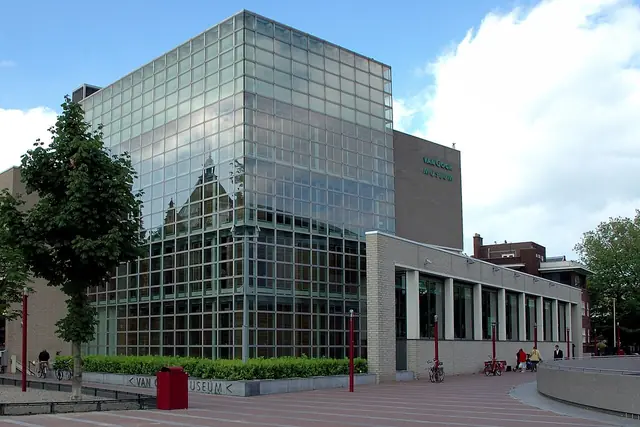
Q-Park Museumplein underground parking (entrance Van Baerlestraat 33b, pedestrian exit “Van Gogh Museum”); paid street parking on Johannes Vermeerstraat, Honthorststraat, Pieter de Hoochstraat and Jan Luijkenstraat, among others. Cheaper via P+R ArenA (metro to Weesperplein, then tram 7 to Spiegelgracht) or P+R Zeeburg (tram 26 to Rietlandpark, then tram 7). Tour buses: follow the City of Amsterdam's rules.
Accessible parking
Access to the museum is open only to pedestrians and cyclists; Kiss & Ride at the corner of Jan Luijkenstraat/Stadhouderskade, about 100 m from the entrance. The museum recommends public transport.
“Het Café” in the atrium (with a kids' menu), espresso bars in the building and a garden pavilion in summer; Michelin-starred restaurant RIJKS® (Museumstraat 2, lunch Wed–Sun, dinner Tue–Sun). Free, attended cloakroom; only bags up to A4 size are allowed in the museum, no backpacks. No storage for suitcases and large luggage – use Lockerpoint on the Museumplein instead.
Events & venue rental
Spaces for rent
Corporate events
According to the museum, business events (e.g., breakfast in the café, a symposium in the auditorium, exclusive tours) are reserved for members of the Rijksmuseum Club or partners.
Photography allowed without flash; drawing only with pencil and paper.
Good to know
Online tickets with a start time; after that you can stay as long as you like until closing, no re-entry after leaving. Audio tours free in the Rijksmuseum app (also in Dutch Sign Language), the same tours at the multimedia desk. Daily guided tour “Het beste van het Rijksmuseum” (1 hr, ages 16 and up, English/Dutch). School classes have no access to special exhibitions.