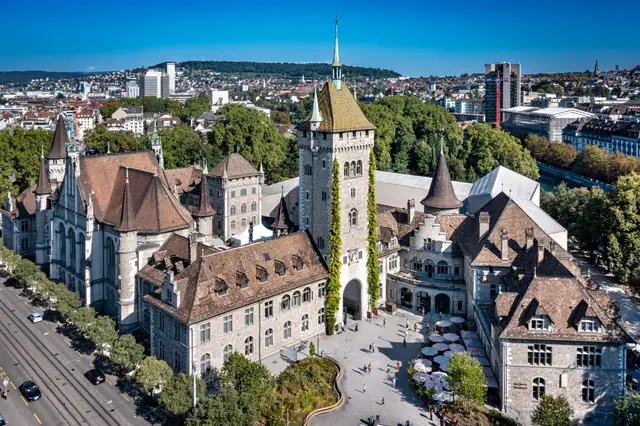
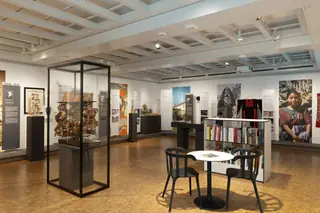
Using objects from the museum's collection, the exhibition asks who names people, things and places, and why names change. It was created with ethnology students and marks the museum's search for a name. Runs until autumn 2027.
About the museum
The collection of the Museum of Ethnology goes back to the Ethnographic Society of Zurich, founded in 1888, which wanted to build up a teaching collection for schools and merchants. On 1 June 1889 it opened with around 500 objects in the former stock exchange building. In 1913 the collection was donated to the canton, passed to the University of Zurich and was first opened to the public in December 1916.
The teaching collection became a public university museum: on 2 May 1972 it opened in the university's main building. Because the location proved unsuitable, it moved to the Old Botanical Garden in late summer 1979 and was officially opened there on 31 October 1980, where it can still be found today. Its directors have included Karl Henking, Michael Oppitz and Mareile Flitsch; since August 2025 the museum has been headed by Alice Hertzog.
Today the museum sees itself as an ethnological science museum between the university and the public, and the third-oldest ethnological museum in Switzerland. It holds a collection of around 40,000 objects as well as image, film, sound and paper archives, and works with descendants of the source communities on provenance research. Since 2023 a question mark has appeared in its name (“Völkerkunde?museum”), inviting discussion of the designation.
Highlights
Free admission
Ethnological collection of around 40,000 objects
Located in the Old Botanical Garden near Paradeplatz
Changing exhibitions on human competences and skills
Museum boxes with original objects for school classes
Founded
1889
Operated by
Universität Zürich
Director
Alice Hertzog
Admission & discounts
Admission is free.
Admission is free. Museum boxes for teachers: rental fee CHF 50, deposit CHF 100.
The museum is wheelchair-accessible throughout; a lift leads to the entrance area, the foyer exhibition, the exhibitions on the first and second floors and the rear part of the lecture hall (use via reception, tel. +41 44 634 90 11). Suitable toilet in the basement. People with disabilities may park directly in front of the entrance after registering by telephone. The museum is listed in the Ginto app.
Kids & families
The museum hasn’t published any information on this.
Getting there & parking
By public transit
Rennweg
From the main station, tram 6, 7, 11, 13 or 17 to “Rennweg”; from Universität Zentrum, tram 9 to “Sihlstrasse”; from Bellevue, tram 2 to “Sihlstrasse” or tram 8 to “Bahnhof Selnau”; S-Bahn S4 and S10 to “Bahnhof Selnau”.
By car
No on-site parking at the museum.
There is no parking directly at the museum; the car parks City Parking, Bleicherweg and Talgarten are recommended.
Accessible parking
The museum is in the Old Botanical Garden at the corner of Talstrasse and Pelikanstrasse. Because of utility works on Talstrasse until the end of October 2027, the street is open to traffic on one side only; access on foot remains guaranteed.
The museum hasn’t published any information on this.
Events & venue rental
The museum hasn’t published any information on this.
Plan your visit
Guided tours
yes
School programs
yes
Good to know
For schools there are tours of the current exhibitions, teaching books on the Indigenous societies of North America and loanable museum boxes with original objects and sound documents (reservation by telephone). The University Library has a branch in the building (Monday to Friday 1–5 pm).