Coventry Music Museum
Volunteer-run museum on the music of Coventry, from the 1960s to today, with a major focus on the 2-Tone ska sound of the late 1970s.
Have only individual sections read aloud
About the museum
The Coventry Music Museum opened at the start of November 2013. It grew out of 2-Tone Central, an eleven-month project at Coventry University about the 2-Tone music scene. When that project lost its space, its team set out to create a museum covering the wider music history of the city. The music journalist Pete Chambers, who later received a BEM, and his wife Julie founded it and serve as its directors.
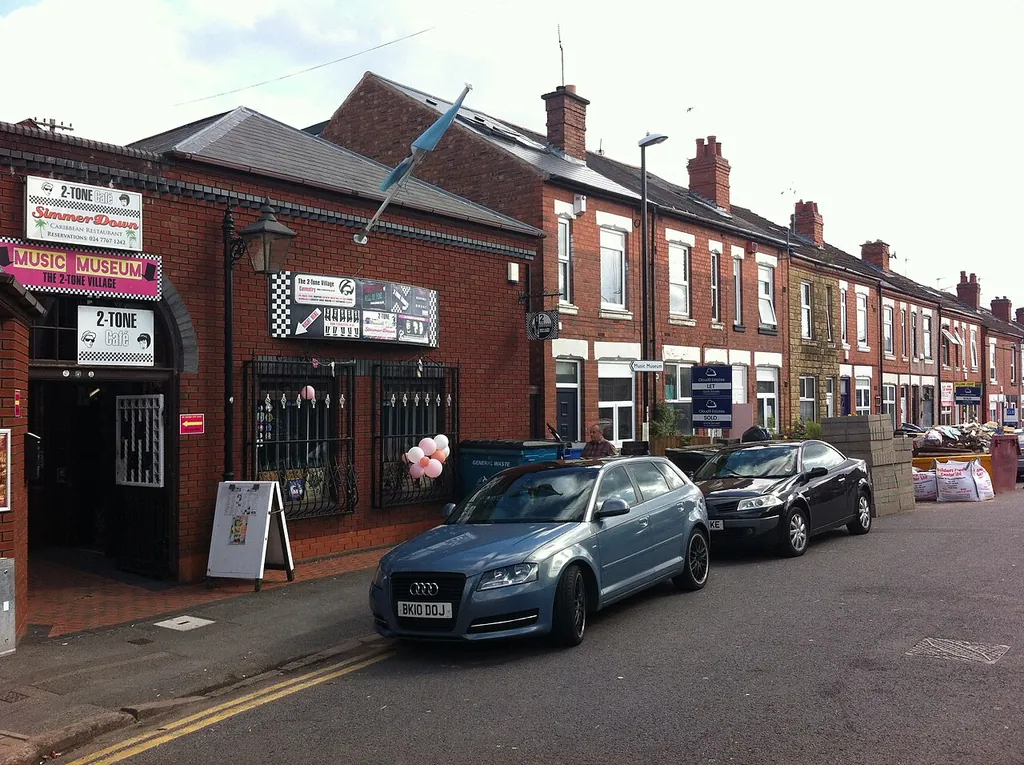
The museum first stood in a courtyard that became known as the 2-Tone Village, with cafe, shops and a restaurant, and later moved to its current premises on Walsgrave Road, about two miles from the city centre. The museum is independent and is run entirely by volunteers, not by the city council. It was named a VisitEngland Tourism Superstar in 2024 after a public vote.
Around half of the displays cover the story of 2-Tone, which was born in Coventry. The rest looks at other local music, including the 1960s and the 1970s and 1980s, the 1990s and more recent sounds, with material about Coventry, Rugby, Leamington Spa, Nuneaton and Bedworth. Highlights include a tape recorder used by the composer Delia Derbyshire, the Rude Boy's Bedroom, the car from the video for Ghost Town and the Lennon bench.
Highlights
- The 2-Tone sound, made in Coventry
- Delia Derbyshire's tape recorder
- The Rude Boy's Bedroom
- The car from the Ghost Town video
- Sections on the 1960s to the new millennium
- Run by volunteers, with a changing yearly exhibition
Permanent exhibitions
- The 2-Tone sound, made in Coventry – The story of the 2-Tone music movement made in Coventry, including the Rude Boy's Bedroom and the Ghost Town car.
- Delia Derbyshire's tape recorder – A tape recorder used by the electronic music pioneer Delia Derbyshire.
- Sixties sound booth and later decades – Displays on Coventry music from a 1960s sound booth through the 1970s, 1980s and 1990s to the new millennium.
- Founded
- 2013
- Operated by
- Independent volunteer-run museum
Admission & discounts
| Adults | £6 |
|---|---|
| Reduced | £3Students and senior citizens |
| Children & teens | freefree up to age 14 · Children under 15 are free but must be accompanied by an adult. |
| Seniors | £3 |
| Visitors with disabilities | £3 |
| Students & apprentices | £3 |
Visitors can simply turn up and pay by cash or card.
Accessibility
- Partially wheelchair accessible
- Elevator: not available
- Accessible restroom: no information
- Accessible parking: no information
- Service dogs welcome: no information
- Tactile models & exhibits: no information
- Sign language tours: no information
- Easy-to-read materials: no information
- Audio description: no information
Most of the museum is on the first floor, and wheelchair users reach it by stair climber only. Please phone the museum 24 hours before your visit if you wish to use it. Volunteers explain the exhibits to blind and partially sighted visitors.
Kids & families
| Kids’ admission | free up to age 14 |
|---|
Children under 15 enter free with an adult.
Getting there & parking
By public transit
Ball Hill
The museum is at the Ball Hill stop, served by bus routes 9, 9A, X30 and 585 from the railway station.
The museum is in the 2-Tone Village, behind the main shops on Walsgrave Road. Cross at the pedestrian crossing by Boots the Chemist; the entrance is opposite, through the archway with the mural.
Get directionsAmenities & dining
The museum hasn’t published any information on this.
Events & venue rental
The museum hasn’t published any information on this.
Plan your visit
| Good to know | Volunteers are on hand to explain the displays. The yearly exhibition changes; the 2026 exhibition is about Hazel O'Connor. |
|---|