West Shed Museum
Railway museum and working locomotive workshop of the Princess Royal Class Locomotive Trust at the Midland Railway Centre in Derbyshire.
Have only individual sections read aloud
About the museum
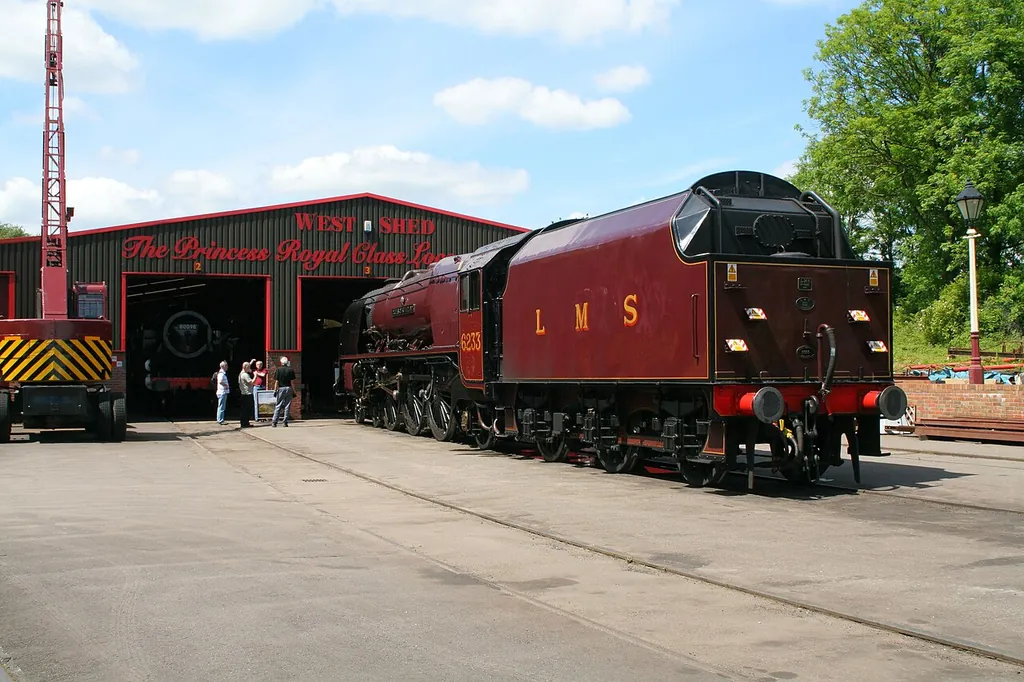
WEST SHED is the public home and operating base of the Princess Royal Class Locomotive Trust, a registered charity. It stands at the west end of the Swanwick Junction site of the Midland Railway Centre near Ripley in Derbyshire. The building works as a museum and a workshop at the same time: historic locomotives are shown to visitors, but they are also maintained and restored there, and prepared for use on heritage lines and the main line.
The collection includes express locomotives such as 6233 Duchess of Sutherland and 46203 Princess Margaret Rose, two BR Standard tank engines and several historic carriages. Among them are a royal saloon, a dynamometer car used to measure locomotive performance, and an observation saloon. A viewing gallery lets visitors watch work in the workshop.
Interpretation panels, films, hands-on displays and original objects explain the engines, the railways they ran on and the crews and volunteers who keep them going. The Trust also holds a non-displayed collection of photographs, engineering drawings, magazines, books and railway memorabilia, which researchers can ask to see through the curator.
Highlights
- 6233 Duchess of Sutherland, an LMS express locomotive
- 46203 Princess Margaret Rose, the first production Stanier Pacific
- BR Standard tank locomotives 80080 and 80098
- Historic saloons including a royal saloon and a dynamometer car
- Viewing gallery over the working locomotive workshop
Permanent exhibitions
- Locomotives and carriages – Preserved locomotives such as Duchess of Sutherland and Princess Margaret Rose, BR Standard tank engines and historic saloons including a royal saloon and a dynamometer car.
- Workshop viewing gallery – A gallery from which visitors can watch locomotive restoration and maintenance work in progress.
- Operated by
- The Princess Royal Class Locomotive Trust
Admission & discounts
The museum hasn’t published any information on this.
Accessibility
- Partially wheelchair accessible
- Elevator
- Accessible restroom
- Accessible parking
- Service dogs welcome: no information
- Tactile models & exhibits: no information
- Sign language tours: no information
- Easy-to-read materials: no information
- Audio description: no information
A lift gives wheelchair access to the upper floors of the building, seating is available at several points, and the toilets include an accessible one. Disabled parking is available close to the building; visitors should contact the Trust in advance for directions. The walk from Swanwick station to the building is about 430 metres and includes some uneven surfaces.
Kids & families
Great for kids & families
- Hands-on stations
- Baby changing facilities
The museum has hands-on displays and a small Parent and Baby Room with a changing table. More baby changing facilities are elsewhere on the Swanwick Junction site, about five minutes’ walk away.
Getting there & parking
By public transit
Swanwick station (Midland Railway – Butterley) · 430 m
Normal access is by heritage train from Butterley station of the Midland Railway – Butterley to Swanwick station, then a walk up to the building.
By car
- Accessible parking
The walk from Swanwick station takes 5 to 10 minutes. For directions to Butterley station, train times and fares, see the Midland Railway – Butterley website.
Get directionsAmenities & dining
- Museum shop
The building has a souvenir shop and a serving area for light refreshments (hot and cold drinks, biscuits, crisps and a small microwaved and toasted menu), available most days depending on volunteers. It has no traditional café.
Events & venue rental
The museum hasn’t published any information on this.
Plan your visit
| Good to know | A viewing gallery lets visitors see work in progress in the workshop. Visitors can explore the museum at their own pace or join guided sessions during selected events. Researchers can ask the curator about the Trust’s non-displayed collection and its reference library. |
|---|