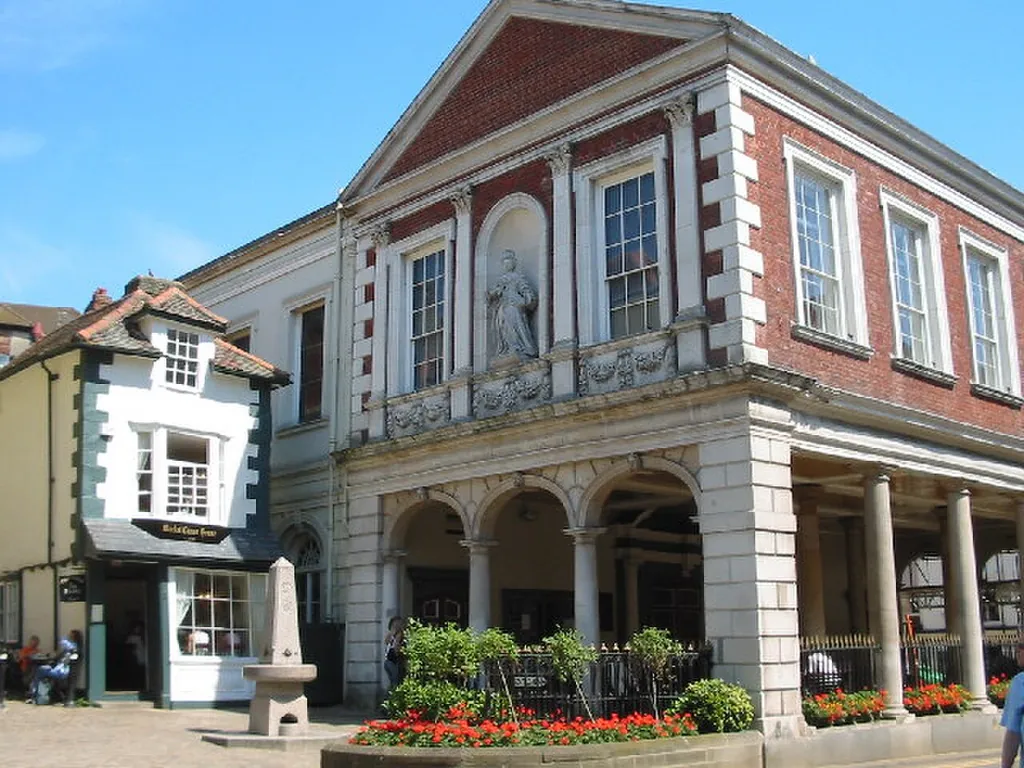
Windsor Guildhall Museum
Local history museum in Windsor’s Grade I listed Guildhall, telling the story of the Royal Borough from the Stone Age to today, with royal rooms upstairs.
Have only individual sections read aloud
About the museum
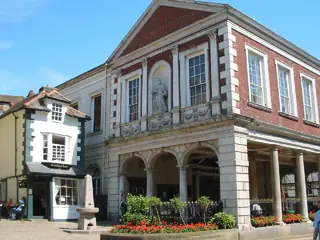
The museum is housed in Windsor Guildhall on the High Street, a Grade I listed civic building begun in 1687 on pillars so that a corn market could trade beneath it. A town guildhall has stood on the site since the Middle Ages. The building was extended in 1829 and restored in 1950–1951, and it was used for courts and for council business for centuries.
The first museum display opened in the Guildhall in 1951 as part of the Festival of Britain, opened by Princess Elizabeth. After the Royal Borough of Windsor and Maidenhead was formed in 1974 the museum was run by the borough council. A new museum was opened by Queen Elizabeth II in 2011, and a refurbishment supported by Arts Council England led to a reopening on 28 June 2026 with a more accessible layout.
The ground-floor gallery follows the history of Windsor and the surrounding Royal Borough from the Stone Age to the present, with objects such as a mammoth tusk about 100,000 years old and a model of the Hawker Hurricane designed by Windsor-born Sir Sydney Camm. Audio stories from local people add personal memories. Upstairs, visitors can walk through the Guildhall’s historic rooms with royal portraits and see the room where King Charles III and Queen Camilla were married in 2005. The collection of more than 13,000 items is cared for with the help of volunteers and the Friends of Windsor Museum.
Highlights
- Gallery on Windsor’s history from the Stone Age to today
- Mammoth tusk about 100,000 years old
- Model of the Hawker Hurricane designed by Sir Sydney Camm
- Upstairs rooms with royal portraits, including the room used for a royal wedding in 2005
- Audio trail with stories and memories from local residents
Permanent exhibitions
- Museum gallery – The history of Windsor and the Royal Borough from the Stone Age to the present day, with a mammoth tusk, a Hawker Hurricane model and an audio trail of local stories.
- Upstairs rooms of Windsor Guildhall – A self-guided visit through the historic rooms with royal portraits and objects about the Guildhall’s role in civic life, including the room used for a royal wedding.
- Founded
- 1951
- Operated by
- Royal Borough of Windsor and Maidenhead
Admission & discounts
| Adults | £5 |
|---|---|
| Children & teens | freefree up to age 15 · Children under 16 enter free and must be accompanied by an adult. |
| Visitors with disabilities | –companion free · Carers are admitted free. |
The ticket covers the ground-floor gallery and a self-guided visit to the upstairs rooms. Entry is free for holders of the Royal Borough’s Advantage Card (for residents). Admission and shop purchases are cashless; the donation box takes cash.
Accessibility
- Partially wheelchair accessible
- Elevator: no information
- Accessible restroom: no information
- Accessible parking
- Service dogs welcome
- Tactile models & exhibits
- Sign language tours: no information
- Easy-to-read materials: no information
- Audio description: no information
Step-free entrance from the Corn Market to the welcome desk and ground-floor gallery. The upstairs rooms are reached by a staircase of about 20 steps or by a stairlift for visitors who can transfer from their wheelchair unaided (weight limit 120 kg); one wheelchair is available upstairs on request. The toilets, including one adapted toilet with baby changing, are on the ground floor but are reached by four medium-height steps. An induction loop is fitted at the reception desk, and large print captions, temporary seating and a few handling objects in drawers are available. Assistance dogs are welcome. Blue Badge bays are on Park Street and the High Street. The High Street outside has cobbles and uneven surfaces.
Kids & families
Great for kids & families
| Kids’ admission | free up to age 15 |
|---|
- Hands-on stations
- Stroller-friendly: not available
- Baby changing facilities
The museum describes itself as family friendly, with objects to handle in a few drawers and a children and families page on the council website. Pushchairs cannot be taken upstairs. The adapted ground-floor toilet has parent and baby changing facilities.
Getting there & parking
By public transit
Windsor & Eton Central station · 6-min walk
Windsor & Eton Central station (trains from London Paddington via Slough) is a 6-minute walk and Windsor & Eton Riverside station (trains from London Waterloo) a 7-minute walk. Buses stop outside at High Street, Windsor or Windsor Parish Church, including London Line 702, Flight Line 703 and First Group 8.
By car
No on-site parking at the museum.
There is no public parking at the Guildhall. The nearest public car parks are Victoria Street (SL4 1EG), King Edward Court (SL4 1TG) and River Street (SL4 1QT). Blue Badge bays are marked on Park Street and the High Street; spaces are limited.
- Accessible parking
From the M4, leave at junction 6 (Slough) and follow signs to Windsor; car parking is signposted. Bicycle stands are behind the Guildhall.
Get directionsAmenities & dining
- Museum shop
There is a small gift shop. There is no luggage storage. Pushchairs cannot be taken upstairs and can be left at the owner’s risk in a limited storage space.
Events & venue rental
- Spaces for rent
- Private parties
- Corporate events
- Weddings / ceremonies
Up to 100 guests.
The Guildhall can be hired for civil wedding ceremonies (up to 100 guests), dinners, meetings and filming, using the Guildhall Chamber or the Ascot Room. Private group tours with drinks can be booked outside opening hours.
Inquiries & detailsPlan your visit
| Guided tours | yes |
|---|---|
| Audio guide | yes (EN, FR, DE, ES, IT, JA, ZH) |
| School programs | yes |
| Good to know | The audio trail in the gallery is in English only; audio overviews of the gallery and upstairs rooms are available in seven languages. Visitors need a smartphone and are asked to bring their own headphones, as none are provided. Guided tours are offered to groups, and school and education visits are accepted. Children must be accompanied at all times. |