Woodbridge Tide Mill Museum
Grade I listed 1793 tide mill on the River Deben that still grinds flour, with three floors of machinery, films and hands-on displays.
Have only individual sections read aloud
About the museum
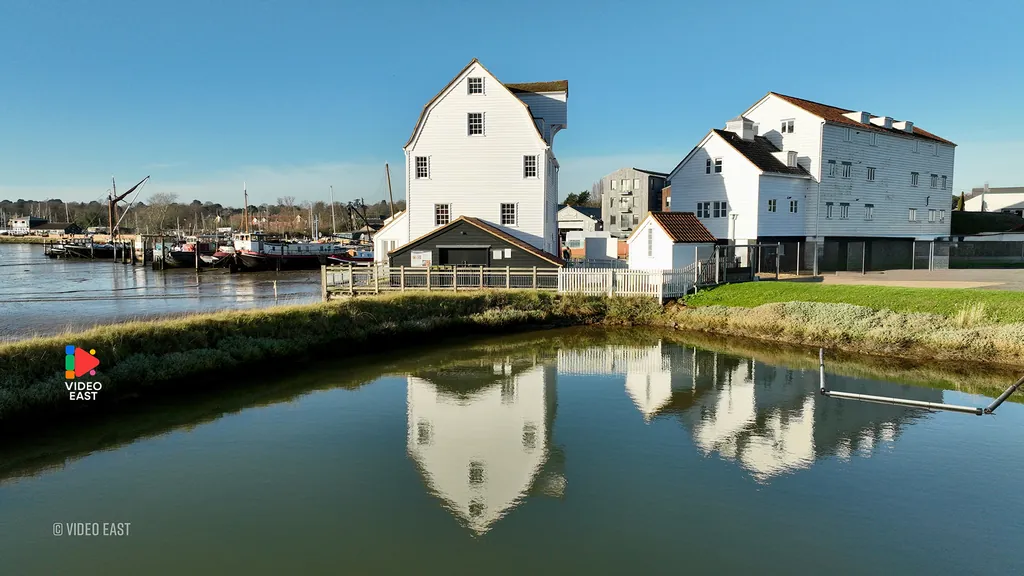
A tide mill has stood on this spot beside the River Deben since at least 1170, when the earliest record of one appears. It belonged to Augustinian priors for about 350 years, until Henry VIII took it over. Later it passed to the Seckford family and then to a series of private owners. The present building dates from 1793 and was put up on the site of earlier mills.
By the 1950s Woodbridge was the last tide mill in England still working commercially. It closed in 1957 but was saved from demolition in 1968, restored and opened to the public in 1973. Funding from the Heritage Lottery Fund in 2012 helped turn the small local museum into a modern visitor attraction.
Today the mill is run by a charitable trust and is again a working tide mill. The incoming tide fills a mill pond, and the outgoing water turns a large oak waterwheel that drives the millstones. Flour made from local wheat is bagged and sold to the public. Visitors can follow the grain from the ground floor to the top of the building, see the machinery in action on milling days and learn how tide power was used.
Highlights
- Five-metre-wide oak waterwheel, which turns on most days
- Working millstones and wood-and-iron machinery on three floors
- Computer-generated film showing how grain and flour move through the mill
- Film shot by Shell in 1951 showing the mill at work, shown on the ground floor
- Boardwalk with close views of the wheel and the birds of the River Deben
- Stoneground wholemeal flour made on site and sold to visitors
Permanent exhibition
- The Tide Mill – Three floors of working machinery, films and interactive displays explain how the tide drives the waterwheel and how grain becomes flour. Films on the ground floor cover the mill's history and workings and include footage shot by Shell in 1951 of the mill in operation.
- Founded
- 1973
- Operated by
- Woodbridge Tide Mill Charitable Trust
Admission & discounts
| Adults | £6 |
|---|---|
| Reduced | £5Concession |
| Children & teens | £3Accompanied child aged 5 to 15. |
| Visitors with disabilities | freecompanion free · Visitors with access limitations enter free. |
| Groups | –Group visits are arranged in advance by email and include a guided tour; school visits cost £3 per student with accompanying adults free. |
| Families | £15Up to two adults and two children. |
Tickets can be pre-booked online on the Plan your visit page or bought on arrival. Online booking offers an optional Gift Aid donation; prices shown are standard admission. Prices are in pounds sterling only; card and PayPal payments usually handle the currency conversion. Carers are admitted free.
Accessibility
- Partially wheelchair accessible
- Elevator: not available
- Accessible restroom
- Accessible parking: no information
- Service dogs welcome: no information
- Tactile models & exhibits: no information
- Sign language tours: no information
- Easy-to-read materials: no information
- Audio description: no information
The mill is a Grade I listed building with narrow stairs and no lift. The ground floor is accessible by a small ramp at the front or a level wooden walkway at the rear; the upper floors can only be reached by stairs. Videos of the upper floors can be watched on the ground floor, and a free digital guide and an online 3D tour are available. There is an accessible toilet with a fold-down baby changing table. There is no parking at the mill; the station car park has six extra-wide bays and the level route from there to the mill takes about 7 minutes. Well-behaved dogs are allowed on the ground floor only, at the discretion of the duty warden. Sensory backpacks can be borrowed free of charge, a sensory floor plan can be downloaded, and quiet visits with reduced capacity can be arranged by phone at the price of one adult ticket.
Kids & families
Great for kids & families
| Time needed | approx. 60 min |
|---|---|
| Family ticket | £15 · Up to two adults and two children. |
- Activity booklet, scavenger hunt or kids’ audio guide
- Hands-on stations
- Baby changing facilities
Children can use a museum trail, a grain detective game, dressing up as the miller's family and free sensory backpacks, and the ground floor has working models and a hand quern. Families can book quiet visits for neurodivergent children or parents.
Getting there & parking
By public transit
Woodbridge station
Woodbridge station on the Ipswich to Lowestoft line is a short walk from the mill.
By car
No on-site parking at the museum.
There is no parking at the mill. Pay and display car parks in town include Theatre Street, Oak Lane, Station Road, The Station, Hamblin Road, Lime Kiln Quay and The Avenue.
Woodbridge lies on the A12 between London and Lowestoft; follow the signs into the town. The mill stands by the river and can be reached from several car parks. From the station car park it is a pleasant 10 to 15 minute walk along the river, passing Woodbridge Museum and the Longshed, where a full-size Anglo-Saxon ship is being built with period tools.
Get directionsAmenities & dining
The mill's own flour is sold to visitors. Cafés and restaurants are nearby in Woodbridge town.
Events & venue rental
- Spaces for rent
- Private parties
Up to 50 guests.
The mill can be hired as an unusual venue for small gatherings such as presentations, book launches and private parties, with catering and guides on request. The building is unheated and limited to 50 people at a time.
Inquiries & detailsPlan your visit
| School programs | yes |
|---|---|
| Good to know | Allow up to an hour for the three floors and the outdoor area. Films on the ground floor cover the history of the mill, how it works and a 1951 Shell film showing it in operation. A free digital guide from Bloomberg Connects offers a highlights tour, history and child-friendly videos in several languages, and the website has a 3D tour of the mill. Private groups can book a guided tour in advance, and educational visits are offered all year. |