Photos, films, documents, and finds from the Grensmaas and MaasBand projects tell the story of a hundred years of flooding on the Meuse – from the dike breach near Meers in 1925/26 to July 2021. In the De Hoppenkamp room, expected to run until mid-January 2027; official opening on October 9, 2026.
Om museet
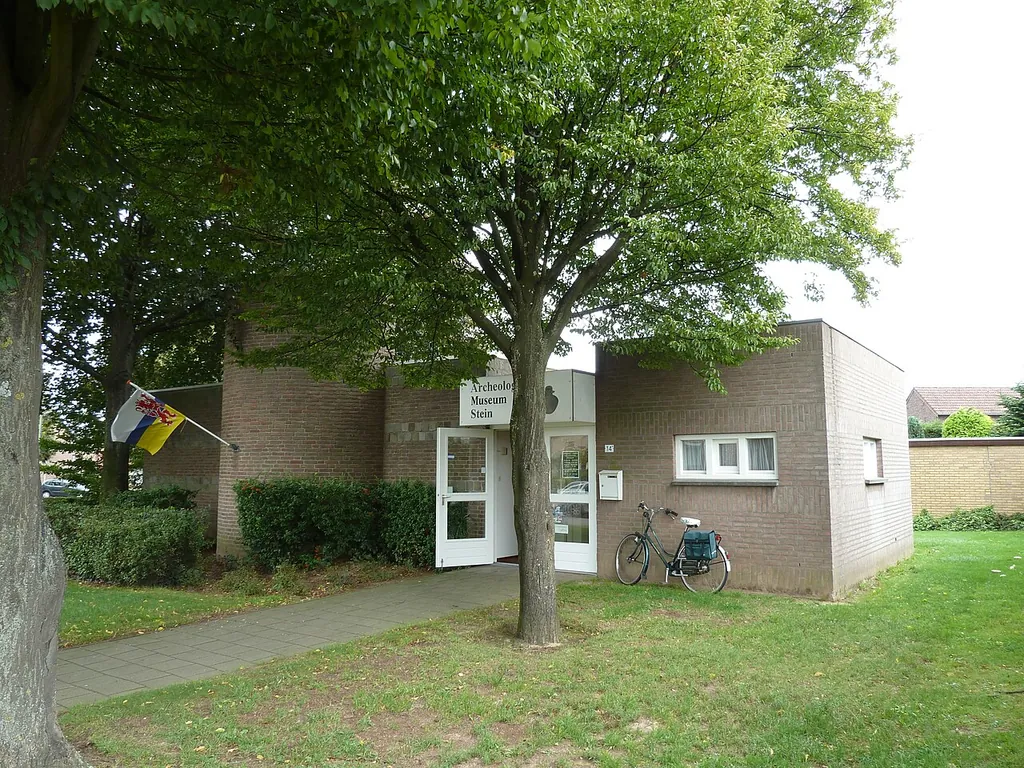
The museum's starting point is a discovery made in 1963: during excavations in Stein, archaeologists came upon a Neolithic burial chamber dating from around 3400 BC, with a floor made of Meuse pebbles, in which the cremated remains of a farming community had been laid to rest. No other structure of this type is known anywhere. The site was protected as a national monument, and instead of moving the tomb, the museum was built directly over it.
On June 30, 1967, the museum opened as the ‘Archeologisch Reservaat’. It is closely associated with the physician Dokter Beckers and Father Munsters, who shaped the archaeology of the region and after whom one of the two supporting foundations is named. In 1997, it was renamed Archeologiemuseum Stein, followed by a comprehensive renovation in 2017. Today it is operated by the Stichting Erfgoed Stein, which also looks after local history, the monastery cemetery, and the castle ruins of Stein, and it is run entirely by volunteers.
The exhibition guides visitors through some 7,000 years of settlement history: from the Linear Pottery people, the first farmers in the Netherlands, whose village once stood on exactly this spot, through burial mounds and urnfields of the Bronze and Iron Ages to wealthy Roman villa owners on the loess plateau. It concludes with Frankish finds such as glass, jewelry, coins, and weapons, along with the reconstruction of a Merovingian warrior's grave. In the adjoining multipurpose room De Hoppenkamp, the foundation shows changing exhibitions on local history.
Højdepunkter
Original Neolithic stone chamber tomb of Stein (around 3400 BC) at its find site
Finds of the Linear Pottery culture, the first farming culture in the Netherlands
Roman stone chest with a reconstruction of ashes and grave goods
Reconstruction of a Merovingian warrior's grave
Urns and grave finds from the Bronze and Iron Ages
Permanente udstillinger
Het steengraf van Stein – The original Neolithic burial chamber with its grave goods as they were found, plus the story of its discovery and a comparison with other megalithic structures in Europe.
Van de eerste boeren tot de Franken – A tour through the region's prehistory with finds of the Linear Pottery culture, Bronze and Iron Age burial forms, Roman grave goods, and Merovingian equipment.
Grundlagt
1967
Ejer
Stichting Erfgoed Stein
Entrépriser & rabatter
Voksne
5 €
Børn og unge
gratisgratis til og med 12 år · Children up to and including age 12 free when accompanied; full price from age 13.
Grupper (fra 10 pers.)
–Group and educational visits with a guided tour for 10 or more people by arrangement, also outside opening hours; book at least one week in advance if possible.
Lectures on the special exhibition for a voluntary donation. The website does not mention participation in the Museumkaart scheme.
Tilgængelighed
Museet har ikke offentliggjort oplysninger om dette – spørg venligst museet direkte.
Børn og familie
Entré for børn
gratis til og med 12 år
Accompanied children up to age 12 get free admission. According to the museum, there are introductory programs for families as well; a children's archaeology club is being set up.
Transport & parkering
Museet har ikke offentliggjort oplysninger om dette – spørg venligst museet direkte.
Service & spisesteder
Museumsbutik
Small sales of postcards, books (including a children's book on the Linear Pottery culture), and calendars; light refreshments can be provided in the multipurpose room for events.
Arrangementer & udlejning
Lokaler til leje
Firmaarrangementer
Op til 75 personer.
Multipurpose room ‘De Hoppenkamp’ for meetings, presentations, classes, and small events for up to 75 people, with technical equipment and light catering; can also be booked outside opening hours.
Guided tours for groups of 10 or more by reservation (form on the website, by email, or by phone). Educational programs for primary and secondary schools, teaching materials including on death and burial; participation in the ‘Reizen in de tijd’ program. The museum is run by volunteers.