Museo delle dogane svizzero
The Customs Museum, in a former border guard post on Lake Lugano, shows the history and duties of customs and the border guard; free admission, arrival by boat.
Ingen lyd? Tjek lydløs-knappen på din enhed.
Få kun enkelte afsnit læst op
Om museet
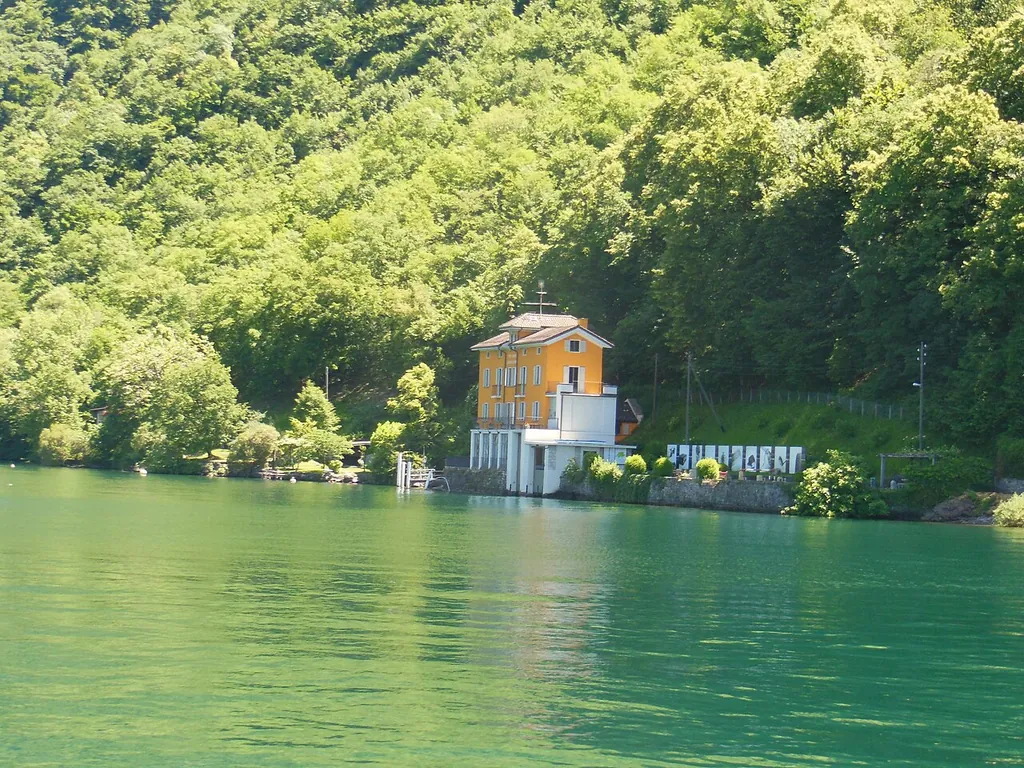
The present museum building in Cantine di Gandria was built in 1904 as a large border guard post and served the Border Guard Corps until 1993; it replaced the first post, the so-called "red house" of 1853. In 1935 the Ticinese border guard Angelo Gianola had the idea of using unused rooms of the building as a museum; his colleagues collected objects documenting the everyday life of border guards. The museum opened in 1949.
In the first decades, smuggled goods, hiding places and ingenious means of transport were the biggest crowd-pullers; for this reason the house is still popularly known as the "smugglers' museum". In the 1970s it was restored and redesigned together with the Swiss National Museum; the collection passed to the National Museum, which took over its care. Since the reopening in 1978 the permanent exhibition has been continuously expanded, and since the border guard post closed in 1993 the entire building has served as a museum.
Today the museum belongs to the Federal Office for Customs and Border Security. It lies in the chestnut forests directly on the Italian border and shows how customs and border surveillance have developed in Switzerland and what tasks they have today for the economy, security and health. Temporary exhibitions take up current topics.
Højdepunkter
- Former border guard post on the shore of Lake Lugano
- Permanent exhibition on the Swiss customs border with 1,935 km of border line
- History of smuggling, known as the "smugglers' museum"
- Arrival by scheduled boat or on the hiking trail
- Free admission, picnic area in the lakeside garden
Permanent udstilling
- 1935 Kilometer Grenze in einem Museum – The permanent exhibition sheds light on the history and significance of the Swiss customs border, the duties of border guards past and present, and the role of customs for the economy, security and health.
- Grundlagt
- 1949
- Ejer
- Bundesamt für Zoll und Grenzsicherheit (BAZG)
Entrépriser & rabatter
Der er gratis entré.
| Grupper | –Groups should register in advance: museodelledogane@bazg.admin.ch, tel. +41 58 463 49 22. |
|---|
Admission is free.
Tilgængelighed
- Kørestolsvenlig: findes ikke
- Elevator: ingen oplysninger
- Handicaptoilet: ingen oplysninger
- Handicapparkering: ingen oplysninger
- Servicehunde tilladt: ingen oplysninger
- Taktile tilbud: ingen oplysninger
- Rundvisninger på tegnsprog: ingen oplysninger
- Letlæste tilbud: ingen oplysninger
- Synstolkning: ingen oplysninger
Because of its construction, the 1904 building has no accessible infrastructure and can only be reached by boat; the team does its best to make access as easy as possible for wheelchair users and guests with walking difficulties.
Børn og familie
Museet har ikke offentliggjort oplysninger om dette.
Transport & parkering
Med offentlig transport
Museo doganale (Schiffsanlegestelle)
By scheduled boat from Lugano (stops Giardino, Centrale or Paradiso) in about 25 minutes; the scheduled boats dock directly at the museum (stop "Museo doganale") or at Cantine di Gandria, from where it is a few minutes on foot.
The museum is on the shore opposite Gandria. On foot it can be reached via the almost level hiking trail on the north shore of Lake Lugano; timetable at lakelugano.ch.
Planlæg ruteService & spisesteder
- Café: findes ikke
- Restaurant: findes ikke
Picnic area in the museum garden by the lake. In Cantine di Gandria, about 200 m away, there are the Grotti Descanso and Teresa (reservation recommended); other eateries: Ristorante Roccabella in Gandria and Grotto dei Pescatori.
Arrangementer & udlejning
Museet har ikke offentliggjort oplysninger om dette.
Planlæg dit besøg
| Rundvisninger | nej |
|---|---|
| Tilbud til skoler | ja |
| Godt at vide | The museum currently offers no guided tours. Accompanying teaching materials are available for schools. |