13. september 2026 – 10. januar 2027
Matt Browning: A Screen of Trees
New York sculptor Matt Browning shows carved, movable wooden chains and a new work of stacked cedar wood that turn outward and reverse the view from the house and garden.
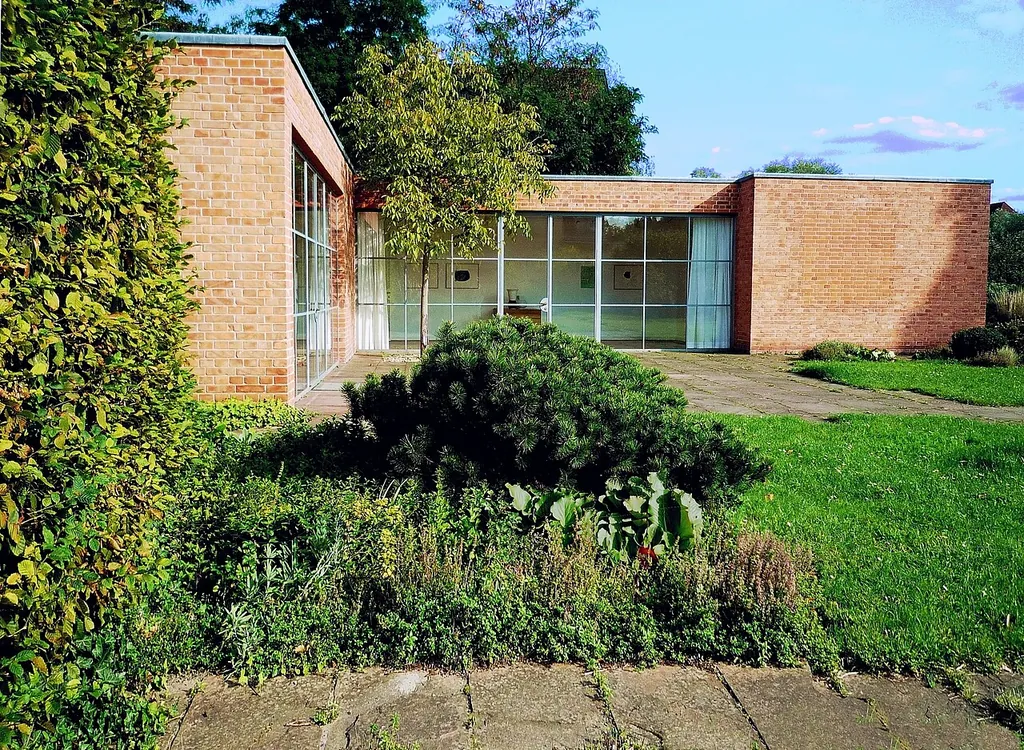
Exhibition space for contemporary art in Haus Lemke, built by Mies van der Rohe in 1932/33 on the Obersee lake in Berlin-Hohenschönhausen.
13. september 2026 – 10. januar 2027
New York sculptor Matt Browning shows carved, movable wooden chains and a new work of stacked cedar wood that turn outward and reverse the view from the house and garden.
Ludwig Mies van der Rohe designed the house in 1932 as a residence for the printing-company owner Karl Lemke and his wife Martha. After several preliminary designs, cost considerations led to a single-story, L-shaped brick building with large windows facing the garden and the Obersee; the couple moved in in the spring of 1933. It was the last residential house Mies completed before emigrating to the USA. The furniture was designed by Mies and Lilly Reich, and the garden was planned by the office of perennial breeder Karl Foerster with Herta Hammerbacher.
After the war the Red Army confiscated the house; later the East German Ministry for State Security (Stasi) used it, among other things, as a laundry depot and as living quarters, significantly altering both house and garden. In 1977 the building was listed as a historic monument. The furniture designed by Mies and Reich passed from the Lemkes' estate to the Kunstgewerbemuseum (Museum of Decorative Arts) in Berlin.
During the political changes of 1990, committed local citizens opened the building to the public for the first time as the "Mies van der Rohe Haus"; since then it has been a municipal exhibition space of the borough, now Lichtenberg. From 2000 to 2002 it was renovated and brought closer to the original plans again – the main original elements to survive are the exterior walls, the roof and some windows. The program focuses on site-specific exhibitions of contemporary art, commissioned works, concerts and regular architecture tours.
Der er gratis entré.
| Børn og unge | –Free admission for everyone. |
|---|---|
| Grupper (fra 8 pers.) | –Groups of 8 or more please register in advance (info@miesvanderrohehaus.de), maximum 25 people. Private tours can be arranged for a fee; if you bring your own guide, group and license fees apply. |
| Public architecture tour | 5 €per person, free up to age 16; register by email |
Admission to the house and garden is free; a participation fee is charged only for the architecture tours.
The house has step-free, accessible entry and a wheelchair-accessible restroom. Leashed dogs are allowed in the house and garden.
Museet har ikke offentliggjort oplysninger om dette – spørg venligst museet direkte.
Tram M5 to Oberseestraße; tram 27 and 37 to Am Faulen See.
Parkering muligt
Parking directly in front of the house as well as on Oberseestraße and nearby.
No food or drinks available. Blankets can be borrowed for relaxing in the garden.
Museet har ikke offentliggjort oplysninger om dette – spørg venligst museet direkte.
| Rundvisninger | ja |
|---|---|
| Tilbud til skoler | ja |
| Godt at vide | Architecture tours usually on the first Sunday of the month at 11:30 (German) and 13:00 (English), registration required; free exhibition tours without registration on selected dates. School classes and educational groups by arrangement, also outside opening hours. The house's original furniture is on display in the Kunstgewerbemuseum at the Kulturforum. |
Cookies hjælper dig med at bruge websitet. Kort og statistik indlæser vi kun med dit samtykke.