In nine stations, the show traces Berlin's conflicts over affordable housing – from the tenants' movement of the 19th century and squatting in East and West to the current debate on socialization.
Om museet
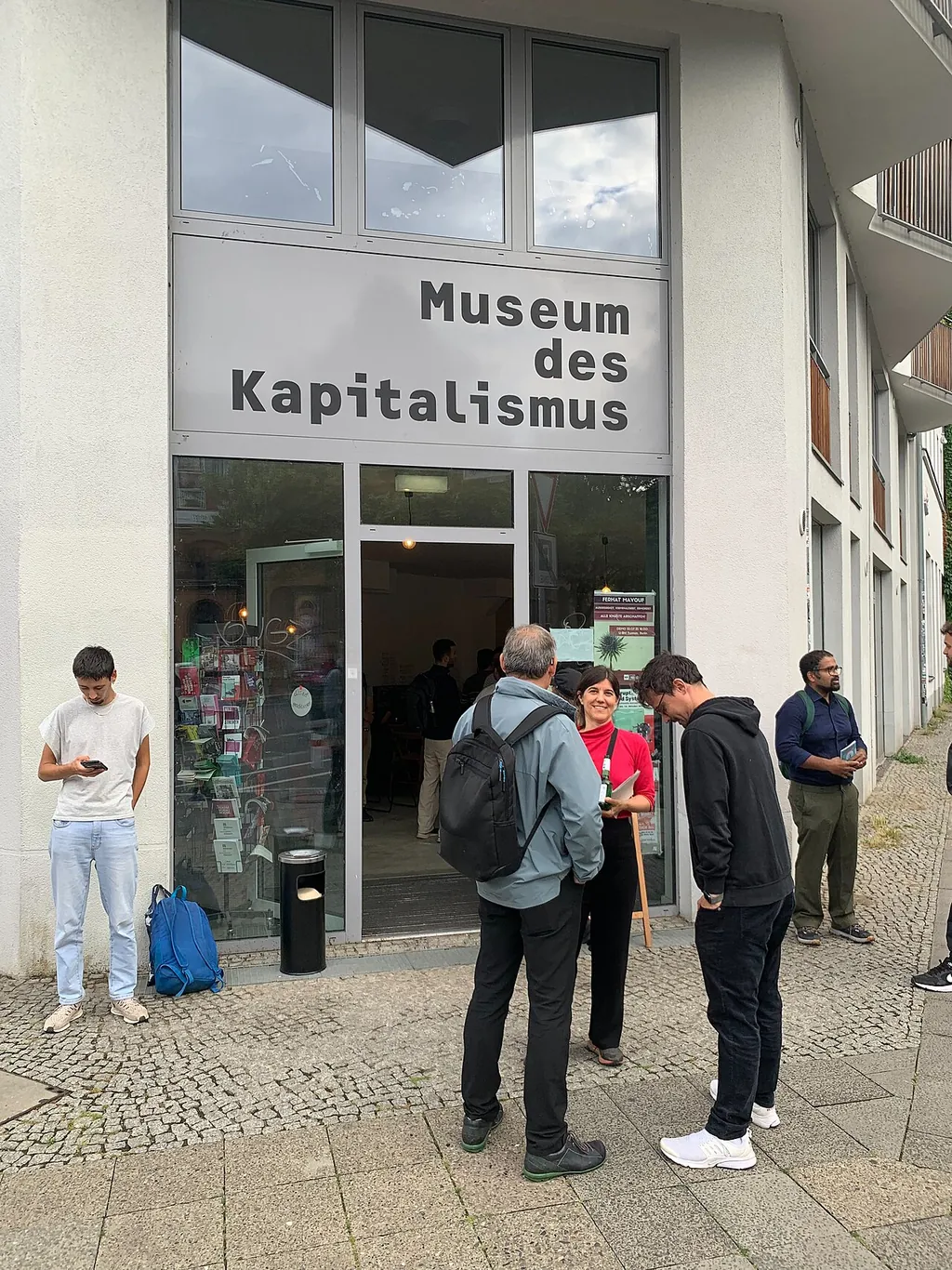
The Museum des Kapitalismus (Museum of Capitalism) sees itself as a self-organized museum "from below": it aims to fill a gap in the museum landscape by making the economic system that shapes work, wages, housing, and global dependencies the subject of an exhibition. The first exhibition, initially temporary, opened in June 2014 in Berlin-Kreuzberg; a second show followed in 2015, and in 2017 the project spent a week as a guest in Hamburg's St. Pauli district.
The museum now has a permanent home at Köpenicker Straße 172 – since February 2018, according to a Berlin city portal. It is run by the Verein für Bildung und Partizipation e. V. (association for education and participation); its work is funded through grants, such as from the Friedrichshain-Kreuzberg district for the current special exhibition, and through donations.
Instead of displaying objects in glass cases, the museum relies on hands-on exhibits that invite visitors to try things out and discuss them: topics include needs and exclusion, crises, colonialism, and possible alternatives. A revised permanent exhibition opened in March 2026. It is complemented by special exhibitions – in 2026, for example, on the history of Berlin tenants' struggles – as well as workshops for school classes and groups, reading circles, and book presentations. The Hans-Georg-Backhaus-Bibliothek, the private library of the Marx scholar comprising some 4,000 volumes, is also set to become a public study library.
Højdepunkter
Interactive permanent exhibition on the mechanisms and consequences of capitalism
Special exhibition "Zur Wohnungsfrage" (On the Housing Question) about Berlin's struggles over housing (until November 7, 2026)
Workshops for school classes and groups, e.g. "Kapitalismus für Anfänger*innen" (Capitalism for Beginners)
Development of the Hans-Georg-Backhaus-Bibliothek with some 4,000 volumes
Free admission
Permanente udstillinger
Museum des Kapitalismus – Revised permanent exhibition that uses interactive exhibits to show how the economic system shapes everyday life, work, and social relationships, leaving room for discussion about alternatives.
Grundlagt
2014
Ejer
Verein für Bildung und Partizipation e. V.
Entrépriser & rabatter
Der er gratis entré.
The official website lists no admission prices and asks for donations; according to Berlin city portals, admission is free. Workshop prices are not stated.
Tilgængelighed
Delvis kørestolsvenlig
Elevator: ingen oplysninger
Handicaptoilet: findes ikke
Handicapparkering: ingen oplysninger
Servicehunde tilladt: ingen oplysninger
Taktile tilbud: ingen oplysninger
Rundvisninger på tegnsprog: ingen oplysninger
Letlæste tilbud: ingen oplysninger
Synstolkning: ingen oplysninger
According to the museum, the space has low-barrier access; there is no wheelchair-accessible restroom.
Børn og familie
Museet har ikke offentliggjort oplysninger om dette – spørg venligst museet direkte.
Transport & parkering
Med offentlig transport
U1 and U3 subway to Schlesisches Tor; bus 165 and 265 to Eisenbahnstraße.
Small bar with cold and hot drinks, mainly during events.
Arrangementer & udlejning
Lokaler til leje
Bryllupper / vielser: findes ikke
Op til 70 personer.
Room of about 148 m² (around 120 m² usable) for artistic, political, and academic events such as seminars, readings, film screenings, or theater, by the hour or by the day. Equipped with a projector, sound system, around 40 chairs, a bar, and a kitchenette. Three-tier pricing: free for non-commercial political projects, plus a standard and a solidarity rate; inquiries via form.
Workshops (about 1.5 to 5 hours) for school classes from grade 7 or 9 and groups on request, including "Kapitalismus für Anfänger*innen" (Capitalism for Beginners), "Kapitalismus & Klima" (Capitalism & Climate), "Klassismus everywhere", and "Climate Justice!"; plus changing public workshop series. The exhibition is multilingual.