Curated solo exhibition in which the sea appears as a connecting element between islands and between personal and collective histories. It addresses the climate crisis, scarcity of resources, migration and environmental justice.
Group exhibition that takes seeds as its starting point for the relationship between humans and the earth. Sculptures, installations, photographs and videos address migration, colonialism, Indigenous knowledge and regenerative futures.
About the museum
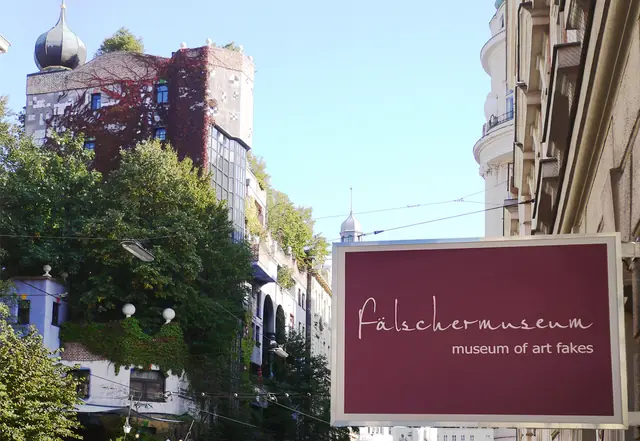
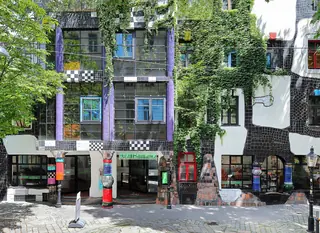
The KunstHausWien arose in the buildings of a furniture factory of the Thonet brothers dating from 1892 in the third district. Between 1989 and 1991 the architect Peter Pelikan converted them according to designs by Friedensreich Hundertwasser: a colourful, glazed front section facing the street, a striking staircase in the courtyard, uneven floors and planted areas were created – a walk-in total work of art.
In April 1991 the house opened as a museum for Hundertwasser’s work and as a venue for international temporary exhibitions, initially with big names in photography. Privately run until 2007, it has since belonged to Wien Holding and is funded by the City of Vienna.
From 2015 the museum re-oriented itself in terms of content as a “green museum” that combines art with questions of climate, environment and sustainability. In 2018 it became the first museum to receive the Austrian Ecolabel; in 2023/24 the energy supply was switched to groundwater heat. Since 2024 the house has organised the Klima Biennale Wien.
The permanent exhibition “Museum Hundertwasser” shows, on two levels, paintings, original prints, tapestries, architectural models and evidence of his ecological commitment – the only permanent museum show on the artist in the world.
Highlights
Building designed by Hundertwasser with uneven floors and tree tenants
World’s largest collection of Hundertwasser’s work
Film about Hundertwasser’s ship “Regentag”
First museum with the Austrian Ecolabel
Café Friedlich in Hundertwasser style
Permanent exhibition
Museum Hundertwasser – On two levels, Hundertwasser’s life, work and worldview are presented – from paintings and prints through tapestries to architectural models and ecological manifestos.
Founded
1991
Operated by
KunstHausWien GmbH (Wien Holding)
Director
Gerlinde Riedl
Admission & discounts
Adults
€16
Reduced
€13Seniors aged 65 and over, people with disabilities, conscripts and civilian service personnel, people without employment, Ö1 Club, Vienna City Card, groups of 10 or more
Children & teens
€7free up to age 10 · Children up to 10 free; children and young people up to 18 €7.
Seniors
€13Aged 65 and over
Visitors with disabilities
€13companion free · Companions of people with disabilities have free admission.
Students & apprentices
€7Students up to 25
Groups (10+ people)
€13 per personReservation is mandatory for groups of 10 or more (even without a tour); maximum 25 people per tour. School classes without a tour €4 per pupil.
Families
€272 adults with 1 to 4 children
Annual pass
€29
Public guided tour (plus admission)
€5
Family Sunday (child aged 4–10, admission included)
€6Accompanying persons reduced admission €13; with the Kinder-Aktivcard child €5, accompanying person €6
Free admission for ICOM members, with the Kulturpass (“Hunger auf Kunst & Kultur”) and with the Niederösterreich-CARD. Tickets on site or in the online shop.
Level side entrance with an automatic sliding door to the left of the main entrance; lift to all levels, accessible toilet in the foyer, café and shop reachable without steps. Because of Hundertwasser’s architecture, the floors are uneven in places. Wheelchair after advance booking (info@kunsthauswien.com), tactile floor plan in the foyer, tactile and audio tour through the Hundertwasser exhibition, and public tours in Austrian Sign Language (ÖGS).
Kids & families
Great for kids & families
Kids’ admission
free up to age 10
Family ticket
€27 · 2 adults with 1 to 4 children
Family tours & workshops
Activity booklet, scavenger hunt or kids’ audio guide
Family Sunday on every 1st and 3rd Sunday at 10:30 am (90 minutes, for children aged 4–10, registration required), children’s workshops and holiday programme. The free activity booklet at the ticket office accompanies children through the Hundertwasser collection with puzzles and drawing ideas.
Getting there & parking
By public transit
Radetzkyplatz · 2-min walk
Tram 1 and O to Radetzkyplatz (approx. 2 minutes on foot); change e.g. from U3/U4 Landstraße (line O), U1/U4 Schwedenplatz (line 1) or U1/U2 Praterstern (line O)
By car
No on-site parking at the museum.
No dedicated car park; multi-storey car parks Tiefgarage Sofiensäle (Blattgasse 14) and Garage Justizzentrum (Marxergasse 1a). Coaches stop at Weißgerberlände or Weißgerberlände/Kegelgasse; two free coach waiting spaces nearby.
By bike along the Danube Canal; numerous bicycle parking spaces and WienMobil-Rad stations nearby. The Hundertwasserhaus is about a five-minute walk away.
Café Friedlich (daily 10 am–6 pm, vegetarian and vegan). Museum shop, also online. Backpacks, suitcases, bags and umbrellas go into lockable lockers.
Events & venue rental
The museum hasn’t published any information on this.
Plan your visit
Guided tours
yes
Audio guide
yes (DE, EN, FR)
School programs
yes
Photography
Photography and filming for private purposes permitted, without flash, tripod or selfie stick; no recording is allowed in the rooms of the Museum Hundertwasser.
Good to know
Audio guide in the Museum Hundertwasser in German, English and French (in temporary exhibitions German and English), as a loan device or for your smartphone (available for 90 days). Public tours as well as bookable group tours in German, English, French and Italian, also in plain language; school classes should register at least three weeks in advance (kunstvermittlung@kunsthauswien.com).