Interactive exhibition for children aged four and over, based on a private collection of around 150 construction sets, with eight play stations and a VR journey into an architectural model. A production of the Deutsches Architekturmuseum.
Solo exhibition by the artist Thomas Demand. Starting from historical stage-set models, he created a photo series specially for the MAK, supplemented by a wall installation and light sources.
The first comprehensive exhibition on the Viennese ceramicist Vally Wieselthier (1895–1945), with objects from European collections, her estate in the US and the archive of the Wiener Werkstätte.
About the museum
The museum was founded in 1863 at the instigation of the art historian Rudolf von Eitelberger as the Imperial and Royal Austrian Museum of Art and Industry. Its model was the South Kensington Museum in London, founded a few years earlier and now the Victoria and Albert Museum. The collection was meant to serve crafts and industry as a pattern collection and, at the same time, to train designers; the School of Arts and Crafts, today's University of Applied Arts, grew out of the museum.
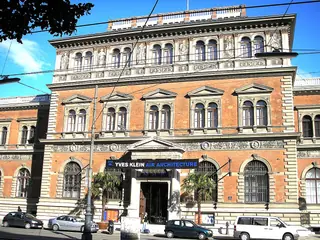
After a transitional period in the Ballhaus on Ballhausplatz, the collection moved in 1871 into the new building by Heinrich von Ferstel on Stubenring – the first museum on the Ringstrasse, designed in the forms of the early Italian Renaissance. Between 1906 and 1909, the large exhibition halls on Weiskirchnerstrasse were added to plans by Ludwig Baumann. Around 1900 the museum was closely linked with the Secession and the Wiener Werkstätte; its archive and the world's largest museum collection of its objects are now housed at the MAK.
The collection comprises around 900,000 objects and printed works – furniture, glass, porcelain, silver, textiles, Asian art, design and contemporary art. Contemporary artists have designed the galleries, for example Tadashi Kawamata the Asian Art Gallery; since 2004, James Turrell's light installation has made the building's windows glow in colour. In 2026 the Vienna 1900 permanent collection was reinstalled together with the artist Markus Schinwald. As a federal museum, the MAK also runs the Geymüllerschlössel in Vienna-Pötzleinsdorf and is involved in exhibition venues in Brtnice (Czech Republic) and Los Angeles.
Highlights
Permanent collection "Vienna 1900 – Everyday Life. Gesamtkunstwerk" with furniture by Hoffmann, Moser, Wagner and Loos
Gustav Klimt's working drawings for the Stoclet Frieze
The world's largest museum collection of the Wiener Werkstätte, including its archive
Frankfurt Kitchen by Margarete Schütte-Lihotzky in the MAK Design Lab
Asian Art Gallery designed by Tadashi Kawamata
Columned Hall in the Ferstel building on the Ringstrasse
Permanent exhibitions
Wien 1900 – Alltag. Gesamtkunstwerk – Newly installed permanent collection, co-designed by the artist Markus Schinwald: ideas and designs of Viennese Modernism from the first Secession exhibition to 1945, from the Wiener Werkstätte to the Stoclet Frieze.
Asien – Permanent collection of ceramics, porcelain and metalwork from China, Japan and Korea in an unusual wooden architecture by Tadashi Kawamata.
MAK Design Lab – A tour of the role of design in climate, society and everyday life, featuring the Frankfurt Kitchen; closed for redesign from 2 November 2026 until probably 8 June 2027.
Founded
1863
Operated by
MAK – Österreichisches Museum für angewandte Kunst (Bundesmuseum)
Director
Lilli Hollein
Visitors per year
approx. 157,154 (2024)
Admission & discounts
Adults
€18
Reduced
€14.50Students under 27, people aged 65 or over or with a pensioner's ID, civil and military service personnel, apprentices, people with disabilities
Children & teens
freefree up to age 18 · Children and young people under 19 free.
Seniors
€14.50From age 65 or with a pensioner's ID
Visitors with disabilities
€14.50companion free · Accompanying person free if noted on the ID.
Students & apprentices
€14.50Students under 27; students of the University of Applied Arts free.
Groups (10+ people)
€15.50 per personFrom 10 people; certified Viennese tour guides free; group bookings via tourism@mak.at.
Tuesday evening 6–9 pm
€8.50online; on site €9.50
Vienna 1900 combination ticket (MAK + Leopold Museum)
€34reduced €30
MAK annual pass
€41Youth (19–25) €31; also valid for the other sites, including one guided tour
Bundesmuseen Card
€99one year of access to all federal museums and the Austrian National Library
Guided tour (1 hour, plus admission)
€5.5030-minute tour €3
Online prices: regular €18, reduced €14.50; on site €19 and €15.50 respectively. Free admission with, among others, the Vienna Pass, Niederösterreich-CARD, Kulturpass ("Hunger auf Kunst und Kultur"), ICOM, Museumsbund Österreich, and for accompanying persons of school classes.
All levels of the main building and the exhibition building can be reached by wheelchair-accessible lift; step-free entrance at the main entrance, Stubenring 5. Accessible toilets on levels 0 and −1. Disabled parking at Weiskirchnerstrasse 3 (opposite Stadtpark). Design Shop and restaurant on the ground floor, reachable without steps through the museum.
Kids & families
Great for kids & families
Kids’ admission
free up to age 18
Family tours & workshops
Family tour Mini MAK and family workshop MAK4Family (each from age 4) as well as MAK Design Kids, a workshop for 8- to 12-year-olds without accompanying adults. Children and young people under 19 enter free of charge.
Getting there & parking
By public transit
Stubentor
U3 and tram 2 as well as bus 3A and 74A to Stubentor; U3, U4, S-Bahn (S1, S2, S3, S4, S7) and City Airport Train to Landstraße/Wien Mitte.
By car
Coaches: drop-off and pick-up point right at the MAK on Weiskirchnerstrasse.
Accessible parking
Bicycle racks in front of the entrance; the porter helps with breakdowns using a repair kit.
Restaurant Salonplafond at the MAK (daily 10 am–midnight, from breakfast to drinks). MAK Design Shop on the ground floor. Cloakroom free of charge (unstaffed in summer), lockers against a €2 deposit; backpacks, umbrellas and large bags are not allowed in the exhibition. Free Wi-Fi throughout the building.
Events & venue rental
Spaces for rent
Corporate events
The Columned Hall, exhibition halls (around 2,700 m²), lecture hall and MAK Lounge can be hired for receptions, gala dinners, presentations, conferences and seminars. Apart from the lecture hall, the rooms are let without furniture and technical equipment; catering is freely selectable. Certified Green Location.
Filming and photography for private purposes are permitted without flash and tripod; commercial recording only with permission.
Good to know
Free digital MAK Guide on your own smartphone (guide.mak.at) with audio pieces on 100 objects. Regular tours: MAKtour on Sundays at 11 am, "short and sweet" (30 min.) on Tuesdays at 6:15 pm, tours of Vienna 1900 on Saturdays at 3 pm (English) and Sundays at 3 pm (German). School programmes for 3- to 18-year-olds. Animals other than assistance dogs are not allowed.