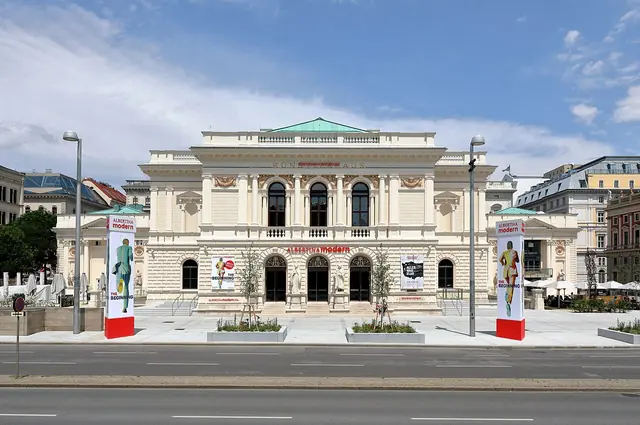
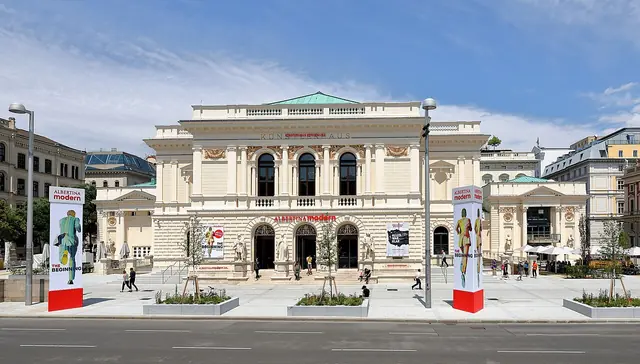
Former residential palace of Prince Eugene in Vienna with baroque state rooms, the Orangery for temporary exhibitions and the Medieval Gallery in the Prunkstall.
Major solo show on the Austrian-American artist and educator (1900–1957): Kinetism, links to theatre and dance, her time in New York and her interest in children’s art, with new research findings.
The first major retrospective in Austria of the Polish avant-garde artist (1913–2004), with around 80 paintings, drawings and assemblages on persecution, loss and mourning.
About the museum
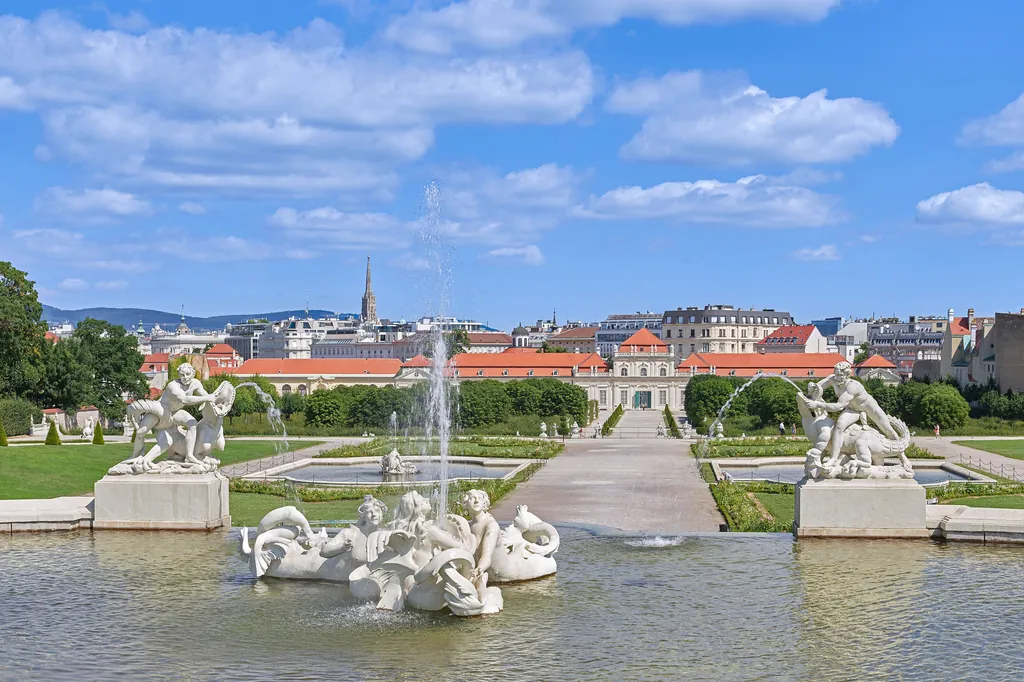
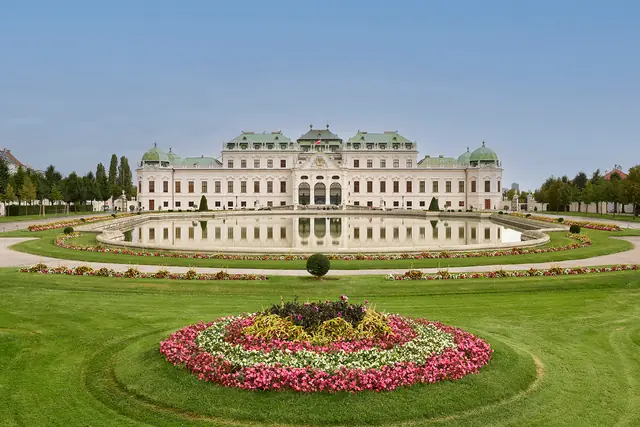
The Lower Belvedere was built from 1712 to designs by Johann Lucas von Hildebrandt as the residence of the military commander Prince Eugene of Savoy at the lower end of his summer palace on the Rennweg. Only afterwards came the grand Upper Belvedere at the upper end of the garden. Besides the palace with its state rooms – including the Marble Hall, Marble Gallery, Grotesque Hall and Gold Cabinet – the ensemble also includes the Orangery, the Prunkstall and the Kammergarten.
Some years after the prince's death (1736), Maria Theresa acquired the complex in 1752. At that time, gilded wall sections with grotesque painting from Eugene's former winter palace in the Himmelpfortgasse were moved to the Lower Belvedere and, together with new flower panels, formed the Gold Cabinet, originally the prince's bedroom. As early as 1813 the room was first used as a museum, for decorative arts from the imperial Ambras Collection.
In 1903 the Moderne Galerie opened in the Lower Belvedere, from which today's Österreichische Galerie Belvedere emerged. From 1923 to 2007 the Baroque Museum was housed here. Bomb hits damaged the palace in 1945, destroying the Grotesque Hall among other places. Since 2007 the converted Orangery has served as a space for temporary exhibitions, and part of the medieval collection has been on view in the Prunkstall since then.
Today the Belvedere mainly shows changing exhibitions here that lead through the historic state rooms, as well as the Medieval and Renaissance Gallery with works from the 14th to the 16th century. The Gold Cabinet was comprehensively restored for a year in 2024/25.
Highlights
Prince Eugene's baroque state rooms with the Marble Hall, Marble Gallery and Grotesque Hall
Gold Cabinet, accessible again in 2025 after a year of restoration
Salzburg Altarpiece by Rueland Frueauf the Elder in the Medieval and Renaissance Gallery
Panel paintings by Michael Pacher and sculptures by the Master of Großlobming
Orangery with changing exhibitions
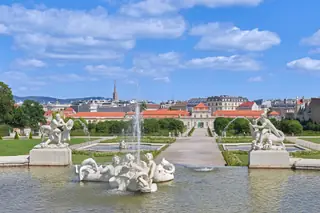
Kammergarten and view across the palace garden to the Upper Belvedere
Permanent exhibition
Galerie Mittelalter und Renaissance – In the former Prunkstall next to the Orangery: panel paintings and sculptures from the mid-14th to the first half of the 16th century, with the Salzburg Altarpiece by Rueland Frueauf the Elder as the principal work.
freefree up to age 18 · Children and young people under 19 free.
Seniors
€16From age 65
Visitors with disabilities
€8companion free · With disability pass; accompanying person free if the need is noted in the pass.
Students & apprentices
€16Students under 26
Groups
–Free reservation is mandatory for groups.
Vienna City Card
€18.50
2-in-1 day ticket Upper + Lower Belvedere
€32Reduced €25, with disability pass €10, with Vienna City Card €29.50; the time slot applies to the Upper Belvedere, the Lower Belvedere can be visited before or after on the same day.
3-in-1 day ticket Upper + Lower Belvedere + Belvedere 21
€34Reduced €27, with disability pass €12
Gold Pass (one year, all three sites, no time slot)
€49Gold Pass +1 €69, Gold Pass U26 €29
Bundesmuseen Card
€99one year of access to all federal museums
Prices change daily; the prices given are those of 15 October 2026. Free admission and free audio guide with Kulturpass ("Hunger auf Kunst und Kultur"), tickets for this at the ticket desk. With Gold Pass, Friends card, Bundesmuseen Card, Vienna Pass, Flexi Pass or ICOM card, go straight to the entrance without a time-slot ticket.
Accessibility
Wheelchair accessible
Elevator
Accessible restroom
Accessible parking
Service dogs welcome
Tactile models & exhibits: no information
Sign language tours: no information
Easy-to-read materials: no information
Audio description: no information
Step-free access via a ramp next to the main entrance in the courtyard; all areas reachable by lift, accessible toilets. One disabled parking space in the courtyard at Rennweg 6. Wheelchairs can be borrowed free of charge. Assistance dogs only with certificate and entry in the disability pass. The path through the palace park to the Upper Belvedere is not accessible.
Kids & families
Great for kids & families
Kids’ admission
free up to age 18
Family tours & workshops
Family programmes and tours "With Baby in the Museum". Children and young people under 19 have free admission.
Getting there & parking
By public transit
Unteres Belvedere
Tram 71 to Unteres Belvedere; tram D to Gußhausstraße.
By car
Paid parking
Discounted up to 6 hours for €6 in the BIP garages Palais Schwarzenberg (Schwarzenbergplatz 9, entrance Prinz-Eugen-Straße, access from Rennweg opposite Traungasse) and Schwarzenbergplatz (Schwarzenbergplatz 5, entrance Am Heumarkt 39) if the parking ticket is validated at a Belvedere ticket desk (not with a parking app); garages open around the clock.
Accessible parking
Bicycle parking at the Rennweg entrance; Citybike station and e-charging station nearby.
Park café (daily 10 am–6 pm). Shop in the palace, also accessible without a ticket (daily 10 am–6 pm). Free lockers; there is no left-luggage service for suitcases. Coats, umbrellas, backpacks and larger bags are not allowed in the exhibition rooms.
Events & venue rental
Spaces for rent
Private parties
Up to 180 guests.
Available for hire are the Marble Gallery (gala dinner for up to 120, theatre-style seating for up to 160, reception for up to 180 people), the Grotesque Hall (dinner for up to 60, theatre-style for up to 100, reception for up to 90 people), and the Gold Cabinet and Kammergarten on request.
Photography and filming only for private purposes without flash, tripod or selfie stick; individual rooms, exhibitions or works may be off limits.
Good to know
Regular tour formats such as "Overview", "In Focus" and "Hands-on" according to the programme. With a tour ticket the time slot is booked automatically; collect tickets at the ticket desk 15 minutes before the start. Groups must reserve free of charge.