Het Stadsmus
City museum of Hasselt in the patrician house Stellingwerff-Waerdenhof, with the history of the city, Hasselt ceramics and free exhibitions.
Have only individual sections read aloud
About the museum
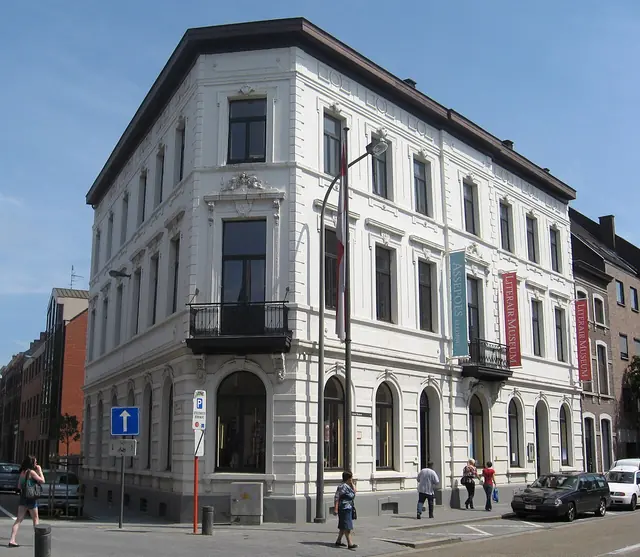
Het Stadsmus is Hasselt's city museum. It is housed in the Stellingwerff-Waerdenhof building, a patrician house on the corner of the Maastrichterstraat and the Guido Gezellestraat. The oldest part, the Waerdenhof, first appears in the sources around 1450 as a half-timbered house made of clay. Later it was the winter residence of the lords of Mombeek, coins were minted there for the Prince-Bishop of Liège, and the highest court of appeal of the County of Loon sat there. At the end of the 17th century mayor Jan Renier de Geloes had the house replaced by a stone building.
In 1829 the building came into the hands of the gin-distilling Jacobs family. In 1856 Peter Jacobs replaced the north wing with a large mansion modelled on a Venetian palazzo, probably the largest private residence in the city. Later it became the home of the Stellingwerff family. In 1926 the city bought the complex and housed there, among other things, the music and art academy, the archive, the library and, temporarily, a museum.
The house has been a protected monument since 1980. After a three-year restoration (1986–1989) the municipal museum found a permanent home there; since 2005 it has been called Het Stadsmus. Today the museum tells the story of Hasselt: the growth of the city, associational life, festivities and traditions, and its military past. It also keeps sub-collections such as Hasselt ceramics and contemporary art. The collection numbers more than 8,000 objects, including masterpieces recognised by the Flemish Community, such as the Monstrance of Herkenrode.
Highlights
- Permanent exhibition on the history of Hasselt, from the first traces of settlement to the present
- Monstrance of Herkenrode, the oldest known monstrance in the world
- Hasselt ceramics from the ceramics factory (1890–1954)
- Hasselt art, mainly from the 19th and 20th centuries
- Museum garden with artworks, free during opening hours
- Free admission to the exhibitions
Permanent exhibitions
- Vaste tentoonstelling: de geschiedenis van Hasselt – A journey through the past of Hasselt, from the first traces of settlement to today's Limburg capital, with archaeological finds, historical objects, artworks and Flemish masterpieces.
- Museumtuin – Garden next to the museum with artworks by, among others, Willy Ceyssens, Gerard Moonen and Hugo Donné, free to visit during opening hours.
- Operated by
- Stad Hasselt
Admission & discounts
Admission is free.
| Groups | –The group rate for the museum is free; the guide costs €80 for a Dutch-speaking guide and €90 for a guide in another language (maximum 20 people per guide, 1.5 hours). Group visits must be requested at least two weeks in advance. |
|---|
The exhibitions are free for everyone; for some temporary exhibitions and activities you pay an admission price. With the HasPas or the museumPASSmusées you can visit several museums; with the UiTPAS you collect or spend points on activities. Payment can be made in cash or by Bancontact.
Accessibility
- Wheelchair accessible
- Elevator: no information
- Accessible restroom
- Accessible parking: no information
- Service dogs welcome
- Tactile models & exhibits: no information
- Sign language tours: no information
- Easy-to-read materials: no information
- Audio description: no information
Visitors using a wheelchair or pushchair use a separate, step-free entrance via the inner courtyard with a ramp; if the door is closed, you can ring the bell. Assistance dogs are welcome. There is an adapted toilet. A folding stool can be borrowed free of charge at reception. There is an accessibility guide on the website.
Kids & families
Great for kids & families
- Family tours & workshops
- Activity booklet, scavenger hunt or kids’ audio guide
- Stroller-friendly
- Baby changing facilities
For families there is, among other things, the family treasure hunt “Op zoek naar de Langeman” (ages 5 to 8) and an audio walk for children through Hasselt; if you do not want to hire a tablet, you can request the files by email. There is a baby changing table, and pushchairs can use the step-free entrance.
Getting there & parking
By public transit
Dusartplein
The museum is within walking distance of Hasselt station. By bus, get off at the Dusartplein or Kunstlaan stops.
By car
No on-site parking at the museum.
The museum has no car park of its own; if necessary, visitors can be dropped off in the inner courtyard. The nearest paid car parks are Blauwe Boulevard and Dusart.
The museum is five minutes from the Grote Markt, on the corner of the Maastrichterstraat and the Guido Gezellestraat. There is a bicycle shelter at the door and in the inner courtyard; at Capucienenplein, two minutes' walk away, there is a monitored bicycle park.
Get directionsAmenities & dining
- Museum shop
The museum has a museum shop. In the museum garden next to the museum you can read a book or have a picnic.
Events & venue rental
The museum hasn’t published any information on this.
Plan your visit
| Guided tours | yes · approx. 1.5 hrs |
|---|---|
| Audio guide | yes (NL, FR, EN) |
| School programs | yes |
| Good to know | Exhibition texts and audio guides are available in Dutch, French and English. Guided tours for groups are possible in Dutch, French, English and German; the guide costs €80 or €90 (maximum 20 people). The museum garden is reached via the gate next to the museum, during the museum's opening hours. |