Fort de Bellegarde
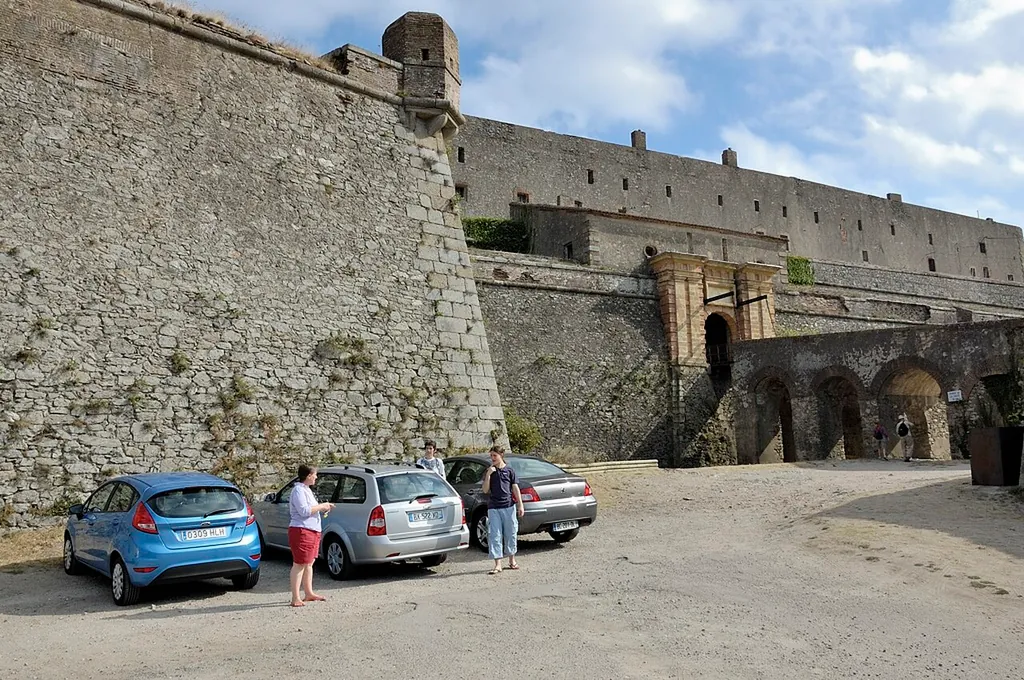
Vauban fortress above the Col du Perthus, with exhibitions on the site's history, the Franco-Spanish border and the Retirada.
No sound? Check your device’s silent switch.
Have only individual sections read aloud
About the museum
The Bellegarde hill, 423 m high, overlooks the Perthus and Panissars passes, the lowest crossings of the Pyrenees. A signal tower was probably the first military structure on the summit. A medieval fort is first mentioned here in 1324. It became French in 1659 with the Treaty of the Pyrenees.
During the Dutch War, the Spanish captured Bellegarde in 1674 and were driven out in 1675. This conflict showed how important the site was, and France decided to build a modern fortress. The military engineers Saint-Hilaire and Vauban drew up the plans; work lasted from 1670 to 1688. The fort could house 1,200 soldiers and 150 horses and covered 14 hectares, with 8,000 m² of buildings.
The site has no natural water source. Five cisterns were planned; in the end a 63 m deep well was dug into the rock. The fort was besieged in 1793 and retaken by the French in 1794. It was then used by Napoleon's troops, as a hospital in 1939, and as quarters for German soldiers from 1943 to 1945.
The commune of Le Perthus has bought the fort. Today it is open to visitors in season, with permanent exhibitions on the history of the site, the border and the Retirada, as well as temporary art exhibitions.
Highlights
- Vauban fortress of 14 hectares above the border
- 63 m deep well cut into the rock
- Drawbridges of the Portes de France and d'Espagne
- Exhibitions on the border and the Retirada
- View over the Roussillon plain and the Empordà
Permanent exhibition
- Histoire du fort, de la frontière et de la Retirada – Several rooms trace the history of the military site, the Franco-Spanish border and the exile of Spanish Republicans in 1939.
- Operated by
- Commune du Perthus
Admission & discounts
| Adults | €6 |
|---|---|
| Reduced | €5Children aged 6 to 12, students, groups of 10 or more and adults with disabilities |
| Children & teens | €5free up to age 5 · Free admission for children under 6. |
| Visitors with disabilities | €5Reduced rate for adults with disabilities. |
| Students & apprentices | €5 |
| Groups (10+ people) | €5 per personReduced rate for groups of 10 or more. |
| Guided tour, adult | €8 |
The €6 fee covers an independent visit. Payment by cash, Eurocard-Mastercard or Visa.
Accessibility
- Wheelchair accessible: no information
- Elevator: no information
- Accessible restroom: no information
- Accessible parking: no information
- Service dogs welcome: no information
- Tactile models & exhibits: no information
- Sign language tours: no information
- Easy-to-read materials: no information
- Audio description: no information
Accessibility is not described in detail; only a reduced rate for adults with disabilities is mentioned. Animals are welcome.
Kids & families
| Kids’ admission | free up to age 5 |
|---|
Free admission for children under 6 and a reduced rate for children aged 6 to 12.
Getting there & parking
By car
Parking available
The commune mentions a car park; an access map is available on its website. The regional tourist office also mentions coach parking.
The fort overlooks the border town of Le Perthus, right beside the A9 motorway.
Get directionsAmenities & dining
The museum hasn’t published any information on this.
Events & venue rental
The museum hasn’t published any information on this.
Plan your visit
| Guided tours | yes |
|---|---|
| Good to know | The fort can be visited independently or with a guide; guided tours take place at fixed times. |