November 5, 2026 – September 19, 2027
Sauvage
An exhibition adapted from the Muséum de Neuchâtel on our representations of the “wild”: everyday objects, scientific collections and reflection on biodiversity and our relationship with non-human life.

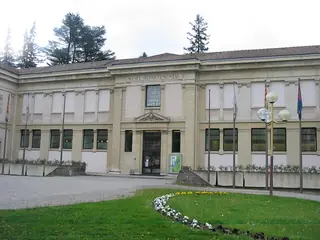
Departmental museum in Gap, housed in a 1910 neoclassical building, presenting the natural history, archaeology and ethnology of the Hautes-Alpes.
November 5, 2026 – September 19, 2027
An exhibition adapted from the Muséum de Neuchâtel on our representations of the “wild”: everyday objects, scientific collections and reflection on biodiversity and our relationship with non-human life.
June 19, 2026 – May 23, 2027
The visual artist Philippe Comar confronts his observational drawings with natural history collections, from botanical plates to taxidermied specimens, and questions how we look at and classify living things.
June 19, 2026 – May 23, 2027
A display devoted to the poster artist Lucien Achille Mauzan, born in Gap in 1883: prints, postcards, previously unseen drawings and behind-the-scenes documents from a donation by his heirs.
The museum’s origins go back to the early 19th century, when the prefect of the Hautes-Alpes, Baron de Ladoucette, proposed creating a natural history museum with a botanical garden in Gap, near the École centrale. The first building project was abandoned after the foundation stones were laid, but it encouraged local collections of mineralogy, archaeology and numismatics.
The decisive step came in 1892 with the donation of the collection of naturalist Léon Olphe-Galliard. A public subscription then financed a new building designed by the departmental architect Léon Chaudier: a neoclassical structure with a base of pink stone from Guillestre and a monumental staircase. The museum opened in September 1910 and later expanded its collections of regional ethnology, initially focused on the Queyras.
A renovation carried out in 1986 by architect Georges Dusserre doubled the exhibition space. The current permanent display covers five levels and 1,600 m² and addresses how people live, know, create and exchange in the mountains, with natural history, painting, archaeology and ethnology.
Admission is free.
Admission is free all year round, activities included, though visitors must still check in at reception. Quarterly activities (tours, workshops, lectures) are free upon registration.
Lifts serve all levels, and a wheelchair can be borrowed at reception. There is a parking space for people with reduced mobility in front of the museum. Folding seats are lent on request. Induction loops are available at the reception, the lecture hall and the Micro-Folie area, and some videos have subtitles. A thermoforming machine allows certain works to be reproduced in relief, and room sheets can be printed in large print; documents in easy-to-read language are available on request (advance preparation: call the museum). For groups, tactile, sensory, audio-described or sign-language tours can be organized as part of a project. Only guide dogs for the blind are admitted.
Great for kids & families
| Time needed | approx. 60 min |
|---|
Booklets and small games are available at reception or for download. A small room for young children is located on the second floor; strollers may enter the galleries, and the basement toilets have a changing table.
The museum is located in the Pépinière park, 6 avenue Maréchal Foch in Gap.
Get directionsBookshop (books and catalogues on the collections and local history, children’s books, souvenirs). No cloakroom: free-access lockers are available for backpacks and bulky items. No café or restaurant; picnicking in the Pépinière park is possible in good weather. Umbrellas and bulky items are not allowed in the galleries.
The museum hasn’t published any information on this.
| Guided tours | yes |
|---|---|
| School programs | yes |
| Dogs | not allowed (assistance dogs excepted) |
| Good to know | Recommended visit duration: one to one and a half hours. Guided tours are for groups only, on request; groups can also book a self-guided visit by phone. Animals are not admitted. A heritage library is open on request to students, researchers and heritage professionals. |
Loading experiences …