Villa gallo-romaine de Plassac
Departmental archaeological site on the Gironde estuary with the remains of three Gallo-Roman villas, mosaics and an association-run museum.
No sound? Check your device’s silent switch.
Have only individual sections read aloud
About the museum
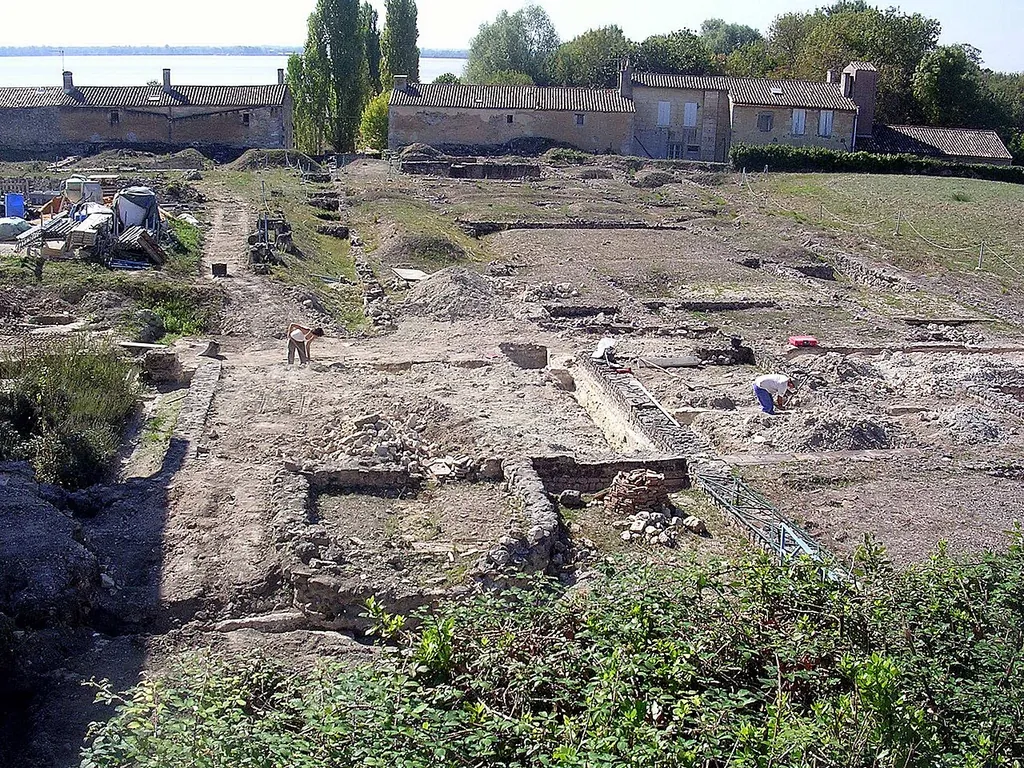
The village's name comes from a Gallo-Roman estate, Blacciacum, which the Bishop of Le Mans, Bertechramnus, bequeathed to his church in his will of 615. The villa was then forgotten. In the 19th century, mosaics discovered by chance recalled its existence beneath the Church of Saint-Pierre. Excavations begun in 1962 then revealed the residential part of a large farming estate.
The site bears traces of three successive building phases, built between the 1st and the early 5th century, based on Italian models. The first villa dates from the years 20 to 40 AD. The second, from the early 2nd century, covered about 5,000 m² around a double courtyard with a peristyle, overlooking the estuary. The last, from the late 4th century, was decorated with polychrome mosaics of the Aquitaine school, of which more than 100 m² are visible on site. Listed as a historic monument in 1975, the estate has belonged to the Gironde Department since 1984, which restored it with walkways and a covered platform.
The site museum occupies an outbuilding of the former presbytery, now the town hall. Created in 1985 by the association Amis du Vieux Plassac, which still runs it, it displays finds from the excavations, a large collection of painted wall plasters, marbles from distant provinces and a 3D reconstruction of the 2nd-century villa. It is currently closed, but the site remains open and guided tours continue.
Highlights
- Remains of three successive Gallo-Roman villas, from the 1st to the 5th century
- More than 100 m² of polychrome mosaics visible on site
- Panorama over the Gironde estuary from the villa's viewpoint
- Association museum with Pompeian-style wall paintings and excavation finds (currently closed)
- 3D reconstruction of the 2nd-century villa and documentary on the re-laying of the mosaics
Permanent exhibition
- Vestiges des villas gallo-romaines – Route across the site with the remains of three villas, the portico, the peristyle and the mosaic floors.
- Founded
- 1985
- Operated by
- Département de la Gironde ; musée géré par l'association des Amis du Vieux Plassac
Admission & discounts
Admission is free.
The visit to the archaeological site is free. The association museum, currently closed, charges admission: €5 for adults and €3 for children aged 8 to 16 and for groups of more than 10 people; free for children under 8.
Accessibility
- Wheelchair accessible
- Elevator: no information
- Accessible restroom: no information
- Accessible parking: no information
- Service dogs welcome: no information
- Tactile models & exhibits: no information
- Sign language tours: no information
- Easy-to-read materials: no information
- Audio description: no information
The site is announced as accessible to people with reduced mobility.
Kids & families
The museum hasn’t published any information on this.
Getting there & parking
By public transit
From Blaye, tourist train to the villas.
By car
Parking available
Two car parks near the site: near the church and near the town hall.
By car from Bordeaux: motorway A10, exit 40a (direction Royan – Blaye) then towards Blaye, or exit 40b via Bourg-sur-Gironde. The site is about 3 km south of Blaye.
Get directionsAmenities & dining
The museum hasn’t published any information on this.
Events & venue rental
The museum hasn’t published any information on this.
Plan your visit
| Guided tours | yes · approx. 40 min |
|---|---|
| School programs | yes |
| Good to know | Guided tours of the site are provided by mediators. In July and August, departures are announced at 11:00, 14:45 and 16:30. Self-guided visits are possible thanks to numbered panels from 1 to 6. A visitor guide can be downloaded from the Department's website. |