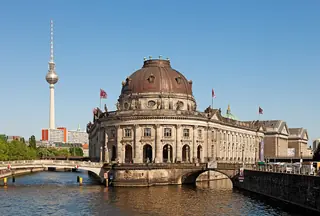
Neo-Baroque domed building at the northern tip of Museum Island, housing a sculpture collection, Byzantine art, and one of the largest coin cabinets in the world.
Medals and coins, including ones featuring George Washington, shed light on American independence in the Münzkabinett; part of the SPK program initiative “We the People.”
First public display of the official portrait of Chancellor Angela Merkel, painted by Jérémie Queyras, before it moves to the Galerie im Bundeskanzleramt.
In the crypt beneath the Kleine Kuppel, the Skulpturensammlung and the Gipsformerei display the restored plaster model of the famous baptismal font from Siena and tell its story.
This exhibition makes the building itself its subject, linking its eventful history, through the German Empire, the world wars, and division, with the history of Berlin.
About the museum
The Bode-Museum was built from 1897 to 1904 to plans by court architect Ernst von Ihne at the northern tip of Museum Island. The three-winged building with its striking dome was placed directly on the riverbank, so it seems to rise out of the Spree. It opened in 1904 as the Kaiser-Friedrich-Museum. The exhibition concept came from Wilhelm von Bode, then director of the Gemäldegalerie and the Skulpturensammlung and later Generaldirektor of the Royal Museums: for the first time, painting, sculpture, and decorative arts were to be shown side by side with equal standing, in rooms designed in the style of their periods.
Severely damaged in World War II, the building was gradually restored between 1948 and 1986, and in 1956 it was renamed the Bode-Museum in honor of its intellectual father. After the reunification of Berlin’s museums, a comprehensive renovation followed, based on modern museum and heritage-conservation standards; since 2006, the museum has been fully open again.
Today, it houses the Skulpturensammlung, the Museum für Byzantinische Kunst, and the Münzkabinett, plus paintings from the Gemäldegalerie. The Skulpturensammlung is among the world’s most important holdings of older sculpture, from the early Middle Ages to the late 18th century, with works by Donatello, Tilman Riemenschneider, and Antonio Canova. The Museum für Byzantinische Kunst displays late antique and Byzantine art from the 3rd to the 15th century. The Münzkabinett holds more than half a million objects; around 4,000 coins and medals trace the history of money from the first coins minted in the 7th century BC to the euro.
Highlights
Donatello: Pazzi-Madonna
Tilman Riemenschneider: Vier Evangelisten vom Münnerstädter Altar
Antonio Canova: Tänzerin
Apse mosaic from Ravenna
Münzkabinett with around 4,000 coins and medals on display
The Große and Kleine Kuppelhalle, the Basilika, and the Merseburger Spiegelkabinett
Permanent exhibitions
Skulptur und Malerei 13.–18. Jahrhundert – European sculpture from Gothic to Neoclassicism, shown alongside paintings from the Gemäldegalerie.
Spätantike und Byzantinische Kunst – Works of late antiquity and the Byzantine Empire from the 3rd to the 15th century, including the apse mosaic from Ravenna.
Münzen und Medaillen – With around 4,000 objects, the Münzkabinett tells the story of money and culture from antiquity to the present.
Founded
1904
Operated by
Staatliche Museen zu Berlin – Stiftung Preußischer Kulturbesitz
Director
Antje Scherner (Direktorin der Skulpturensammlung und des Museums für Byzantinische Kunst)
Visitors per year
approx. 210,245 (2023)
Admission & discounts
Adults
€14
Reduced
€7school pupils, apprentices, university students, volunteers in the BFD or FSJ programs, job seekers receiving ALG I, and people with severe disabilities (GdB 50 or higher), each with proof
Children & teens
freefree up to age 17 · Children and young people up to their 18th birthday are admitted free (free ticket available at the box office or online).
Seniors
–No senior discount.
Visitors with disabilities
€7companion free · Reduced admission for GdB 50 or higher; a companion whose medical need is recognized is admitted free if noted on the severe disability ID.
Students & apprentices
€7Students and school pupils receive a 50% discount; admission is free within registered courses or school class visits.
Groups (10+ people)
–Groups of 10 or more must register at least two weeks in advance (online ticket shop or information service). Admission is charged at the individual rate plus a €10 registration fee per (sub)group; groups of 25 or more are split.
Families
–No family ticket; children and young people under 18 are admitted free.
Day tickets; online advance sales open four weeks ahead. An audio guide in German and English is included in the ticket price. Museum Island ticket (area pass): €24, reduced €12, valid for one day for all Museum Island houses of the Staatliche Museen (Alte Nationalgalerie, Altes Museum, Bode-Museum, Neues Museum, Pergamonmuseum. Das Panorama), as well as the Friedrichswerdersche Kirche and PETRI Berlin. Berlin Museum Pass (3 days, over 30 museums): €32, reduced €16. Annual passes Basic, Classic, and Classic Plus. Free admission for, among others, recipients of Bürgergeld, Wohngeld, Grundsicherung, or benefits under the AsylbLG, ICOM members, and press.
Museum passes & city cards
Berlin WelcomeCard · free admission · Free admission only with the Museumsinsel or all-inclusive option; applies to the permanent exhibition.
According to the Staatliche Museen, the museum is partially wheelchair accessible. According to “Reisen für Alle,” the exhibition levels can be reached by elevator or platform lift (including a stairlift to the Große Kuppelhalle and a platform lift to the basement). Accessible restroom and changing table according to the floor plan. Loaner wheelchairs are available on request, arranged in advance with the information service (030 266424242, Mon–Fri 9:00–16:00). Only trained assistance dogs are allowed.
Kids & families
Great for kids & families
Kids’ admission
free up to age 17
Family tours & workshops
Activity booklet, scavenger hunt or kids’ audio guide
Baby changing facilities
A free “Schreib Kritzel Block” activity pad for visitors aged 6 and up is available at the museum ticket desk. Family festivals and activity days, as well as programs from the lab.Bode education lab. Changing table according to the floor plan. According to the usage rules of the Staatliche Museen, certain strollers may have to be exchanged for strollers provided by the museum; children may not be carried in backpack carriers or on shoulders.
Getting there & parking
By public transit
S-Bahn and U-Bahn to Friedrichstraße, S-Bahn to Hackescher Markt; tram to Am Kupfergraben or Hackescher Markt; bus to Friedrichstraße or U Museumsinsel.
By car
No on-site parking at the museum.
The Staatliche Museen recommend arriving by public transport or bicycle.
Café in the Bode-Museum (Tue–Sun 10:00–18:00) and the Walther König bookshop (Tue–Sun 12:00–18:00). Cloakroom, lockers, Wi-Fi, and workshop rooms according to the floor plan. Luggage larger than 30 × 20 × 10 cm must be checked; travel luggage is not accepted. Education program lab.Bode and offerings for schools.
Events & venue rental
Spaces for rent
Corporate events
Up to 300 guests.
Events outside opening hours can be arranged through Museum&Location, the events company of the Staatliche Museen: standing receptions in the Große Kuppelhalle and on the balcony for up to 300 guests, dinners in the Basilika for up to 150 guests, and meetings, conferences, and concerts in the Gobelin-Saal for up to 100 guests.