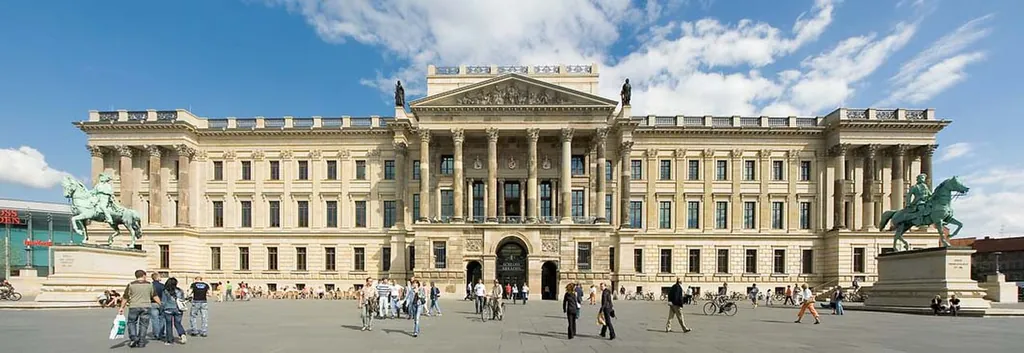
In the rebuilt residential palace, reconstructed state rooms with original furniture evoke the Guelph court of Braunschweig; plus the Quadriga viewing platform.
Opening hoursAdmission from €5 Wheelchair accessible
Drawings and clay works made by children and young people from the Jugendkunstschule (youth art school) during project weeks in the exhibition on animals in the palace.
The exhibition is devoted to the Stobwasser lacquerware manufactory and other workshops that produced painted papier-mâché pieces under Duke Carl I, sold across Europe; with an accompanying program.
A small presentation with photos, a hiking log and equipment on the love of hiking and nature of the last Duchess of Braunschweig; no end date has been announced.
About the museum
The history of Braunschweig’s residential palace spans three buildings. From 1717 Duke August Wilhelm had the so-called Grauer Hof (Gray Court) built; in 1753/54 Duke Carl I moved the entire court from Wolfenbüttel to Braunschweig. During the uprising against Duke Karl II in 1830, the palace went up in flames. His brother Wilhelm then had court architect Carl Theodor Ottmer build a new Neoclassical palace, which he moved into in 1837; the Quadriga on the portico was not added until 1863. With the abdication of Duke Ernst August in November 1918, its time as a residence came to an end.
In the 1920s the palace became a cultural venue, including a museum in the former private and state rooms. From 1935 the Nazis converted it into an SS Junker school (officer cadet school). Half destroyed in the Second World War, the ruin was demolished in 1960 after a narrow council vote, and a park was created in its place.
In 2003 the city council decided to reconstruct the palace in connection with the development of the Schloss-Arkaden shopping center. Around 650 salvaged original stones were incorporated; the building was completed in 2007, followed by a reconstructed Quadriga in 2008. On the first floor of the north wing, the Stiftung Residenzschloss Braunschweig, founded in 2010, set up the Schlossmuseum, which opened on April 9, 2011.
For the show rooms, furniture, paintings and furnishings from the old palace that had survived in museums and private hands were tracked down over many years; many were reacquired at the 2005 Guelph auction at Marienburg Castle. Wallpapers, ceilings and floors were recreated based on historical sources. As a “museum of interior art”, the museum thus conveys the apartments of Duke Wilhelm, complemented by themed rooms on the palace, the duchy and the Guelphs. The same building houses the city library and the city archives.
Highlights
Reconstructed throne room with rewoven silk wall coverings and original gilded furniture
Suite of Duke Wilhelm’s apartments: music room, study and audience room with original furniture
Media stations of the “Historical Menu”, designed as a dining table
Guelph family tree from the 11th century to the present
Quadriga platform with Brunonia, the city’s goddess, and views over Braunschweig
Permanent exhibitions
Zeitreise: Vom Thronsaal zum „Historischen Menü“ – The permanent exhibition leads through Duke Wilhelm’s reconstructed private and state rooms up to the throne room and, in themed rooms with media stations, information panels and films, tells the story of the palace, the Guelphs and the duchy.
Founded
2011
Operated by
Stiftung Residenzschloss Braunschweig
Director
Helga Berendsen (Museumsleitung)
Admission & discounts
Adults
€5
Reduced
€2School students aged 16 and over, apprentices, university students up to age 28, FSJ and BFD volunteer-service participants, Braunschweig-Pass holders, people with severe disabilities (degree of disability 50 or higher), Bürgergeld recipients and MuseumsCard Braunschweig holders from the 2nd visit
Children & teens
€2free up to age 15 · Children and young people up to age 15 free when accompanied by an adult; school students aged 16 and over pay the reduced price.
Seniors
–No senior discount listed.
Visitors with disabilities
€2Reduced admission with a degree of disability of 50 or higher; no information on companions.
Students & apprentices
€2University students up to age 28; school classes and student groups visiting as a class or course are free.
Groups
–No separate group rate; groups of 10 or more are asked to register. Guided tours (60 min.) €5 per person plus admission, minimum fee €45; combined tour of the museum and Quadriga (90 min.) €7.50 per person. Guided tours for school classes from €3 per person with free admission.
Families
–No family ticket; children up to age 15 free when accompanied. Family guided tour €5 per adult plus admission and €3 per child.
Climb to the Quadriga platform €2 (at the ticket machine). Free admission for, among others, Braunschweig city tour guides and members of the Deutscher Museumsbund, the Museumsverband Niedersachsen und Bremen, ICOM, the Deutscher Verband für Kunstgeschichte and the Ulmer Verein. MuseumsCard Braunschweig (€22): one free admission plus one year of reduced admission to seven Braunschweig museums, available at the Schlossmuseum.
Accessibility
Wheelchair accessible
Elevator
Accessible restroom: no information
Accessible parking: not available
Service dogs welcome: no information
Tactile models & exhibits: no information
Sign language tours: no information
Easy-to-read materials
Audio description: no information
Accessible entrance with elevator via the side entrance to the left of the museum’s main entrance (entrance to the Roter Saal). A written description of the permanent exhibition tour in Easy-to-Read German is available at the ticket desk. The Quadriga platform can only be reached by stairs or by elevator followed by 48 steps. There is no dedicated parking.
Kids & families
Great for kids & families
Kids’ admission
free up to age 15
Family tours & workshops
Activity booklet, scavenger hunt or kids’ audio guide
Kids’ birthday parties
Princess rally with puzzles and a small surprise, family guided tour (60 min.), costumed tour with Duchess Philippine Charlotte, and “Feiern wie die Herzöge” (Celebrate Like the Dukes) birthday parties for ages 5 and up (90 min., up to 10 children).
Getting there & parking
By public transit
Rathaus
Tram 1, 2, 3, 4 and 10 to “Rathaus” or tram 1, 2, 3, 5 and 10 to “Schloss”; numerous bus lines (including 230, 411, 413, 416, 418, 420, 422) to “Rathaus”.
By car
Parking available
No dedicated parking; nearby parking garages Schloss-Arkaden and Schlosscarree (Ritterbrunnen), Wilhelmstraße 98 and Magni (Bohlweg 72).
Museum shop with books, souvenirs and porcelain from the Fürstenberg manufactory (orders also by phone or email).
Events & venue rental
No venue rental is listed on the website; guided tours can also be booked outside opening hours for a special opening fee.
Plan your visit
Guided tours
yes · approx. 60 min
School programs
yes
Photography
Permitted in the permanent exhibition for private purposes without flash or tripod; in special exhibitions, follow the instructions on site; commercial photography requires a request.