Deutsch-Deutsches Museum Mödlareuth
Museum and memorial in the once-divided village of Mödlareuth, with original border fortifications, a vehicle hall and a new permanent exhibition.
About the museum
For centuries the border between Bavaria and Thuringia ran through Mödlareuth – after 1945 it became the inner German border. East Germany increasingly sealed off its part of the village and in 1966 built a concrete wall about 700 meters long straight through it, which is why the village became known as “Little Berlin”. Only on December 9, 1989 did a border crossing open for pedestrians, and in 1990 most of the wall came down.
On the initiative of Töpen's mayor Arnold Friedrich, parts of the wall and the barriers were preserved. A museum association was founded on September 3, 1990, and Bavaria and Thuringia supported the project from the 1990s onward. Since 2005 Mödlareuth has been part of the federal memorial funding program; since 2006 a special-purpose association of the districts of Hof, Saale-Orla and Vogtland and the municipalities of Töpen and Gefell has run the museum.
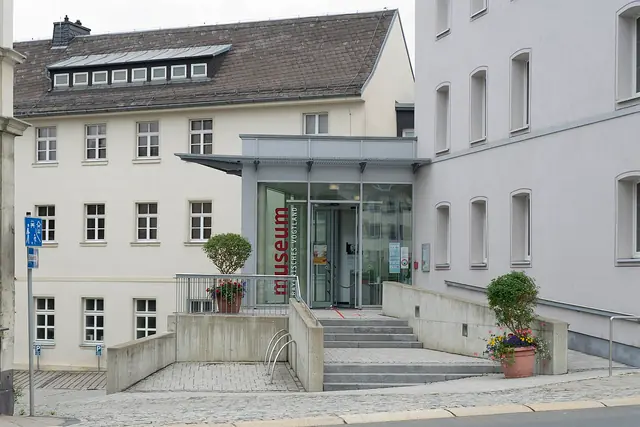
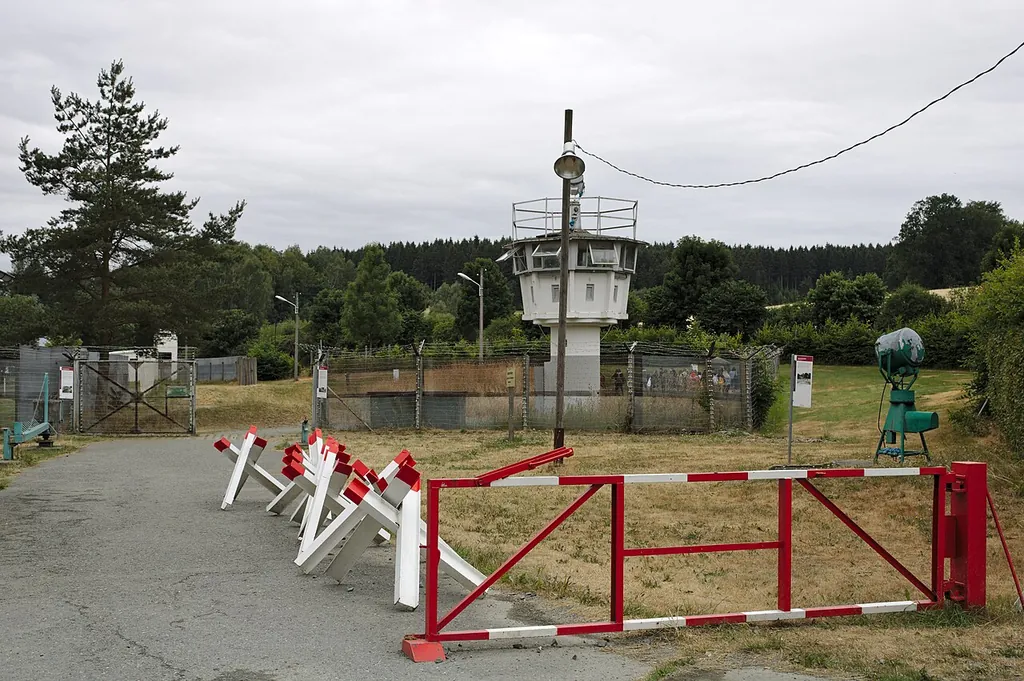
The outdoor area shows original and reconstructed border barriers from various phases of construction, a watchtower and traces of demolished houses; a vehicle hall presents around 30 vehicles used by the border authorities of East and West. A new building costing around €22 million was erected on the Bavarian side and inaugurated by Federal President Frank-Walter Steinmeier on October 2, 2025. Since November 9, 2025 it has housed a new permanent exhibition of around 500 square meters on the division of Germany and its consequences for the village; the outdoor area has also been redesigned.
Highlights
- Surviving section of the 1966 concrete wall running through the village
- Outdoor area with original border fortifications and a watchtower
- Vehicle hall with around 30 vehicles of the border authorities of East and West
- New permanent exhibition in the new building (since November 2025)
- Film “Alltag an der Grenze” (Everyday Life at the Border) in the museum cinema
Permanent exhibitions
- Die Geschichte des geteilten Dorfes Mödlareuth – Redesigned permanent exhibition in the new building that tells the story of Germany's division chronologically and through the example of the village and its residents, with exhibits and media stations.
- Freigelände mit Grenzanlagen – Original and reconstructed barriers, a section of the wall and a watchtower along the former border through the village.
- Fahrzeughalle – Walk-in storage area with around 30 vehicles used by the border authorities in East and West.
- Founded
- 1990
- Operated by
- Zweckverband Deutsch-Deutsches Museum Mödlareuth
Admission & discounts
| Adults | €6 |
|---|---|
| Reduced | €4Children aged 7 and over, school students, university students, seniors, people with disabilities |
| Children & teens | €4free up to age 6 · Reduced price for children aged 7 and over; younger children free. |
| Seniors | €4 |
| Visitors with disabilities | €4 |
| Students & apprentices | €4 |
| Groups (10+ people) | €4 per personWithout guided tour; school groups €2 per person. |
| Families | €152 adults with up to 3 children/teens under 18. |
| Group tour up to 10 people (flat rate) | €50incl. admission, approx. 90–120 minutes |
| Group tour 11 people or more | €6per person incl. admission |
| Tour for school groups | €3per pupil incl. admission |
Admission covers the outdoor area, the exhibitions and the museum cinema. Classic and VR guided tours cannot be booked through the online ticket system, only by phone or email.
Accessibility
- Wheelchair accessible
- Elevator: no information
- Accessible restroom: no information
- Accessible parking: no information
- Service dogs welcome: no information
- Tactile models & exhibits: no information
- Sign language tours: no information
- Easy-to-read materials: no information
- Audio description: no information
According to the museum, the buildings and large parts of the outdoor area are accessible.
Kids & families
The museum hasn’t published any information on this – please ask the museum directly.
Getting there & parking
By public transit
Deutsch-Deutsches Museum
VGN bus line 1566 (Hof – Töpen – Gefell – Schleiz) Monday to Friday to the "Deutsch-Deutsches Museum" stop at the new museum building; on weekends and public holidays, supplemented by the Hofer LandBus.
By car
Parking available
Designated parking lots P1 at the main building and P2 on the Thuringian side at the wall segment. Buses use the turning loop at P1 for boarding and alighting; overflow parking for buses by registration at the ticket desk.
Via the A72 (exit Hof-Töpen) or, from the direction of Berlin, via the A9 (exit Lobenstein) via Gefell. Coaches need a permit to drive through Gefell because of the 7.5-ton limit on the B2.
Get directionsAmenities & dining
- Café
- Museum shop
- Coat check
- Lockers
Cafeteria with a terrace in the new building, daily from 11:00 (hot and cold dishes, cake; groups of 20 or more please reserve in advance, tel. 09295 91501-36). Info desk with shop, coat check with 50 lockers.
Events & venue rental
The museum hasn’t published any information on this – please ask the museum directly.
Plan your visit
| Guided tours | yes · approx. 1.5 hrs |
|---|---|
| School programs | yes |
| Good to know | Group tours (approx. 90–120 minutes with introduction, film and walk across the outdoor area) and VR tours should be booked at least two weeks in advance if possible; if a group is more than 20 minutes late, the tour may be canceled. The film “Alltag an der Grenze” (approx. 20 minutes) is shown in German, English or French on the hour and half hour. Educational programs for school classes and youth groups. The museum also includes the Grenzturm Heinersgrün memorial (border watchtower). |