Dorfmuseum „Buisch ahl Huss“
Private village museum in a half-timbered farmstead from 1766 in Schlitz-Fraurombach, furnished like a farmhouse of about a hundred years ago.
Have only individual sections read aloud
About the museum
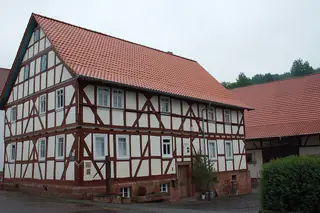
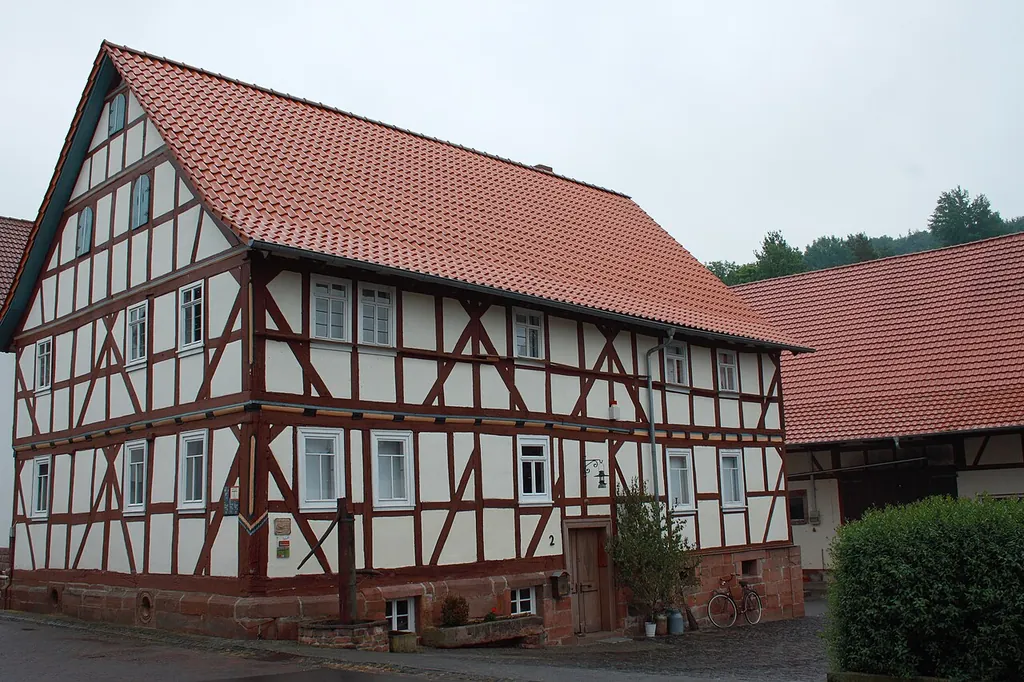
The imposing half-timbered house was built in 1766, shortly after the Seven Years' War, in the middle of Fraurombach by the farmer Christoffel Dickert. The house name “Buisch” points to an undivided, prosperous farm. At the end of the 1970s the family built anew next door; the old house then stood empty and fell increasingly into disrepair.
In 2000 the retired master weaver Hans Feick, who had himself lived in the house for a few years, took on the building. With the support of the owner, the monuments office, the town of Schlitz and many donors from the Schlitzerland, it was renovated and furnished as a museum; much of the furniture and many tools come from attics in the region.
Today the private museum shows rural living and working around 1900, including the production of traditional Schlitz linen on a hand loom. The weaving room holds two old hand looms and shows the journey from flax to linen or damask cloths. In 2022, shortly before the founder's death, the community of heirs transferred the farm to his son Matthias Feick, who spent the first six years of his life in the house; he is now its sole private owner and guides visitors through it himself. The museum is closely linked to the support association for the wall paintings in Fraurombach church and serves as its clubhouse.
Highlights
- Half-timbered farmstead from 1766
- Furnished like a farmhouse of about a hundred years ago
- Weaving room with two hand looms: from flax to linen and damask
- Guided tours by someone who once lived in the house – also in English
- Tours can be combined with Fraurombach church and its wall paintings
Permanent exhibition
- Bäuerliches Leben im Schlitzerland – Parlour, kitchen and tools show the everyday life of a farming family around 1900, including linen weaving.
- Operated by
- Matthias Feick (privat)
Admission & discounts
Admission is free.
No fixed admission price: the museum is funded by visitors' donations.
Accessibility
- Wheelchair accessible: not available
- Elevator: no information
- Accessible restroom
- Accessible parking: no information
- Service dogs welcome: no information
- Tactile models & exhibits: no information
- Sign language tours: no information
- Easy-to-read materials: no information
- Audio description: no information
Because of the structure of the historic house it is not accessible; only stairs lead to the upper floors. Accessible toilets are available in an outbuilding in the courtyard.
Kids & families
The museum hasn’t published any information on this.
Getting there & parking
By public transit
By train to Fulda ICE station.
By car
Parking available
Parking around the museum and, if needed, in the courtyard.
By car via the A7, exit Hünfeld/Schlitz. The R1 cycle route runs right past the house. Also worth seeing in Fraurombach are the church with its famous wall paintings and the village fountain; nearby the Rombachtal cycle path crosses with the Rombachtal bridge, Germany's second-highest railway bridge, and there are walks along the Fulda to Schlitz or to the Pfordter See with swimming.
Get directionsAmenities & dining
Visitor groups can use the museum for a coffee break or a snack with food they bring themselves or in cooperation with local catering.
Events & venue rental
Spontaneous events take place throughout the year, such as readings, small (theatre) performances, spinning evenings or the snail race in the courtyard.
Plan your visit
| Guided tours | yes |
|---|---|
| School programs | yes |
| Good to know | Guided tours of the museum and Fraurombach church, individually or as a package, by arrangement; tours are also available in English. Clubs, schools and nurseries are regular visitors. |