Former central Stasi remand prison: guided tours, often led by former inmates, and exhibitions on political imprisonment in the Soviet zone and the GDR.
Opening hoursAdmission from €9 Partially accessible Café
Photographer André Wagenzik portrays one hundred people who were held in Stasi custody in the GDR for political reasons. Free admission, accessible by elevator.
About the museum
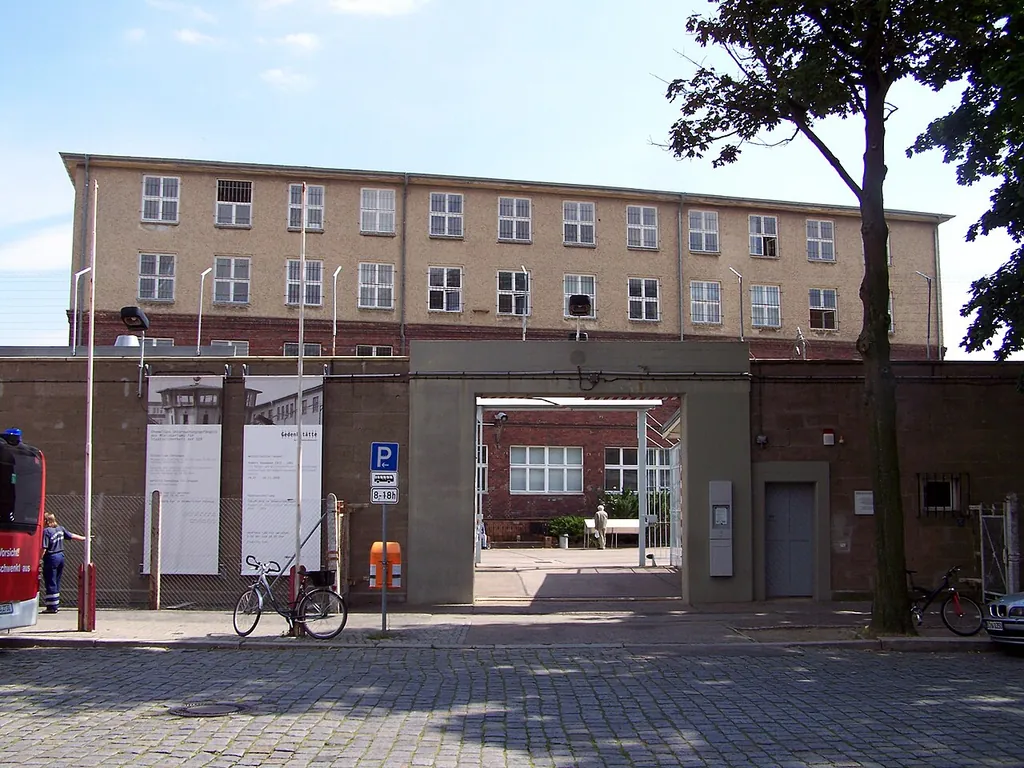
In 1945 the Soviet secret service set up a collection camp on the site on Genslerstraße, Special Camp No. 3, where thousands of people were held in miserable conditions. In 1947 it had windowless cells built into the basement of a former industrial kitchen and used the building as its central remand prison; because the cells had no daylight and were completely cut off from the outside world, prisoners called the basement the “U-Boot” (submarine).
In 1951 the newly founded Ministry for State Security (Stasi) of the GDR took over the prison. In the late 1950s prisoners were forced to build a new block with cells and interrogation rooms, and the Stasi's central prison hospital was added as well. The surrounding restricted area did not appear on city maps. Until 1989 more than 11,000 people were imprisoned here for political reasons, including people who wanted to flee, those who had applied to leave the country, and members of the opposition.
After the Peaceful Revolution, the prison was closed in 1990. At the urging of former prisoners it was placed under heritage protection and opened as a memorial in 1994; since 2000 it has been an independent foundation of the state of Berlin. Because the complex has remained largely intact, it conveys an unusually authentic picture of everyday prison life and interrogation methods.
The core of a visit is the guided tour through the cell blocks, interrogation rooms and exercise cells, often led by former political prisoners. The permanent exhibition “Inhaftiert in Hohenschönhausen” (Imprisoned in Hohenschönhausen) documents the history of detention from 1945 to 1989 on around 700 square meters, and a second exhibition is devoted to the female convicts in the work detail. The grounds also hold the last surviving prisoner transport railcar of the Reichsbahn, the so-called “Grotewohl Express.”
Highlights
Guided tours with former political prisoners
Original basement wing, the “U-Boot,” from the Soviet period of detention
Stasi prison block with cells, interrogation rooms and exercise cells
Permanent exhibition “Inhaftiert in Hohenschönhausen” with rare original objects
“Grotewohl Express” prisoner transport railcar
Permanent exhibitions
Inhaftiert in Hohenschönhausen. Zeugnisse politischer Verfolgung 1945–1989 – On around 700 square meters, original objects, documents and photos trace the history of the site from Soviet camp to the end of Stasi detention.
In Zwangsgemeinschaft. Die Arbeitskommandos der Strafgefangenen in Hohenschönhausen – The exhibition in the newer prison building sheds light on the living and working conditions of the female convicts who had to keep the prison running (daily 10:00–16:00, not accessible).
€5University students, trainees, people with severe disabilities, holders of the Berechtigungsnachweis (formerly berlinpass) or the Ehrenamtskarte (volunteer card), recipients of ALG I/II (unemployment benefits), unemployed people, federal volunteer service participants, members of associations of victims of political persecution in the GDR
Children & teens
€2.50School students pay €2.50 for the tour. Visit recommended from age 14.
Seniors
–No senior discount.
Visitors with disabilities
€5companion free · Reduced with a severe disability ID (Schwerbehindertenausweis); one companion free.
Students & apprentices
€5University students pay the reduced rate; school students €2.50.
Groups (7+ people)
–Group tour (max. 25 people) flat rate €110, reduced €90, school classes €60; advance booking required for groups of 7 or more. Listening and touch tour (max. 12 people) €55/€25, tour in Easy Language (max. 15) €90/€68/€35.
Families
–No family ticket.
Prices apply to the guided tour of the former prison (including the introductory film). The exhibitions are free and accessible without registration. Advance booking for public tours recommended (max. 25 participants). Payment in cash, by debit card or credit card.
Accessibility
Partially wheelchair accessible
Elevator
Accessible restroom
Accessible parking
Service dogs welcome
Tactile models & exhibits
Sign language tours
Easy-to-read materials
Audio description
Listed historic complex, not accessible everywhere. Visitor information, cafeteria and bookshop are accessible; the newer prison building and the basement prison can be reached by elevator (not suitable for wide electric wheelchairs); the prison hospital and the exhibition “In Zwangsgemeinschaft” are not wheelchair-accessible. The elevator to the permanent exhibition is activated at the ticket desk. A lightweight wheelchair and folding stools can be borrowed; tactile model of the site; no floor guidance system. Tours in Easy Language and German Sign Language (DGS), as well as listening and touch tours. One accessible parking space directly in front of the entrance.
Kids & families
Only partly suitable for kidsRecommended for ages 14+
Time needed
approx. 2 hrs
The memorial recommends visits and tours only from age 14, as the accounts may overwhelm younger children both in content and emotionally.
Getting there & parking
By public transit
Tram M5 to Freienwalder Straße, tram M6 and 16 to Genslerstraße; bus 256 to Große-Leege-Straße/Freienwalder Straße. Do not travel to S Hohenschönhausen.
By car
Free parking
Free car parking and eight designated bus parking spaces in the immediate vicinity; one accessible parking space directly in front of the entrance. Buses should wait with the engine switched off.
Cafeteria in the visitor center (daily, snacks and small hot meals). “BuchHandlung ’89” bookshop with literature on GDR history (daily 9:00–18:00). Lockers in various sizes. Pets not allowed (except assistance dogs).
Events & venue rental
The museum hasn’t published any information on this – please ask the museum directly.
Plan your visit
Guided tours
yes · approx. 1.5 hrs
Audio guide
yes (DE, EN, FR, IT, ES, DA, RU)
School programs
yes
Photography
Allowed for private purposes during the tours; audio/video recordings and photos outside the tours only by arrangement with the press office.
Good to know
Tour approx. 1.5 hours plus introductory film (special tours approx. 2.5 hours). Tickets for public tours online or at the ticket desk; groups of 7 or more book in advance via the form. Group tours in ten languages. Audio guides and multimedia tablets free of charge with a deposit.