Guests at the museum for the first time: members of the Hohenloher Kunstverein show works from the past two years in dialogue with the rooms and the permanent exhibition.
Paintings, collages, and three-dimensional tableaux by the Heilbronn artist in the small Wintergarten gallery.
About the museum
The museum’s roots go back to the Historischer Verein für Württembergisch Franken (historical society), founded in Künzelsau in 1847, which collected antiquities from the region from the outset. In 1873 the society’s headquarters and collection moved to Schwäbisch Hall. After several moves, the society’s museum found a permanent home in the Hohenstaufen-era Keckenturm in the early 1930s; for the town’s 800th anniversary in 1956, it reopened after the war as the Keckenburgmuseum.
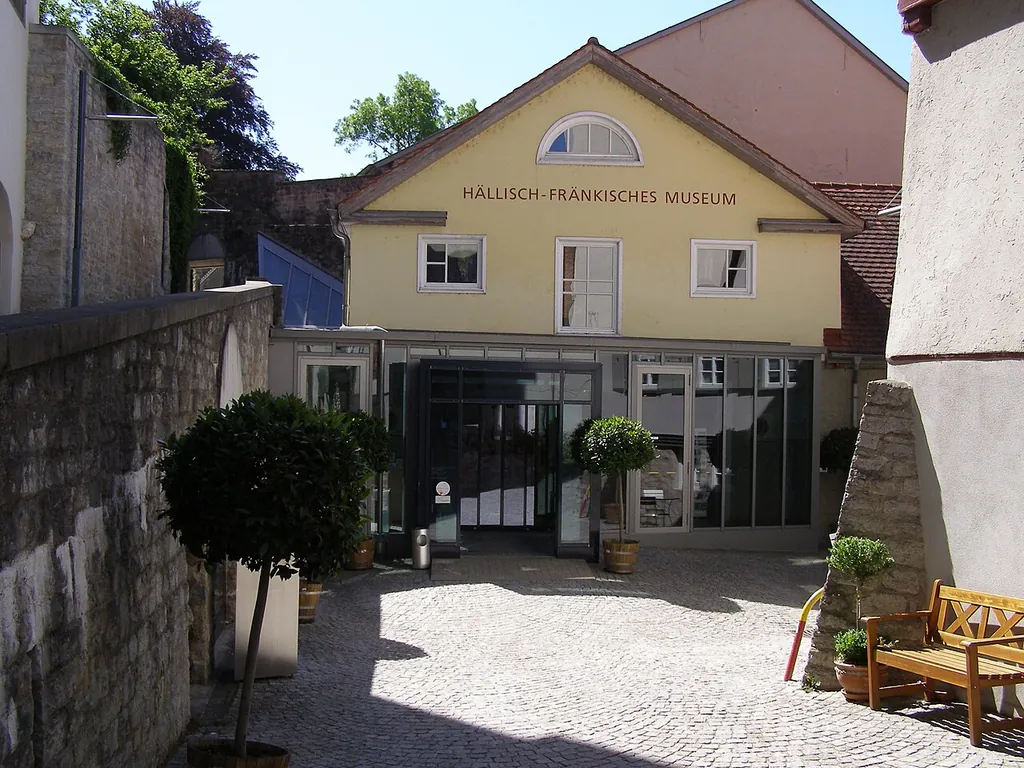
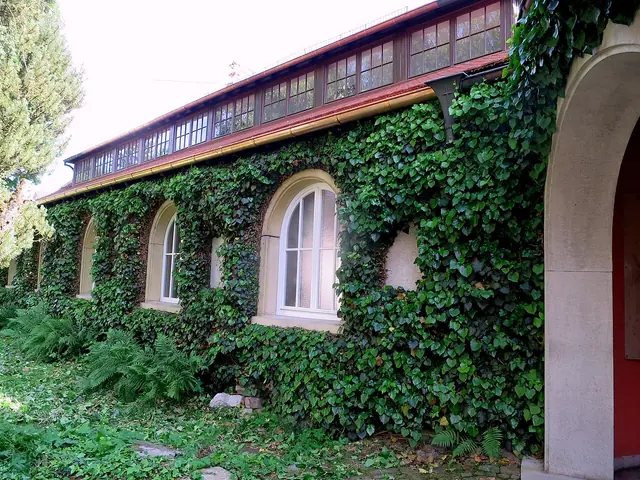
In 1981 the town of Schwäbisch Hall became a co-sponsor, the museum received its current name, and it was gradually expanded and remodeled – a process completed in 2001 with the inauguration of the Stadtmühle (town mill). Today a tour leads through seven historic buildings covering more than 3,000 square meters: the residential tower built around 1240, a rectory building from 1397, a coach house remodeled in Neoclassical style that serves as the entrance, and the 19th-century mill. The small house at Lange Straße 49 from 1470 in the Katharinenvorstadt belongs to it as a branch site.
The exhibition spans geology and prehistory, the era of the Free Imperial City, and the postwar years. Of supraregional importance are the synagogue paneling from Unterlimpurg and Steinbach painted by Elieser Sussmann in 1738/39, the ivory works of Baroque sculptor Leonhard Kern, and the Hall shooting targets. With artists’ estates, for example that of Louis Braun, and company archives, the museum is also a documentation center for Württembergisch Franken.
Highlights
Synagogue paneling by Elieser Sussmann (1738/39)
Ivory figures by Leonhard Kern
Hohenstaufen-era Keckenturm (around 1240) with eight exhibition floors
Hall shooting targets
“Hall und das Salz” (Hall and Salt) section
Baroque hall
Permanent exhibitions
Keckenturm – Reichsstadt Hall – On eight floors of the residential tower: geology, prehistory and early history, the medieval town and piety, the Reformation, the Baroque, and shooting targets.
Stadtmühle – Hall vom 19. Jahrhundert bis heute – Town history from the French Revolution to the postwar period, plus sections on salt, Jewish life, Louis Braun, and historical toys.
Operated by
Stadt Schwäbisch Hall und Historischer Verein für Württembergisch Franken
Director
Dinah Rottschäfer
Admission & discounts
Admission is free.
Groups
–Group tours up to 25 people: 60 minutes €60, 90 minutes €70; €5 for each additional person, weekend/public holiday surcharge €5, foreign-language surcharge €10; outside opening hours €100.
Public guided tour
€5reduced €3
Family tour
€3Children up to 6 free
Lunch-break tour
€3
Studio workshop
€10Accompanying adults free
Free admission to the permanent and special exhibitions; the museum asks for a voluntary contribution.
Accessibility
Partially wheelchair accessible
Elevator
Accessible restroom: no information
Accessible parking: no information
Service dogs welcome: no information
Tactile models & exhibits: no information
Sign language tours: no information
Easy-to-read materials: no information
Audio description: no information
Due to historic preservation, only the first floor of the Keckenburg wing and the Stadtmühle are accessible – about two-thirds of the exhibition space. The media room can be reached by elevator. In addition, there is a virtual tour and the media guide.
Kids & families
Great for kids & families
Family tours & workshops
Activity booklet, scavenger hunt or kids’ audio guide
Kids’ birthday parties
Museum game “Der kleine Keck im Turm” as an accompanying booklet (€1) with puzzles and a small surprise at the end. Family tours, monthly studio workshops (some for children aged 8 and up), and children’s birthday parties for ages 5 to 12 (90–120 minutes, up to ten children, €70–85).
Getting there & parking
By public transit
Bahnhof Schwäbisch Hall · 10-min walk
Schwäbisch Hall train station, then about a 10-minute walk.
By car
Parking available
Parking lots P2 Schiedgraben and P7 Haalplatz.
By car via the A6 (Heilbronn–Nuremberg), exit Kupferzell or Schwäbisch Hall.
Museum shop at the ticket desk with catalogs, regional literature, children’s books, and replicas of exhibits.
Events & venue rental
The museum hasn’t published any information on this – please ask the museum directly.
Plan your visit
Guided tours
yes · approx. 60 min
Audio guide
yes
School programs
yes
Good to know
Free media guide with a tour of selected works via the “monamu” app. Public guided tours regularly on Sundays; book group tours (60 or 90 minutes) and visits with your own guide through visitor services.