September 25, 2026 – January 10, 2027
Irina Razumovskaya: KORE
The exhibition takes up the goddess Kore as a symbol of women's double roles; broken ceramic moulds and text fragments make loss, control and grief visible.

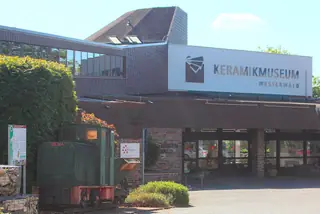
Large ceramics museum in the Kannenbäckerland: Westerwald stoneware from the Middle Ages to today and contemporary ceramic art on four levels.
September 25, 2026 – January 10, 2027
The exhibition takes up the goddess Kore as a symbol of women's double roles; broken ceramic moulds and text fragments make loss, control and grief visible.
May 8, 2026 – April 4, 2027
The show focuses on serially produced, colourful ceramics of the post-war period („Made in West Germany“) and also addresses working conditions and environmentally harmful production.
The museum was founded in 1976 by the Westerwaldkreis (Westerwald district). It was initially housed in the Schillerschule in Höhr-Grenzhausen and run by the Förderkreis Westerwald für Kunst und Keramik (friends' association). The core of the collection came from the holdings of the former Kreisheimatmuseum Montabaur and the town of Höhr-Grenzhausen, which grew steadily through purchases, donations, and loans.
After the district took over as operator, a dedicated new building was constructed on Lindenstraße to plans by the architect Scheubert: ground was broken in October 1980, and the museum opened in October 1982. Its four exhibition levels wind like the chambers of an ammonite around a common axis and lead visitors chronologically through the history of ceramics. An extension was added in 2007.
The museum broadened its view to international ceramics early on. It hosts the Westerwaldpreis, established in 1973 and open to entries from across Europe since 1999. Since August 2000 operations have been run by Museen im Westerwald GmbH, together with the Landschaftsmuseum in Hachenburg; the Westerwaldkreis remains the owner. The museum includes a restoration workshop for ceramics and glass as well as a workshop for courses and workshops.
The permanent exhibition ranges from the formation of the Westerwald clay deposits some 30 million years ago through salt-glazed stoneware of the Renaissance and Baroque, Historicism and Art Nouveau, to the colorful industrial ceramics of the postwar period and the free ceramic art of the present.
| Adults | €7 |
|---|---|
| Reduced | €6People with a pensioner ID, groups of 10 or more |
| Children & teens | freefree up to age 18 · Children and young people up to 18 years have free admission. |
| Seniors | €6With a pensioner ID. |
| Visitors with disabilities | freePeople with disabilities have free admission with an ID. |
| Students & apprentices | €4Students in Höhr-Grenzhausen have free admission. |
| Groups (10+ people) | €6 per personGroup tour (max. 25 people, approx. 1 hr.) €50 plus reduced admission; pottery demonstration at the historic potter's wheel (approx. 30 min.) €35 plus reduced admission. Bus drivers and tour guides have free admission. |
| Families | €10At most 2 adults with at least 1 child. |
| Combination ticket with the Sayner Hütte | €10Individual |
| Combination ticket with the Sayner Hütte (family) | €20At most 2 adults with at least 1 child |
| Admission on the first Tuesday of the month | €1 |
Free admission with ID also for unemployed people, holders of the Rhineland-Palatinate Ehrenamtskarte (volunteer card), members of the Förderkreis as well as of the Museumsverband Rheinland-Pfalz and ICOM. On the first Tuesday of every month admission costs €1.
The entire building is accessible via gentle ramps and an elevator; wheelchair-accessible, family-friendly restroom in the foyer. The free media guide is also available in Easy Language and in sign language. Level parking directly at the entrance, including 2 accessible parking spaces in front of the museum entrance. Certified under "Reisen für Alle" (Travel for All).
Great for kids & families
| Kids’ admission | free up to age 18 |
|---|---|
| Family ticket | €10 · At most 2 adults with at least 1 child. |
Children's birthday parties in the museum workshop (2.5 hrs., max. 10 children, €150 including materials and firing costs), e.g., with candy monsters or animal bowls made of clay. In the Kinder Keramik Club, 8- to 15-year-olds make pottery in course rounds of five sessions (€50). Children and young people up to 18 years have free admission.
Schillerstraße · 300 m
By bus to the Schillerstraße stop (approx. 300 m) or Rastal (approx. 450 m).
Free parking
Around 30 free car parking spaces and 2 coach parking spaces at ground level directly at the entrance; additional parking behind the building on the street Seiferwiese.
Museum café "Café Creativ" with a view into the exhibition (for groups, breakfast and lunch buffets on advance order). Museum shop with ceramics by regional and international artists, jewelry, and books. Free lockers and coat check in the foyer – bags and backpacks are not allowed in the exhibition.
Up to 199 guests.
Lecture hall with modern technology for up to 199 people in theater-style seating, e.g., for symposia and conferences; catering through Café Creativ. No rentals for party-political events.
Inquiries & details| Guided tours | yes · approx. 60 min |
|---|---|
| Audio guide | yes (DE, EN, FR, NL) |
| School programs | yes |
| Photography | Photography of the exhibitions and objects is allowed. |
| Dogs | not allowed (assistance dogs excepted) |
| Good to know | Free media guide as a web app for your own smartphone (link at the ticket desk), also in Easy Language and sign language. Book group tours and pottery demonstrations at least 14 days in advance; tours in English, Dutch, or Italian on request. Workshops for adults (2.5 hrs., max. 10 people, €170) as well as tours and workshops for school classes and daycare centers. |
Loading experiences …