Retrospective of the Rhineland-Palatinate artist with central groups of works from several creative phases. The iron wire works, including walk-in large sculptures, stand inside and on the grounds in dialogue with the industrial history of the site.
About the museum
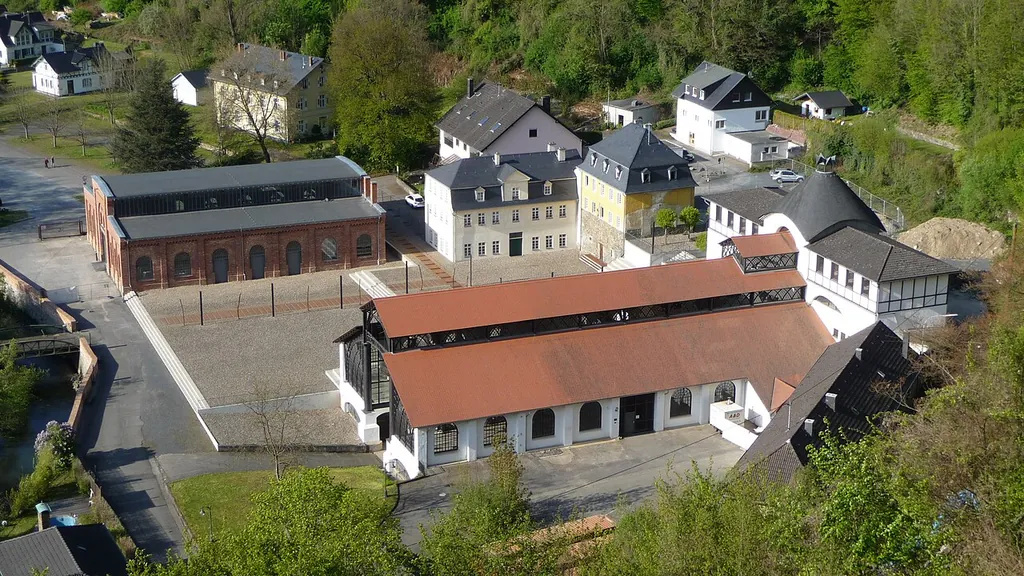
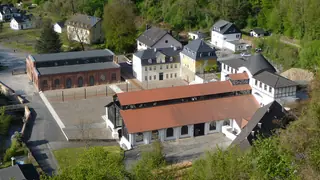
In the 19th century the Sayner Hütte was one of the most important Prussian sites for iron casting. The only surviving building from the founding period is the Comptoir (counting house) of about 1769, which still serves as the administrative headquarters. In 1830 the technical manager Carl Ludwig Althans had the casting hall built from prefabricated cast-iron parts and a large glass front; it is regarded as a prototype of modern industrial architecture and in 2010 was honored as a "Historisches Wahrzeichen der Ingenieurbaukunst" (historic landmark of engineering). In 1865 Alfred Krupp acquired the ironworks; in 1926 iron production ended. The former machine factory from 1909, the Krupp'sche Halle, now serves as the visitor center. The site was rescued from demolition and is run by a foundation.
The Rheinisches Eisenkunstguss-Museum was housed from 2000 in the neighboring Schloss Sayn and has shown its collection on the works site since autumn 2019. Its focus is cast-iron objects from the industrial era in Bendorf and the surrounding area.
Visitors today experience three exhibition areas: the history of the ironworks in the Krupp'sche Halle, the multimedia staging of the blast furnace in the casting hall, and the art-casting gallery in the former product warehouse. There you can see everyday objects, delicate jewelry, busts, New Year's plaques and garden chairs, as well as the Sayner Mücke, at one gram the smallest cast-iron art object in the world.
Highlights
Casting hall from 1830, made of cast iron and glass
Multimedia staging of the blast furnace with augmented reality
Art-casting gallery with jewelry, busts and New Year's plaques
Sayner Mücke, the smallest cast-iron art object in the world
Krupp'sche Halle as the visitor center
Audio guide for adults and children
Permanent exhibitions
Geschichte der Sayner Hütte – On the gallery of the Krupp'sche Halle, small stations and a site model tell the story of the ironworks and its key players.
Inszenierung des Hochofens – Light, sound and projections, as well as augmented-reality stelae, show in the casting hall how iron was smelted.
Kunstgussgalerie – In the former product warehouse, the gallery presents everyday objects, jewelry, busts and plaques made from Sayn cast iron across four stations.
Founded
2000
Operated by
Stiftung Sayner Hütte
Director
Barbara Friedhofen (kommissarische Geschäftsführung)
Admission & discounts
Adults
€7
Reduced
€6Young people under 18, people with severe disabilities, trainees, students, pensioners, recipients of Bürgergeld, Grundsicherung (basic income support) or benefits under the Asylbewerberleistungsgesetz, and holders of the Ehrenamtskarte Rheinland-Pfalz (honorary volunteer card), each with proof
Children & teens
€6free up to age 12 · Children up to and including 12 years old enter free; young people under 18 pay the reduced rate.
Seniors
€6Pensioners pay the reduced rate (with proof).
Visitors with disabilities
€6companion free
Students & apprentices
€6
Groups (10+ people)
€6 per personAdult groups of 10 or more: €6 per person; youth groups of 10 or more: €3 per person.
Families
€10Family ticket 1 (1 adult with their own children or grandchildren under 18): €10; Family ticket 2 (2 adults): €16.
Family ticket 2 (2 adults with children or grandchildren under 18)
€16
Annual pass, adults
€28Reduced: €24
Combination ticket Sayner Hütte and Keramikmuseum Westerwald
€10Family combination ticket (2 adults + children) also €10
Triple combination ticket Sayn (Sayner Hütte, Butterfly Garden, Schloss Sayn)
€17One-time visit, also on different days within the season
Members of the Freundeskreis Sayner Hütte and the Förderverein Rheinisches Eisenkunstguss-Museum (friends' association) have free admission.
Accessibility
Wheelchair accessible
Elevator: no information
Accessible restroom: no information
Accessible parking: no information
Service dogs welcome: no information
Tactile models & exhibits: no information
Sign language tours: no information
Easy-to-read materials: no information
Audio description: no information
The tour of the works grounds begins in the accessible visitor center; the paths can be navigated with a wheelchair or walking aids. Guided tours for people with limited mobility are offered on request.
Kids & families
Great for kids & families
Kids’ admission
free up to age 12
Family ticket
€10 · Family ticket 1 (1 adult with their own children or grandchildren under 18): €10; Family ticket 2 (2 adults): €16.
Family tours & workshops
Activity booklet, scavenger hunt or kids’ audio guide
Hands-on stations
Kids’ birthday parties
Children's audio guide, an adventure rally through the Sayn cultural park (March to October; free cards at the visitor center), a flashlight tour "Nachts auf der Hütte" and workshops: in the moulders' and casters' workshop (Wednesdays, €5 material cost per child), children cast a "Mückentaler"; in the "Bunte Güsse" workshop (ages 10 and up) they make casts from sugar. From summer 2026 there is also the Erfinderpass (inventor's pass) for young visitors. Children's birthday parties are possible.
Getting there & parking
By public transit
Sayner Hütte
Bus to the stops "Sayn Schloss" or "Sayner Hütte" (a few minutes' walk). From Koblenz Hbf (main station), lines 8 (toward Sayn Schloss), 33 (toward Vallendar Bahnhof, then line 8), 160 and 319; from Neuwied Bahnhof, line 107 (toward Bendorf, Stadtpark) and then line 8.
By car
Free parking
Large free car and bus parking directly at the entrance. There are no charging stations for electric cars or e-bikes.
In your navigation device, please enter "Althansweg".
Public tours according to the events calendar. Group tours (1 hour: €6 per person, or 1.5 hours: €8 per person, plus admission, up to 40 people) must be booked at least 14 days ahead at +49 2622 9849550. Exhibition texts are in German and English; a chatbot offers more depth on the art-casting gallery. The meeting point is the visitor center.