September 20, 2026 – December 31, 2026
Klingendes Schnoogeloch
Exhibition on sounds, noises and music along the Upper Rhine between Basel and Strasbourg, created within the trinational museum network "Zuhause – unterwegs".
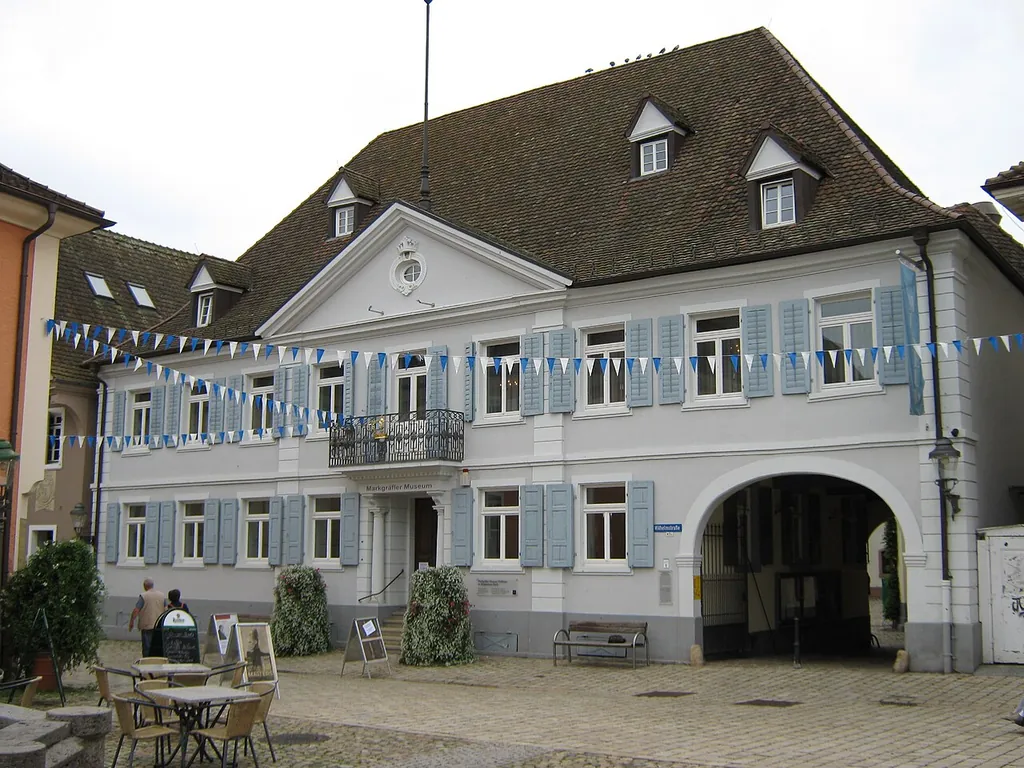
Regional museum in the neoclassical Blankenhorn-Palais covering the art, history and winemaking of the Markgräflerland, plus the Frick-Mühle mill museum.
September 20, 2026 – December 31, 2026
Exhibition on sounds, noises and music along the Upper Rhine between Basel and Strasbourg, created within the trinational museum network "Zuhause – unterwegs".
From November 14, 2026
Presentation of the youth art project of the same name, in which young people develop their own works at the museum; runs until early 2027.
The Blankenhorn-Palais on Wilhelmstraße traces its origins to the "Zur Krone" inn. Around 1820 it was converted into the residence of the Blankenhorn family in the early neoclassical style. It later became the home of the lawyer Fritz Hack, who became Müllheim's first mayor after World War II and hosted guests such as Max Weber and Theodor Heuss. From 1955 to 1973 the building served as the town hall.
Collections on local history had existed since the 1920s. In 1974 the Markgräfler Wein- und Heimatmuseum (wine and local history museum) was founded and moved into the vacated palais; following a renovation, it has been called the Markgräfler Museum since 1991. Across more than 1,500 square meters on four levels, it presents the region's geology and archaeology, art from the 18th century to the present, upper-middle-class domestic culture, and town and literary history, while the vaulted cellar is devoted to winemaking, with wine presses and a cooper's workshop.
A second site was added with the Frick-Mühle, a former manorial mill first mentioned in 1392 that belonged to the Frick family from 1690 and fell into decay after 1912. The town acquired the building in 1993 and, together with the museum association, converted it into a mill museum with working millstones, which opened in 2008. Altogether the collection comprises around 20,000 objects, complemented by a research library.
| Adults | €4 |
|---|---|
| Children & teens | freefree up to age 21 · Free for children, young people up to age 21 and school students |
| Visitors with disabilities | freeFree for people with severe disabilities |
| Students & apprentices | freeFree for university students |
| Annual pass | €10 |
| Guided tour incl. admission | €5 |
Free for members of the museum association. Admission to the Frick-Mühle is free; donations welcome.
The museum hasn’t published any information on this – please ask the museum directly.
Great for kids & families
| Kids’ admission | free up to age 21 |
|---|
In the Frick-Mühle, children can grind grain with hand mills and sift flour. Creative workshops with artists for teens (ages 10–18) during the fall holidays, as well as projects for elementary school classes.
The museum asks that you call ahead with any questions about getting there, parking, or using the elevator in the inner courtyard.
Get directionsThe museum hasn’t published any information on this – please ask the museum directly.
The Fritz-und-Ilse-Fischer-Saal in the Frick-Mühle is available for private events: €250 (€125 for members of the museum association), tableware or glasses €30 each. Inquiries via the museum office.
Inquiries & details| Guided tours | yes |
|---|---|
| School programs | yes |
| Good to know | Guided tours (€5 incl. admission) on history, art and technology, workshops and educational programs for school classes; "Museum zur Marktzeit" and "Kultur in der Mühle" series with lectures and concerts. |
Cookies help you use this website. We only load the map and statistics with your consent.