July 17, 2026 – November 8, 2026
Ich, Gustave Courbet. Maler und Rebell
Major retrospective of the pioneer of Realism, organized by self-image, social reality, eroticism, landscape and exile; admission charged.
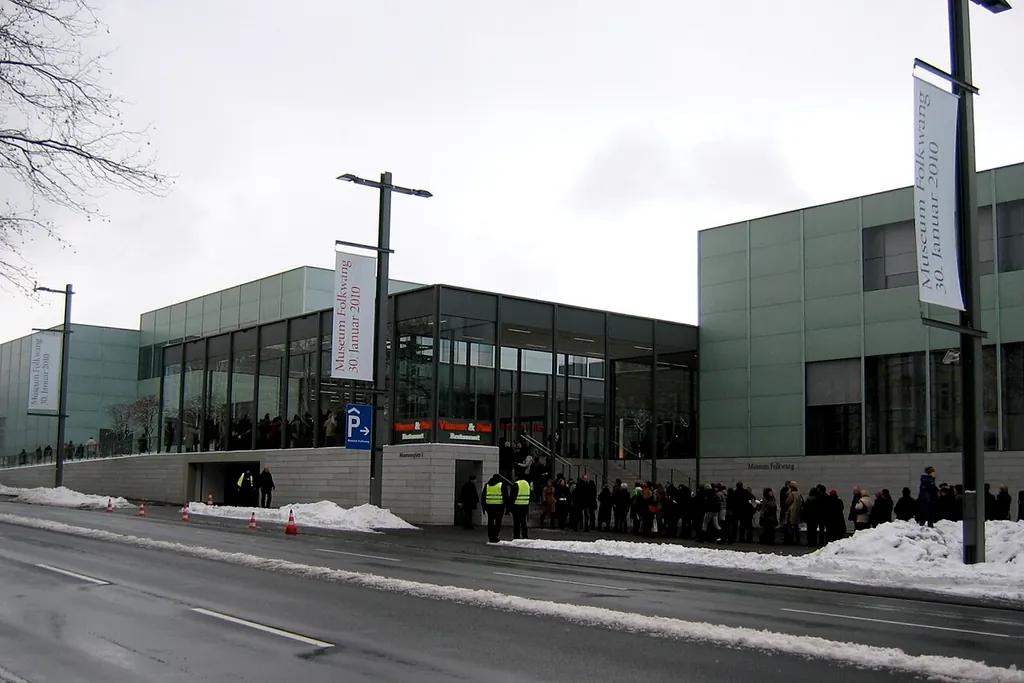
Essen art museum with masterpieces from the 19th century to the present and a large photography collection – admission to the collection is free.
July 17, 2026 – November 8, 2026
Major retrospective of the pioneer of Realism, organized by self-image, social reality, eroticism, landscape and exile; admission charged.
June 12, 2026 – April 18, 2027
Site-specific installation by the New Zealand artist in the transition between the 1960 museum building and the Chipperfield building, using materials including concrete and glass found in Essen.
October 16, 2026 – January 10, 2027
Around 250 works by two pioneers of generative photography and early computer art, on the occasion of a major donation of works by Herbert W. Franke.
October 16, 2026 – January 10, 2027
Graduation projects by graduates of the Photography Studies & Practice master's program at the Folkwang Universität der Künste.
November 6, 2026 – February 21, 2027
First exhibition on the museum's former Islamic department, with around 300 objects including ceramics, textiles, a Shahnameh and Ibero-Islamic tiles, in dialogue with modernism and design.
The museum goes back to Karl Ernst Osthaus, the son of a Hagen banker, who opened the Folkwang Museum in Hagen in 1902; he borrowed the name from the Old Norse Edda. Advised by Henry van de Velde, Osthaus bought works of French modernism early on, such as Renoir's “Lise with a Parasol” in 1901; in 1905 his became the first German museum to hold a van Gogh exhibition, and he exhibited the Brücke and the Blauer Reiter. He presented art from Africa, Asia and the Islamic world on an equal footing alongside them.
After Osthaus's death, Essen citizens, companies and the city acquired the collection in 1922 and merged it with the Städtisches Kunstmuseum Essen (municipal art museum); since then it has been jointly owned by the city and the Folkwang-Museumsverein. Under Ernst Gosebruch, the museum was one of the leading museums of modern art until the Nazis confiscated more than 1,400 works in 1937 and bombs partly destroyed the buildings.
A new building opened in 1960, and directors such as Paul Vogt rebuilt the collection with reacquisitions and works of Abstract Expressionism. The photography collection was added in 1978, and the Deutsches Plakat Museum (German Poster Museum) in 2008. In 2010 the extension by David Chipperfield was inaugurated.
Since 2015 admission to the collection has been free thanks to the Alfried Krupp von Bohlen und Halbach-Stiftung; in 2020 the foundation and the city agreed to keep it that way permanently. In 2019 the German section of the art critics' association AICA named the Folkwang Museum of the Year. Peter Gorschlüter has headed the museum since 2018.
Admission is free.
| Children & teens | –Collection free for everyone. In the special exhibition “Ich, Gustave Courbet”, children and young people aged 6 to 18 pay the reduced price of €12. |
|---|---|
| Seniors | –No senior discount mentioned. |
| Visitors with disabilities | –companion free · Collection free. In the special exhibition, people with disabilities (GdB of 70 or more) pay the reduced price of €12; one companion (GdB of 70 with the corresponding marker) is free. |
| Students & apprentices | –Collection free; special exhibition reduced €12 for school and university students. |
| Groups | –No group rate needed since the collection is free. Bookable guided tours for groups of up to 20 people: collection 60 min. €80, 90 min. (also on the architecture) €100, special exhibition 60 min. €80 plus admission; English, French, Dutch or Italian €20 surcharge each. Booking via the visitor office (+49 201 8845 444). |
| Families | –For the special exhibition “Ich, Gustave Courbet”: family ticket €33 (two adults with up to four children aged 6–18) or €17 (one adult with up to four children). |
The permanent collection is free on all opening days; timed tickets can optionally be booked online. Major special exhibitions are subject to a charge, currently “Ich, Gustave Courbet. Maler und Rebell” (I, Gustave Courbet. Painter and Rebel; until November 8, 2026): €16, reduced €12 (children and young people aged 6–18, school students, university students, people with disabilities with a degree of disability (GdB) of 70 or more, Federal Volunteer Service participants, recipients of social assistance). Free admission to the special exhibition with, among others, an ICOM, CIMAM or press card, the Ehrenamtskarte NRW/Essen (volunteer card), and for members of the Folkwang-Museumsverein; RuhrKultur.Card once a year. Voluntary climate ticket €1. Audio guide to the collection €4, museum app free.
Main entrance via a gentle ramp, plus an elevator from outside and from the underground parking; all levels accessible. Four accessible restrooms, four accessible parking spaces in the underground parking. Magnifiers, folding stools and a limited number of wheelchairs available on loan. Regular tours in sign language and in easy-to-read language, as well as tour conversations for people with dementia; at events, hearing support via the Sennheiser MobileConnect app. Assistance dogs allowed.
Great for kids & families
Family tours and talks for families (Sundays), open family workshops on Saturdays for children aged 5 and up, an art workshop for schoolchildren, a holiday academy and family days twice a year. Children under 10 only when accompanied by an adult.
Rüttenscheider Stern · 7-min walk
Tram 103, 106, 107 and U11 to Rüttenscheider Stern, then about a 7-minute walk; from the south exit of Essen Hauptbahnhof, about a 20-minute walk via Huyssenallee.
Parking available
Museum's own underground parking with 125 spaces and 4 accessible parking spaces (entrance height 2 m, open 24 hours); other parking garages: Hotel Mercure, Philharmonie, Stadtgarten. Bus parking on Kahrstraße.
16 free bicycle parking spaces in the underground parking, more on Museumsplatz; e-bike charging stations against a key deposit.
Get directionsRestaurant-café “Edda” in the new building with terrace (Sat–Wed 11:00–17:00, Thu/Fri 11:00–19:00, closed Mon). Walther König bookstore at the main entrance, accessible without admission. Bags, umbrellas, jackets and backpacks must be left at the coat check; bag checks take place. Free Wi-Fi. Reading room Tue–Fri 10:00–18:00.
Up to 400 guests.
Rental and catering through the restaurant Edda in the museum: Hirschland-Saal (receptions up to 200, gala dinners up to 130 people), private dining room (up to 20), exclusive use of the restaurant (up to 80) and terrace; events of up to 400 people in total, including birthday parties and weddings.
Inquiries & details| Guided tours | yes |
|---|---|
| Audio guide | yes (DE, EN) |
| School programs | yes |
| Photography | Allowed in the collection for private purposes without flash; selfie sticks not allowed; generally prohibited in temporary exhibitions |
All 8 museums in Essen All museums in North Rhine-Westphalia
Cookies help you use this website. We only load the map and statistics with your consent.