National Archaeological Museum
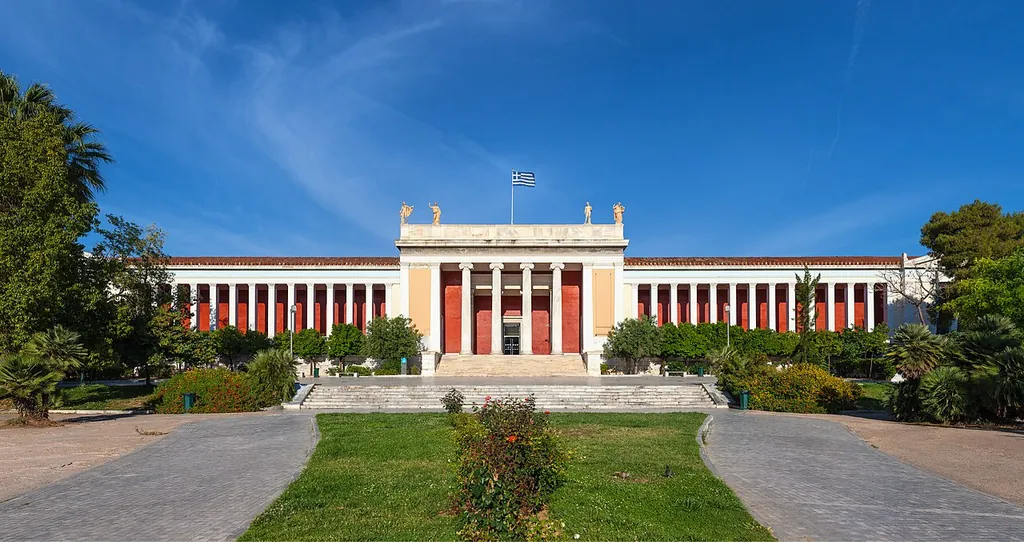
Antiquities from the 6th millennium BC to the 4th century AD from Greece, Cyprus, Egypt and Italy, displayed in the neoclassical building on Patision Street.
Have only individual sections read aloud
About the museum
The National Archaeological Museum was founded in 1829 and was the first museum of the newly established Greek state. It was first housed on Aegina, the first capital. After the capital was moved to Athens in 1834, the antiquities were kept in various buildings and monuments around the city.
The present building began construction in 1866, to designs by L. Lange with changes to the façade by E. Ziller, on a plot donated by Eleni Tositsa and funded by the Bernardakis family of Saint Petersburg. The museum opened to the public in 1889, and between 1932 and 1939 it was extended to the east to designs by G. Nomikos.
During the Second World War the collections were hidden in pits and cellars to protect them, and the museum reopened in 1947. After the 1999 earthquake the exhibition spaces were renovated, and from 2004 to 2009 today's permanent exhibitions opened, from the Prehistoric Antiquities and the Sculptures to the collections of jewellery and glass.
Highlights
- Sculpture collection with works from the 7th century BC to the 5th century AD
- Mycenaean antiquities collection
- Antiquities from Thera, including the wall paintings of Akrotiri
- Cycladic antiquities collection
- Egyptian collection and bronze collection
- Collection of vessels and small objects with more than 5,000 exhibits
Permanent exhibitions
- Συλλογή Γλυπτών – Rooms 7–35 on the ground floor with sculptures of Greek antiquity from the 7th century BC to the 5th century AD.
- Συλλογή Μυκηναϊκών Αρχαιοτήτων – Rooms 3–4 on the ground floor with finds and objects from the Mycenaean civilisation.
- Αρχαιότητες της Θήρας – Room 48 on the first floor presents the wall paintings of the prehistoric settlement of Thera, with Spring, the swallows and the lilies.
- Founded
- 1829
- Operated by
- Υπουργείο Πολιτισμού
- Director
- Μαρία Λαγογιάννη-Γεωργακαράκου
- Visitors per year
- approx. 594,219
Admission & discounts
| Adults | €20 |
|---|---|
| Reduced | €10Citizens over 65 from Greece and other EU countries from 1 October to 31 May; parents accompanying primary school visits from the EU and the EEA; teachers accompanying school visits from non-EU countries |
| Children & teens | freefree up to age 18 · Free admission for children and young people up to 25 from EU countries and for children up to 18 from non-EU countries, upon presentation of ID or passport. |
| Seniors | €1050% reduced ticket for citizens over 65 from the EU, from 1 October to 31 May. |
| Visitors with disabilities | freecompanion free · Free admission for people with a disability of 67% or more, and one companion. |
| Groups (10+ people) | –An adult group is considered to be 10 to 30 people plus one companion. |
Free admission: 6 March, 18 April, 18 May, the last weekend of September, 28 October, and every first and third Sunday of the month from 1 November to 31 March.
The ticket costs €20 all year round. Free admission is also granted, among others, to teachers and pupils on educational visits, members of ICOM and ICOMOS, journalists and guides, upon presentation of the appropriate proof.
Accessibility
- Wheelchair accessible
- Elevator
- Accessible restroom
- Accessible parking: no information
- Service dogs welcome
- Tactile models & exhibits
- Sign language tours: no information
- Easy-to-read materials: no information
- Audio description: no information
Separate entrance for people with disabilities from the Vasileos Irakleiou Street side, with a ramp. Lifts to the basement and the first floor, an accessible toilet in the basement, and a wheelchair on request at the information desk. For visitors who are blind or partially sighted there is a list of 20 exhibits from the Sculpture Collection, and guided tours and workshops with a tactile focus are also organised.
Kids & families
Great for kids & families
| Kids’ admission | free up to age 18 |
|---|
- Family tours & workshops
Educational programmes for schools and groups, including for people with visual and hearing impairments.
Getting there & parking
By public transit
Ομόνοια
Metro and electric railway station Omonia or Victoria. Buses B5, A6, B6, E6, A7, B7, E7, A8, B8, A12, B12, G12, E12, 022, 035, 046, 060, 200, 224, 605, 608, 622 and trolleybuses 2, 3, 4, 5, 6, 7, 8, 9, 11, 13, 14.
By car
No on-site parking at the museum.
The museum has no car park. Private car parks are located on Boumpoulinas and Zaimi Streets and on Alexandras Avenue.
Amenities & dining
- Café
- Museum shop
- Coat check
- Wi-Fi
Café in the museum's garden courtyard, with free entry without a ticket. Shared WiFi network throughout the museum spaces. Cloakroom in the lobby for large items (over 30 x 30 x 15 cm).
Events & venue rental
The museum hasn’t published any information on this.
Plan your visit
| Guided tours | yes |
|---|---|
| School programs | yes |
| Photography | Photography of the antiquities is permitted without flash and free of charge. Tripods and video recording require permission from the museum management. |
| Good to know | Guided tours are given by guides after prior telephone arrangement. School visits take place Monday to Friday during opening hours and must be arranged in advance. Electronic tickets give priority entry without queuing. |