Corrie ten Boomhuis
Home of the ten Boom family in Haarlem with the hiding place where persecuted people went into hiding during World War II – by free guided tour only.
About the museum
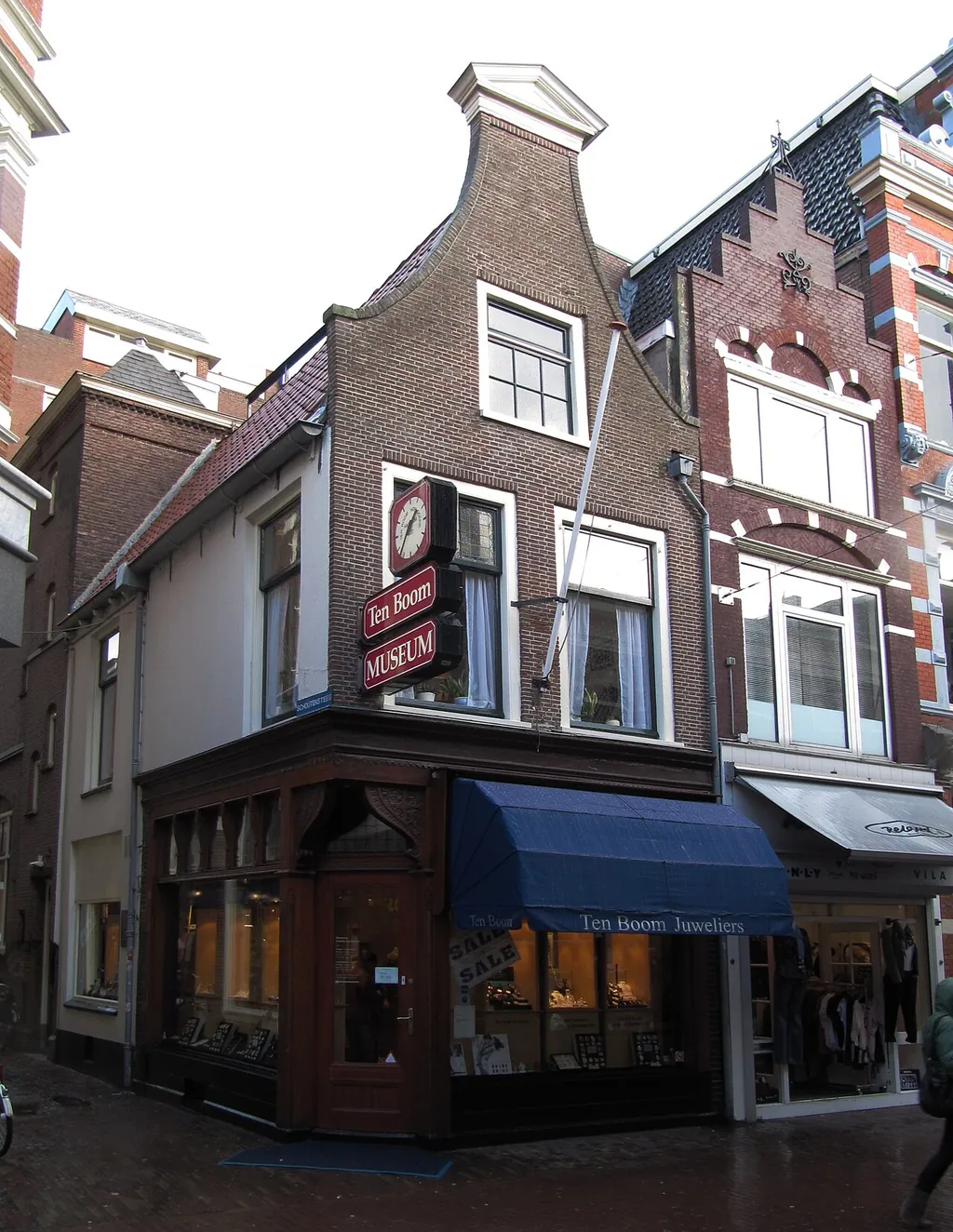
The narrow house on the Barteljorisstraat was built around 1600 for the schout, Haarlem's chief law officer. In 1837 Willem ten Boom opened a clock and watchmaking shop here and lived with his family on the upper floors. The shop and house later passed to his son Casper and Casper's daughter Corrie. The deeply religious family was involved in many ways in the life of the city and took in numerous foster children in the 1920s and 1930s.
During World War II, the house became a refuge for Jews and resistance fighters and a hub of a larger underground network. In 1943 and 1944, five to six people in hiding lived permanently in the house, with others staying for short periods. A hiding place was created behind a false wall built into Corrie's bedroom. After a betrayal, the Sicherheitsdienst (SD, the Nazi security service) searched the house on February 28, 1944, and arrested more than 30 people, including Casper ten Boom and his daughters Betsie and Corrie. The six people in hiding were not discovered and were freed by the resistance after about two days.
Casper ten Boom died in Scheveningen prison ten days after his arrest, and Betsie died in Ravensbrück concentration camp. Corrie survived and, for decades after the war, traveled to more than 60 countries speaking about faith and forgiveness; her book "The Hiding Place" made the story known worldwide. She died in 1983 on her 91st birthday.
The Stichting Corrie ten Boomhuis, founded in 1987, opened the house as a museum on April 15, 1988. Parts of the home are furnished in the style of the period, and the upper floor serves as an exhibition space. The house is run entirely by volunteers and is funded by donations.
Highlights
- The original hiding place behind a false wall in Corrie's bedroom
- The ten Boom family's living quarters, partly furnished in the style of the period
- Family photos and objects from World War II
- Exhibition on the upper floor about the history of the family and the resistance
- The family's former watch shop on the Barteljorisstraat
Permanent exhibitions
- De Schuilplaats – Guided tour of the ten Boom family's living quarters and hiding place, plus an exhibition on the upper floor about the help they gave to persecuted people during World War II.
- Founded
- 1988
- Operated by
- Stichting Corrie ten Boomhuis
Admission & discounts
Admission is free.
| Groups | –Group visits by arrangement via tours@corrietenboom.com. |
|---|
Admission and guided tour are free, but reservations are required. At the end of the tour, visitors are asked for a voluntary donation (Blessing Box); the foundation receives no public subsidies.
Accessibility
- Wheelchair accessible: not available
- Elevator: not available
- Accessible restroom: not available
- Accessible parking: no information
- Service dogs welcome: not available
- Tactile models & exhibits: no information
- Sign language tours: no information
- Easy-to-read materials: no information
- Audio description: no information
Because of the narrow, steep stairs, the house is not wheelchair-accessible and is difficult for people with limited mobility; according to the museum, a visit with a guide dog is practically impossible. The house has no visitor restroom – the nearest restrooms include those in the bicycle garage at Smedestraat 43 (free, 2 min.), on the Grote Markt and at the train station. A virtual 360° tour with a digital guide is available online.
Kids & families
Only partly suitable for kidsRecommended for ages 10+
According to the museum, the tours are suitable for children aged about 10 and up. On Mondays there is the free school program Corrie4Kids for primary school groups 7 and 8 (two hours, including a city walk); a children's magazine and an animated film are also available through the online shop.
Getting there & parking
By public transit
Haarlem (Bahnhof) · 15-min walk
Less than a 15-minute walk from Haarlem train and bus station via the Kruisweg and Kruisstraat to the Barteljorisstraat.
By car
No on-site parking at the museum.
No dedicated parking; the recommended options are the De Appelaar and Raaks parking garages in the center (under a 10-minute walk via the Grote Markt). Bus parking on the Dreef.
The entrance is not on the Barteljorisstraat but in the side alley Schoutensteeg.
Get directionsAmenities & dining
- Museum shop
Museum shop with books by and about Corrie ten Boom in several languages, DVDs and the museum book; also available as an online shop. No visitor restroom. No food or drink in the museum.
Events & venue rental
The museum hasn’t published any information on this – please ask the museum directly.
Plan your visit
| Guided tours | yes · approx. 60 min |
|---|---|
| School programs | yes |
| Good to know | Entry only as part of a free guided tour led by volunteer guides (max. 12 people, about 60–70 minutes) in Dutch or English, regularly also in German and occasionally in French. Online reservation required; arrive about 10 minutes early and wait outside at the entrance on the Schoutensteeg, as the house has no waiting area. Whispered interpretation during the tour is not allowed; Dutch-speaking visitors should book the Dutch tour. Lectures given by the foundation off-site can be arranged via presentatie@corrietenboom.com. |